
Ghana’s gambit
Ghana's President has appointed a former national security chief as envoy to the Alliance of Sahel States, aiming to repair ties which had soured under the previous government.

Ghana's President John Dramani Mahama has appointed a former national security chief Larry Gbevlo-Lartey as envoy to the Alliance of Sahel States (AES) formed by Niger, Mali, and Burkina Faso, aiming to repair ties with the military-led nations. Diplomatic relations with Burkina Faso had soured in 2022 under former president Nana Akufo-Addo over allegations of hiring Wagner mercenaries. The AES was established in July 2024 as an alternative to ECOWAS. Mahama also appointed Edward Omane Boamah as defence minister and Seth Terkper as presidential adviser on the economy, reflecting his administration's focus on strengthening regional and domestic political and economic strategies.
Mahama may have sanctioned that appointment as part of individual initiatives by ECOWAS members to maintain relations with the breakaway states, but below that, it is his government’s way of ensuring that the security crisis in neighbouring Burkina Faso does not spill into an active war zone in Ghana’s North. In late 2024, Reuters reported that militants from the Al Qaeda-backed JNIM group are using Ghana as a staging area on which to attack Burkina Faso, a development that Ghanaian authorities are aware of but chose to look the other way in a tacit understanding that the militants will not attack Ghanaian territory—a claim the government denied.
However, the badly deteriorating security in the country’s Upper Northeast region has provided militants with a pool of recruitment tools. Therefore, Gbevlo-Lartey’s job is expected to be to mend fences with Burkina Faso to solve this problem. Even if Accra takes the problem seriously, it may find itself doing much of the heavy lifting, taking the fight to the Islamists.
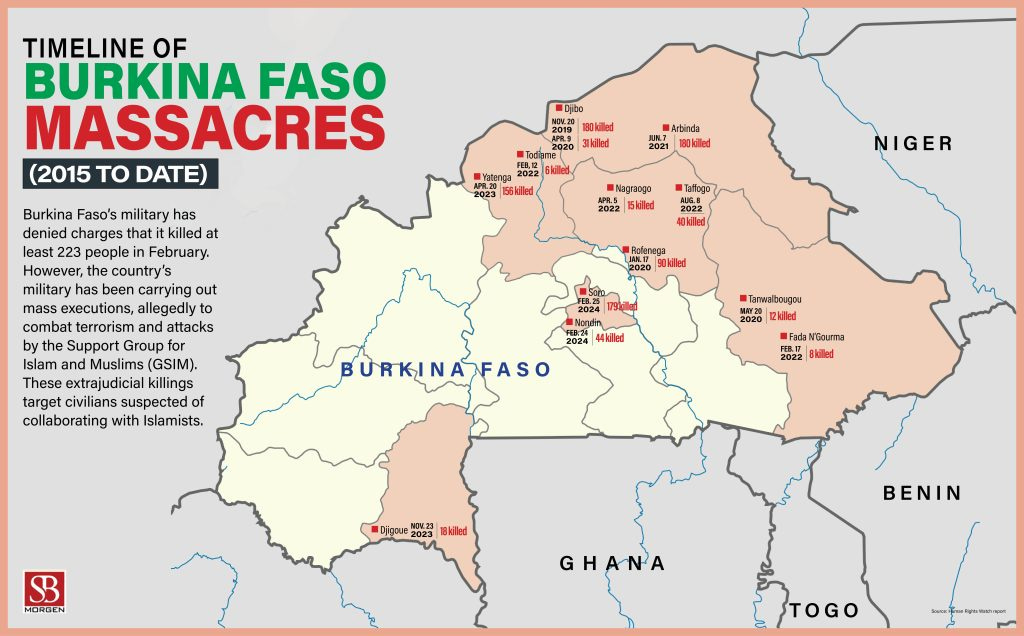
Burkinabé forces are creaking badly under the weight of the counterterrorism operations against armed groups that now control more than 60% of the country’s territory. Just last week, an attack allegedly carried out by the Islamic State took out a convoy of Burkinabe soldiers along Dori and Seytenga, killing 25. The government has sought to augment this haemorrhage by giving greater responsibility to vigilante groups—a solution that has not done enough to move the needle. This situation underscores the limitations of regional security frameworks when confronted with failing states. Gbevlo-Lartey's appointment, therefore, is not simply a diplomatic gesture but a recognition that Ghana may be compelled to assume a more proactive, potentially unilateral, role in combating regional Islamist militancy to protect its national security interests.
This precarious situation highlights the potential for regional instability driven by the weakness of individual states. Ghana currently stands as a beacon of hope in efforts to restore democratic governance in the Sahel regions of West Africa. Over the years, the ECOWAS bloc has struggled to bring junta leaders to the negotiation table for meaningful discussions on a return to democracy. This failure has deepened geopolitical fractures within the region, rendering sanctions and other measures largely ineffective. The decision by Ghana's new President, John Dramani Mahama, to invite Burkina Faso’s coup leader, Captain Ibrahim Traoré, along with other junta leaders, to his inaugural ceremony was a strategic and calculated move. While Nigeria’s President Bola Ahmed Tinubu was the guest of honour, the presence of Sahelian military leaders elevated the ceremony into a significant geopolitical event. It marked a notable shift in approach to one that prioritises dialogue and engagement over isolation and condemnation.
President Mahama’s post-ceremony meeting with Captain Traoré further underscored his commitment to fostering diplomacy. The cordial nature of their interaction contrasts starkly with the strained relations under Ghana’s former president, Nana Akufo-Addo, who openly criticised Mali and Burkina Faso for hiring Russian Wagner mercenaries. Akufo-Addo’s approach not only alienated these leaders but also heightened regional tensions. Mahama’s approach signals a departure from his predecessor’s confrontational stance. By embracing dialogue and inclusivity, Ghana’s new leadership is positioning the country as a mediator in efforts to reintegrate Sahelian nations into the ECOWAS fold, reflecting a broader commitment to addressing the region’s democratic deficits through diplomacy rather than division.