
Ghana’s liquid gold
A report from the Public Interest Accountability Committee’s (PIAC) 2023 semi-annual report has shown that Ghana made a total of $540…

A report from the Public Interest Accountability Committee’s (PIAC) 2023 semi-annual report has shown that Ghana made a total of $540 million in petroleum revenue from January to June 2023. Ghana wants to boost its oil and gas production by selling more exploration rights. This is to avoid leaving valuable fossil fuels in the ground and generate revenue to fund its energy transition, Andrew Kofi Egyapa Mercer, deputy minister at Ghana’s energy ministry, said in an interview with Reuters during the Singapore International Energy Week. Mercer said Ghana is marketing oil and gas blocks, including new acreages and fields relinquished by ExxonMobil.
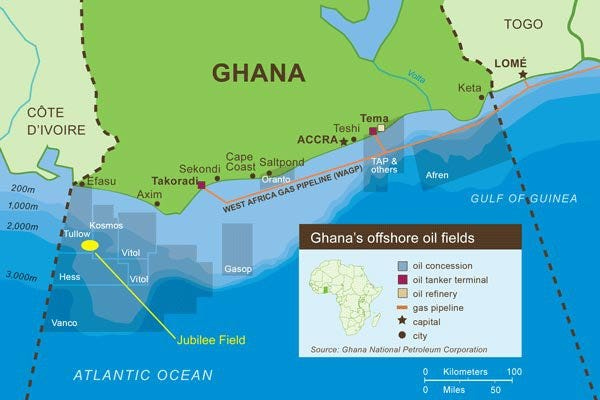
Ghana’s 17th IMF programme emphasises revenue mobilisation. The revenue from oil production and other precious minerals has historically been the backbone of Ghana’s economy. However, fluctuations in market prices have often thwarted the government’s revenue goals. To illustrate the gravity of the situation, Ghana needs an average of $3.5 billion to address its balance of payment challenges between 2023 and 2026, emphasising the crucial role of revenue from crude oil and other major exports. The Petroleum Revenue Management Act, 2011 (Act 815), delineates various revenue streams, feeding into the Petroleum Holding Fund (PHF) at the Bank of Ghana. To meet the 2023 petroleum revenue target of $1.5 billion, authorities must strive to generate approximately $541 million in the year’s second half. This seems achievable considering the anticipated higher average crude oil prices in the global market during the latter part of 2023 compared to the first half. However, recent data from the Bank of Ghana paints a concerning picture. In the first half of 2023, Ghana’s petroleum exports totalled just over half a billion, a stark decline from the $2.8 billion recorded in the same period in 2022. This drop occurred amidst one of Ghana’s worst economic crises, depleting its international reserves significantly. Ghana’s energy ministry actively strives to increase crude production to mitigate these challenges. Encouragingly, discussions with ExxonMobil indicate a potential return to Ghana’s petroleum sector after exiting in 2021. Also, Ghana plans to commence lithium mining by 2026. The government has enhanced revenue prospects by increasing the royalty rate to 10% and raising the state’s interest in the project to 13%. Additionally, Ghana’s Minerals Income Investment Fund will acquire a further 6% in the mining operation and 3.06% in Atlantic Lithium, indicating a strategic move to bolster the nation’s financial standing.