
Glimmers of growth
Ghana's economy shows recovery with 5.3% GDP growth and upgraded credit ratings, but gold smuggling cost $11.4 billion.

Ghana recorded 5.3% GDP growth in Q1 2025, up from 4.9% in the same period last year — a development President John Mahama welcomed as a sign of recovery. He stressed that restoring macroeconomic stability would boost investor confidence and support economic planning. Complementing this outlook, Fitch Ratings upgraded Ghana from “restricted default” to “B-”, citing progress in debt restructuring, while S&P raised its rating to “CCC+”. However, challenges remain. A Swissaid report revealed Ghana lost $11.4 billion over five years due to smuggled gold, with most illicit exports headed to Dubai.
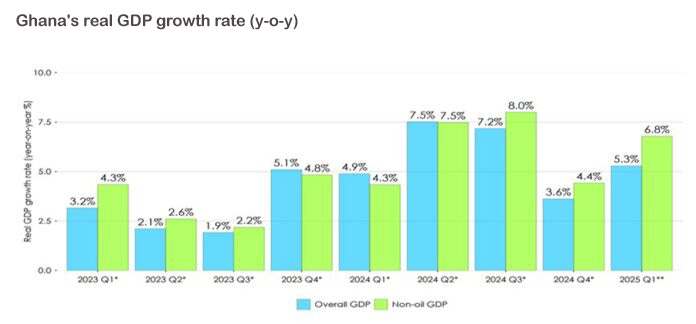
Ghana’s economy is showing firm signs of recovery, with GDP growth reaching 5.3% in the first quarter of 2025, an increase from 4.9% in the same period last year. President John Mahama welcomed the figure as a promising indicator of economic revitalisation, stressing that restoring macroeconomic stability is crucial for boosting investor confidence and enabling long-term planning. The composition of this growth is also shifting encouragingly; while mining was a key driver in the previous year, the recent expansion has been led by the agricultural sector, supported by a 3.4% rise in cocoa production.
This optimism is being mirrored in international markets, where Ghana’s currency and creditworthiness have seen significant improvements. The cedi has appreciated by over 30% against the US dollar this year, making it the world’s best-performing currency. This strength is largely attributed to the government’s new gold purchase programme, GOLDBOD, which is designed to nationalise small-scale gold exports and provide direct foreign exchange access. Underscoring this growing confidence, Fitch recently upgraded Ghana from "restricted default" to a “B-” rating, with a similar upgrade from S&P earlier in the year, marking the country's most significant credit improvements in four years.
However, a significant shadow hangs over these gains, highlighting the immense challenge of illicit financial flows. A recent report by the Swiss NGO Swissaid revealed that Ghana lost $11.4 billion over the past five years due to gold smuggling, with most of the illicit trade headed to Dubai. This staggering figure exposes serious governance and enforcement gaps that directly undermine the objectives of the GOLDBOD programme. While the initiative aims to formalise the artisanal mining sector and curb smuggling, the scale of the problem suggests that strategic policies must be paired with far more robust regulatory oversight.
The overall economic outlook remains positive but conditional. Inflation is projected to fall to 15% by the end of 2025, and the ongoing IMF programme may allow Ghana to return to international capital markets as early as 2026, a year ahead of schedule. Nevertheless, these positive forecasts hinge on the government’s ability to tackle deep-seated structural issues. The foundations for a sustainable recovery are being laid, but long-term success will ultimately depend on translating strategic initiatives into effective governance and institutional discipline.