
Golden shield
Ghana’s gold reserves rose to 32.99 tonnes (June 2025), up 8.05% since January, bolstering forex stability.

Ghana’s gold reserves rose to 32.99 tonnes in June 2025, up from 32.16 tonnes in May, marking an 8.05% increase since January. This steady growth, driven by the Bank of Ghana’s Domestic Gold Purchase Programme, has strengthened foreign exchange reserves, boosted investor confidence, and stabilised the cedi. From just 8.78 tonnes in May 2023, the reserves have grown significantly. Meanwhile, President John Mahama has launched the GOLDBOD Task Force to combat illegal gold mining. Equipped with body cameras, the unit aims to enforce mining regulations transparently. However, analysts remain cautious, citing past enforcement difficulties and entrenched illegal mining networks.
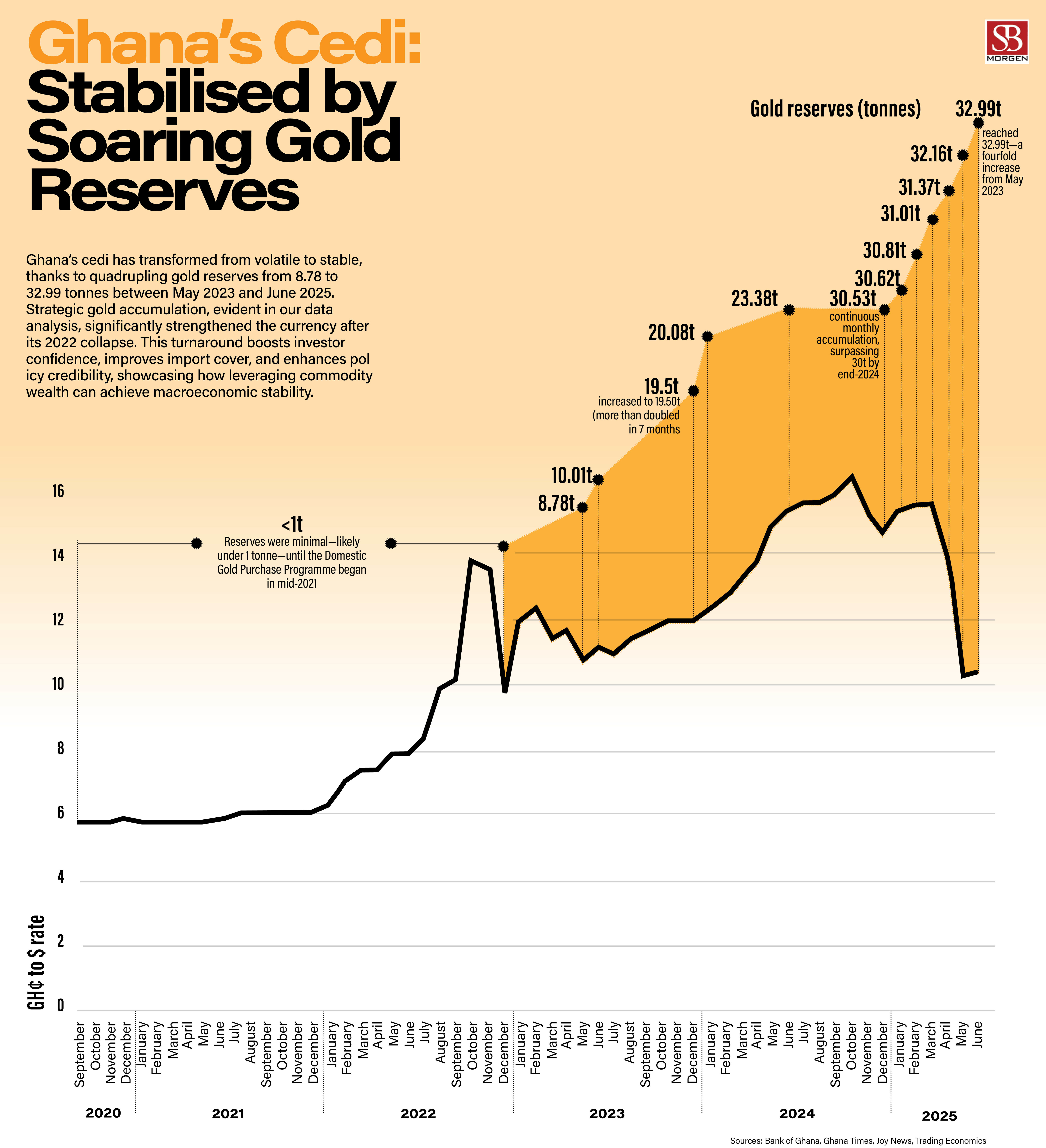
Ghana's economic narrative over the past five years is one of deliberate reinvention, moving from a heavy dependence on cocoa and Eurobonds to a strategic gold-backed stabilisation strategy. The data reveals a stark turning point: in May 2023, gold reserves stood at a modest 8.78 tonnes, but by June 2025, they had surged to an impressive 32.99 tonnes. This remarkable 275% increase was primarily driven by the Bank of Ghana’s Domestic Gold Purchase Programme. This substantial accumulation directly coincided with the cedi’s dramatic recovery from its 2022–2023 nadir, when it traded at GHC 15.3/USD in mid-2024, to a robust GHC 10.34/USD by June 2025, marking a 32% appreciation year-to-date.
The recent economic trajectory exposes two parallel stories. The first is the Cedi's collapse, a period characterised by relentless currency depreciation, peaking at GHC 16.25/USD in October 2024 amid global shocks and severe domestic debt distress. During this time, Ghana's gold reserves were negligible until mid-2021, leaving the nation highly vulnerable to external pressures. The second narrative is a gold-led revival that accelerated reserve growth, climbing from 19.5 tonnes in December 2023 to 32.99 tonnes by June 2025. This growth directly correlated with the cedi’s significant rebound. The Mahama administration’s strategic pivot—involving the domestic purchase of gold in cedis and the centralisation of gold exports—created a virtuous cycle. As claimed by presidential statements, this policy shift reportedly generated $5 billion in foreign exchange inflows within six months, thereby bolstering both reserves and currency stability.
A closer look at the data reveals three critical dynamics that are often underplayed. Firstly, gold’s direct impact on import cover has been profound. The rapid growth in reserves lifted import cover from a precarious level of less than two months in 2022–2023 to over five months in 2025, significantly reducing external sector fragility. Secondly, policy precision matters. The evolution from gold-for-oil swaps (2021–2023) to a centralised gold export strategy (2024–2025) demonstrably amplified foreign exchange retention, a factor clearly reflected in the cedi’s strong rally in 2025.
However, a significant structural weakness persists: despite GOLDBOD’s ambitious $1 billion target, small-scale mining output is estimated at $12 billion, suggesting that over 90% of potential revenue remains informal. This substantial illicit trade represents a significant drain on national resources.
While Ghana’s gold strategy has undeniably proven its worth in halting a currency crisis and rebuilding reserves, its long-term sustainability hinges on addressing several key areas. Foremost is the urgent need to formalise small-scale mining and crack down on smuggling, which is estimated to siphon off over $10 billion annually and could potentially double official reserves if brought into the formal economy. Furthermore, Ghana should consider diversifying reserve uses beyond mere foreign exchange stabilisation, exploring options to back strategic infrastructure investments or debt collateralisation. Finally, the nation must remain vigilant regarding global gold price risks, as a significant downturn could pressure the value of its reserves, necessitating agile management.