
‘Greenvestment’
Nigeria’s agricultural Foreign Direct Investment (FDI) rose by 226.45 percent in the first three months of 2024 compared to the same period…

Nigeria’s agricultural Foreign Direct Investment (FDI) rose by 226.45 percent in the first three months of 2024 compared to the same period in 2023, amid worsening insecurity. Data from the National Bureau of Statistics shows that Foreign Direct Investment in agriculture reached $15.80 million in the first quarter of 2024, up from $4.84 million in the same quarter of 2023. This marks a 3,661.90% increase from Q4 2023’s $0.42 million. Despite security challenges that hinder farmers, including the need for private security, the sector saw its highest investment levels since the first quarter of 2022.
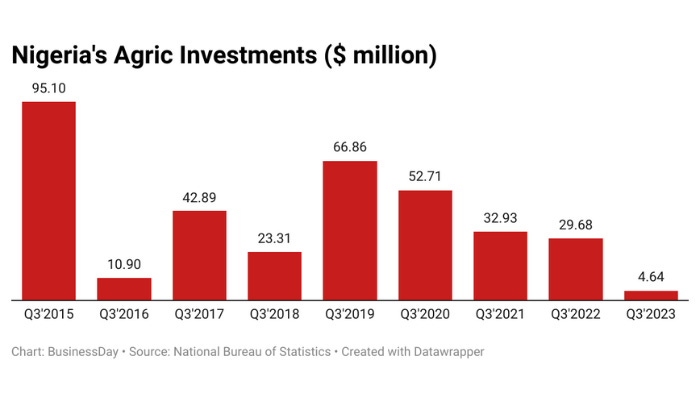
Despite ongoing security concerns, Nigeria’s agricultural sector has seen a significant increase in Foreign Direct Investment (FDI) in recent months, reflecting the sector’s potential for growth. It is always positive to see some growth in FDI, especially in agriculture which contributes a large portion of GDP and employs most Nigerians. This uptick in investment occurs against the backdrop of a worsening security situation, particularly in Nigeria’s northern and central regions, where farmers increasingly face threats from armed groups, leading some to hire private security to protect their lands and crops. Yet, despite these obstacles, foreign investors continue to see promise in Nigeria’s agricultural sector, driven by the country’s large consumer market, diverse agro-ecological zones, and favourable climatic conditions. However, Nigeria’s agricultural FDI still lags behind other major agricultural economies. For instance, Brazil, a global agricultural powerhouse, attracted $2.8 billion in agricultural FDI in 2023, while India received $1.2 billion, and South Africa secured $400 million during the same period. Nigeria could further increase its agricultural FDI by addressing security issues and implementing policies that support large-scale, mechanised farming. Strengthening infrastructure, ensuring land rights, and offering incentives for commercial agriculture could significantly enhance the sector’s appeal to foreign investors. If these measures are successfully implemented, the potential benefits to Nigeria’s economy are considerable. Increased agricultural productivity could create jobs, reduce the country’s reliance on food imports, and contribute to overall economic growth. Despite the current challenges, the rising investment in Nigeria’s agriculture sector offers a positive outlook for the country’s future. However, the current amount is still a drop in the ocean compared to what is needed for the sector to achieve its potential. Several reasons for this shortfall are clear: the infrastructure to support agriculture is lacking, security is a huge challenge, exporting from Nigeria is a nightmare, and domestic purchasing power has been destroyed. All these factors mean that while agriculture produces essential food, it does not translate into the most viable returns for investors. Some of these challenges can be resolved fairly quickly. To begin, a concerted effort on security could significantly improve the situation.