
Guard change
Ghana’s President, Akufo-Addo, announced changes to his cabinet a month after two ministers resigned to focus on their political campaigns…

Ghana’s President, Akufo-Addo, announced changes to his cabinet a month after two ministers resigned to focus on their political campaigns. He made new appointments and reshuffled some ministers. However, the country’s economic challenges persist. MTN has announced that the Ghanaian tax authority has withdrawn the tax liability case it had earlier levelled against the pan-African telco in mid-January. The Ghana revenue authority had slapped MTN Ghana with a GHS8.2 billion ($665 million) fine, citing unpaid back taxes. In a statement published on the Johannesburg Stock Exchange news service (SENS) last Friday, MTN stated that the withdrawal came after extensive discussions between itself and the relevant Ghanaian authorities.
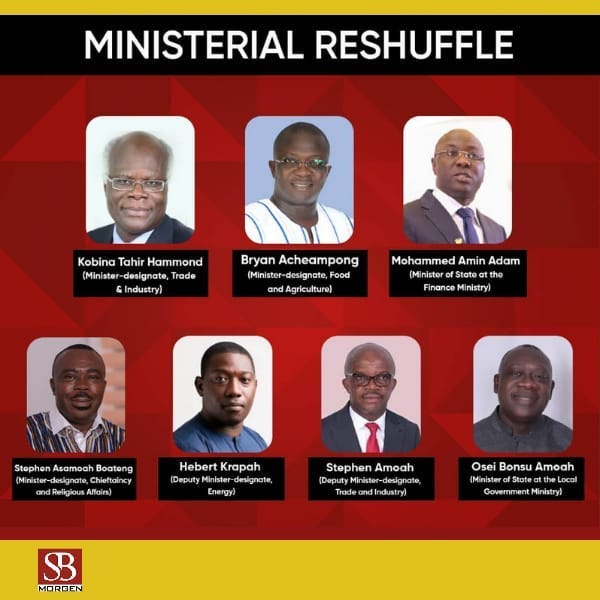
President Akufo-Addo’s letter to parliament carrying the news of new faces in his cabinet wasn’t a reshuffle as many wanted to see; it was a simple case of filling the gap, which has turned out to be a fiasco, as he only opted to fill the vacant positions in his government, the result of four ministers resigning for their presidential ambitions, ill health or a scandal. Many party insiders, especially the top brass of the ruling New Patriotic Party (NPP) and some MPs, had been anticipating a decisive removal of some ministers from the government, particularly Finance Minister Ken Ofori-Atta, but Mr Akufo-Addo only filled the potholes and skipped an opportunity to properly recalibrate his cabinet in a parochial bid to keep finance minister, Ken Ofori-Atta. As it turns out, the finance minister happens to be the President’s cousin. The state of play is that Mr Akufo-Addo is running a government with 86 ministers. Some research suggests that Ghana could save close to 7 billion cedis ($372 million) if the President reviews, ‘right-sizes’ and outrightly closes Ministries, Departments and Agencies (MDAs) and State-Owned Enterprises (SOEs) to reduce the enormous pressure on compensation expenses. In October 2022, Mr Akufo-Addo insisted that the five ministers he had confidence in were Mr Ofori-Atta: Finance and Economic Planning Minister, Alan Kyerematen: Trade And Industry Minister, Kwasi Amoako Atta: Roads and Highways Minister, Ignatius Baffuor Awuah: Employment and Labour Relations Minister and Owusu Afriyie Akoto: Food And Agriculture Minister. Today, two have left, leaving him with a smaller bench. For many, the Finance Minister has lost credibility and must be removed from office to inject some much-needed confidence in Ghana’s economic prospects. Ken Ofori-Atta first promised Ghanaians that the country did not need the support of the IMF to solve its deep-rooted economic crises. A few weeks later, Ghana was back at the IMF negotiation table. Another big u-turn was the inclusion of individual bondholders, who were initially promised an exemption by the ministry from the domestic debt operation exercise. For many, Mr Ofori-Atta lost legitimacy after seeing inflation hit more than 54%, import cover dropping to less than two months; the cedi losing more than 20 percent of its value against the US dollar in January 2023 alone, coupled with skyrocketing fuel prices and an unending hike in the cost of borrowing. However, President Akufo-Addo believes the current economic situation is no fault of the finance minister and would not sack him “based on his track record of growing the economy by an average of 7 percent between 2017 and 2019.” With the government’s projected expenditure exceeding 205 billion cedis this year, the key question has to be how the President and his finance minister intend to finance a budget deficit hovering around 62 billion cedis while total revenue plus grants are pegged a little above 143 billion cedis. The pressure is on to see who blinks, and desperate measures have entered the fray. The cash-strapped government has resorted to multi-million tax demands from some of the largest corporations in the country: Tullow Oil, MTN, Gold Fields and Kosmos Energy, among others. The Ghana Revenue Authority (GRA) has backtracked the MTN tax liability case while several other companies slapped with back taxes remain in talks with the authority. Following the official announcement, investors have flocked to snap up MTN Ghana shares, and all may seem well, but the Ghana Revenue Authority has to find a way to meet its tax revenue target of 112 billion cedis, which is more than 78% of the entire revenue and grants programmed for this year. It is good news that cooler heads have prevailed within the government with regard to the MTN tax issue. Pursuing such a measure would have resulted in further depletion of investor confidence in the rule of law in Ghana at a time when it desperately needs investor confidence to at least remain at the same level.