
Hell breaks loose
Angry youths set a police station on fire in the Ikeja district of Lagos over the alleged killing of 23-year-old Idris Bakare by a police…

Angry youths set a police station on fire in the Ikeja district of Lagos over the alleged killing of 23-year-old Idris Bakare by a police officer. The Guardian reported that the attack occurred at about 0300 hours on Monday, while the police officer, simply identified as Kabiru, allegedly killed Bakare at about midnight on Sunday, 28 May 2023. Some people fled on sighting the policeman when he parked his car at a spot. Hence he went back to park his car at the Divine Health Centre, Lawal Street, where he killed Idris.
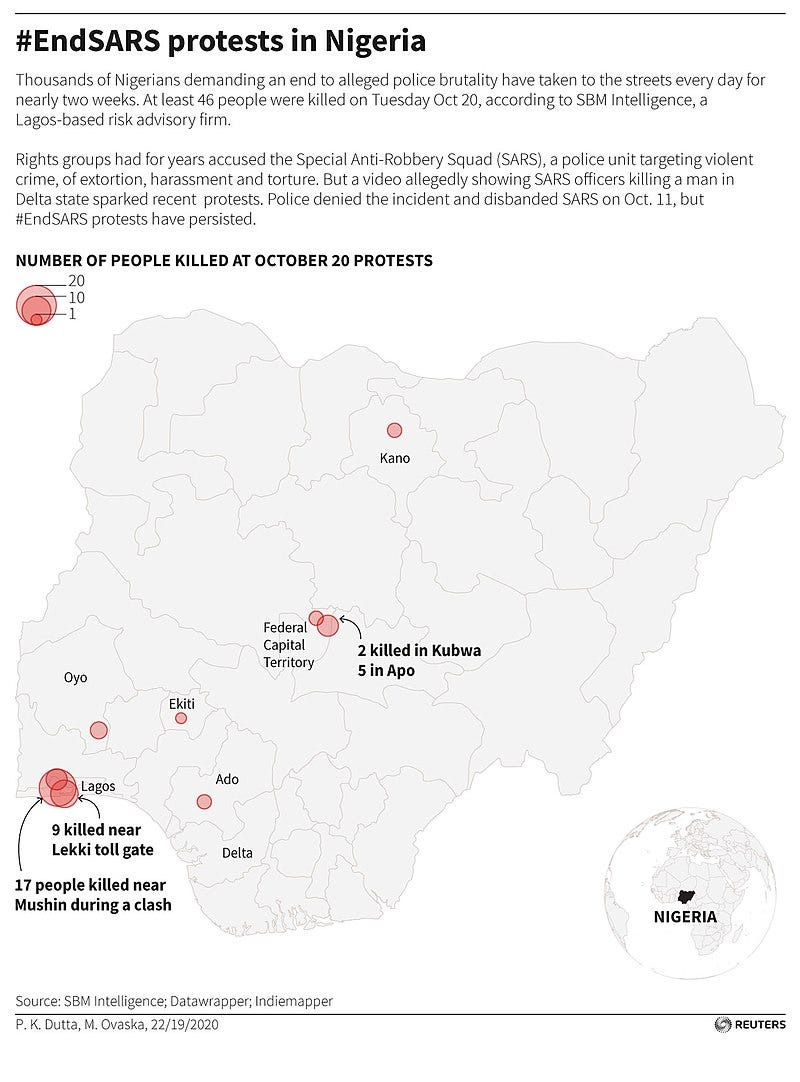
To say that the Tinubu administration has its work cut out is a grave understatement. One of the many drivers of Nigeria’s security challenges is impunity by its security services, leading to pent-up resentment and, ultimately, violence against these institutions. The Nigerian police are at their lowest point ever, and the arrogance of its members suggests that they need to be made aware that the Nigerian population significantly outnumbers the Nigerian Police Force. Nigeria has over 200 million people. The Nigerian Police Force has a strength of about 370,000 officers, meaning there is about one police officer for every 5,400 people in Nigeria. Even if they were all clones of the Hollywood bogeyman, John Wick, each one of them would not be able to handle being attacked by just 500 people simultaneously, which is a possible outcome if the Nigerian public finally gives up on the Nigerian police. The Nigerian police do not understand their capacity to wield violence on behalf of the Nigerian state is because of the people’s permission, and it is possible for that permission to be retrieved. Despite calls for institutional reforms for such agencies, especially the police, the government has yet to do anything to move the needle. When it disbanded the Special Anti-Robbery Squad (SARS) following the EndSARS protests in 2020, the only thing it succeeded in doing was cutting off just one unit of Nigeria’s security agencies involved in the widespread human rights abuses. It did not take the extra step of reforming the police as the protesters demanded, which is because reforms cost money. Hardpressed for revenues, police reform has never been a pressing challenge for any government, all of whom have only sought to paper over the cracks by recruiting more constables to make up for the shortage. Poor firearms training and an antediluvian salary structure provided the basis for the stated impunity. Furthermore, there was no incentive to reform the force because it is often used as an essential tool for government rights abuses. Successive governments had only taken the lazy approach of police welfare: give them (officers) guns, let them source for their bullets and pay elsewhere, which is what they have done so far — source their income elsewhere, especially by extorting young people. What EndSARS achieved was the global notification of the problem. It was also relevant because it highlighted the critical issue of police corruption in a third-world country such as Nigeria. The government could have built on it to ensure lasting changes in line with various available options, one of which was decentralising the force as a cheaper way of ensuring basic-level accountability. The Tinubu government can gain the approval of youths if it implements the reports of the EndSARS panel and carries out a holistic reform of the police to ensure greater institutional accountability. It increasingly looks like proper policing in Nigeria is only going to be achievable with a re-engineered police force built around smaller police departments that are staffed mainly by locals, who are more likely to have a connection to the local community and be held accountable for their actions, unlike this situation where erring police officers are sent off to other states after they have been caught harming innocent people.