
Helos
The Minister of Defence, Mohammed Badaru Abubakar, and the Chief of the Air Staff (CAS), Air Marshal Hasan Abubakar, are currently in…

The Minister of Defence, Mohammed Badaru Abubakar, and the Chief of the Air Staff (CAS), Air Marshal Hasan Abubakar, are currently in Türkiye to facilitate the speedy delivery of the T-129 ATAK helicopters acquired for the Nigerian Air Force (NAF) by the federal government. As part of programmes lined up for the visit, the Minister held talks with his Turkish counterpart, Lieutenant General Yasar Guler (Rtd), on critical bilateral and defence cooperation issues. General Guler promised the Minister every support required from the Turkish military and defence companies to enhance Nigeria’s counter-terrorism efforts and address other criminal challenges.
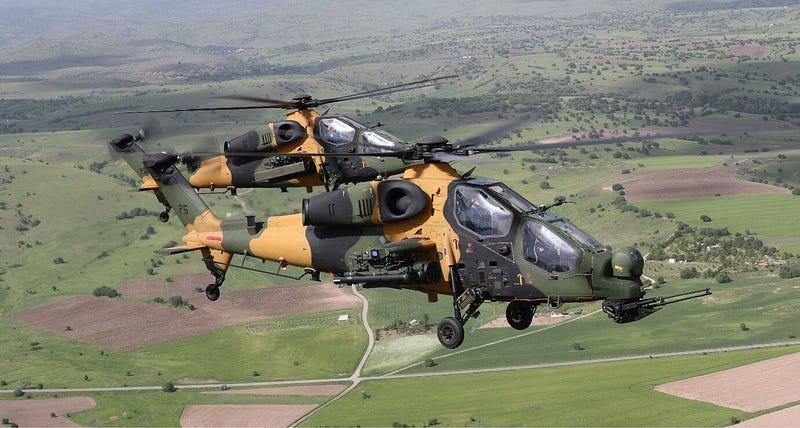
In 2022, then Zamfara Governor Bello Matawalle visited Türkiye in search of drones against bandits troubling the state. Matawalle’s current role as the junior defence minister has further developed this partnership at the state level, offering room for potential improvements. This is building on that relationship, and the military should benefit. The Nigerian Air Force will receive a substantial boost with the acquisition of T-129 ATAK helicopters. These helicopters, known for their exceptional capabilities and versatility, are poised to provide advantages over the NAF’s current fleet, ultimately aiding the fight against these threats. Firstly, they provide enhanced firepower, being armed with air-to-air and air-to-ground missiles, rockets and cannons, ensuring precise and lethal strikes against terrorist and bandit targets. Secondly, they boast improved mobility, enabling them to operate effectively in diverse weather conditions and challenging terrains. Additionally, the helicopters have features that enhance survivability, including armour protection and advanced electronic countermeasures. They excel in surveillance and reconnaissance missions, which would help the NAF track and gather intelligence on threats. Their precision strikes minimise collateral damage, and their rapid response capabilities should aid in preventing further casualties and damage from terrorist and bandit attacks. In the ongoing effort to combat terrorism and banditry in Northern Nigeria, Nigeria has been striving to diversify its sources of weapons imports, reducing its dependence on Western countries. This effort was accelerated by the strained relations between the Jonathan administration and the West over alleged human rights abuses during military counterinsurgency operations in the Northeast. One of the beneficiaries of that diversification has been Türkiye, whose defence industry has attracted both federal and state governments in Nigeria. Türkiye’s drone industry has presented a cost-effective yet high-quality supply of military-grade weaponry. Turkish military equipment, including aircraft, tanks, armoured vehicles, artillery and missiles, align well with the needs of African countries. Türkiye has flexible payment terms that further make its products accessible and affordable for African countries. Additionally, Türkiye’s history of cooperation with the continent on defence matters, including military assistance and personnel training, helps position it as a reliable partner. However, there is a downside. Typical arms deals often encompass maintenance and training services offered by the seller for a specified period. During this time, the buyer’s military is anticipated to gradually assume maintenance and operations, slowly transitioning the partnership. This component is missing in the deal with Türkiye for combat helicopters. One of the reasons why the Air Force has retired some birds in the past is their inability to get replacement parts at short notice. This might also be a factor in the present deal and may be complicated further if the defence company (Turkish Aerospace Industries) phases it out of production.