
Inflated realities
Nigeria’s inflation fell to 22.22% in June 2025, the third monthly drop, reaching its lowest since January after a CPI basket rebasing adjustment.

Nigeria’s headline inflation declined for the third consecutive month in June 2025, falling to 22.22% from 22.97% in May, according to the National Bureau of Statistics (NBS). This marks the lowest inflation rate since January 2025, following the consumer price basket rebasing, which updated the base year from 2009 to 2024. The NBS report noted a month-on-month decrease of 0.75 percentage points, indicating a gradual easing of inflationary pressures. This downward trend may reflect the impact of recent economic adjustments, offering cautious optimism for policymakers and analysts monitoring price stability and broader macroeconomic conditions in Nigeria.
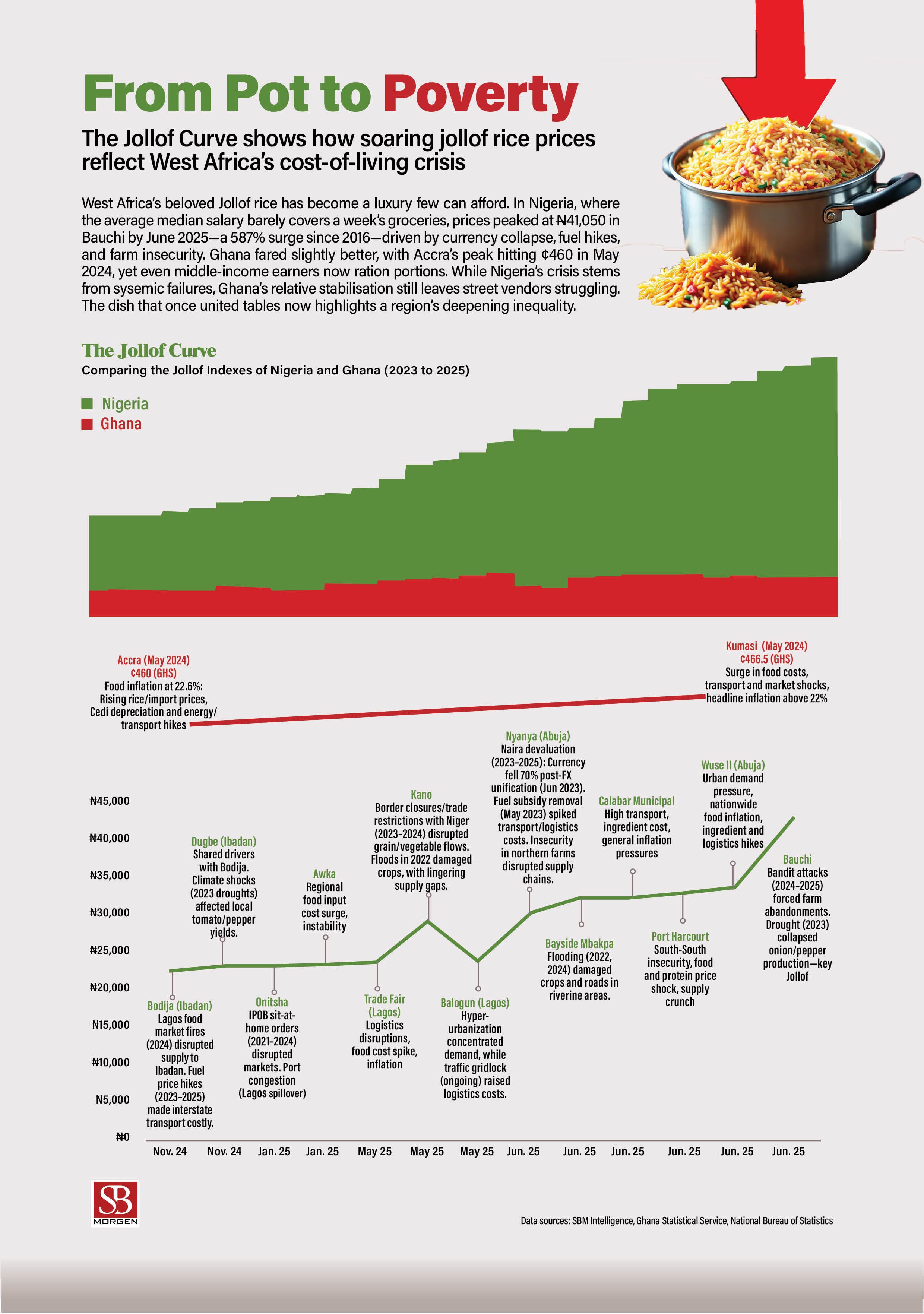
The Tinubu administration had ambitiously set an 18% inflation target for 2025, banking on a rebasing exercise that recalibrated the base year and adjusted the consumer price basket. Consequently, the official year-on-year inflation figure for January 2025 seemingly plummeted to 24.48%, a notable drop from December 2024's 34.80%. However, for the average Nigerian household, these figures often feel detached from their daily struggle.
The SBM Jollof Index for Q2 2025, a barometer of real economic pressures, starkly illustrates this disconnect. It showed a staggering 153% surge in the national average cost of preparing a simple pot of jollof rice between March 2023 and June 2025, reaching ₦27,527.85. This isn't merely a statistic; it means that for the average Nigerian family, chicken or turkey is no longer a staple for a single meal, forcing a reliance on cheaper alternatives like eggs, or even foregoing protein altogether.
Food inflation, a significant driver of overall headline inflation, clearly shows a concerning divergence between the National Bureau of Statistics' (NBS) reported figures and the harsh realities faced on the ground. The Jollof Index notes that in such methodological shifts, transparent practice demands the concurrent publication of both old and new data series to ensure analytical continuity and maintain public trust. Unfortunately, the NBS's failure to adhere to this standard erodes confidence in these revised figures. While a decline in fuel prices during this period may have offered some reprieve, subtly contributing to the reported fall in inflation across various categories, the escalating cost of a beloved national dish truly highlights the "crushing cost of a pot" for many Nigerians.