
“Insane” rebel put away for life
Nnamdi Kanu, the IPOB leader, has been sentenced to life imprisonment by a Federal High Court after being convicted of terrorism charges.

Nnamdi Kanu, leader of the proscribed Indigenous People of Biafra (IPOB), has been sentenced to life imprisonment after being convicted of terrorism. The sentencing was announced on Thursday by Justice James Omotosho of the Federal High Court, Abuja. Kanu was handed life imprisonment for counts 1, 4, 5 and 6 of the seven-count charges. The Biafra Radio director also received 20 years’ imprisonment and 5 years’ imprisonment on counts 3 and 7, respectively. Delivering judgment, James Omotosho, the presiding judge, held that the prosecution had successfully established every allegation. He said Kanu offered no credible defence and “deliberately refused” to challenge the evidence presented in court. The judge said the IPOB leader was “a person who cannot be allowed to remain in the company of sane minds”, while describing him as an “international terrorist”.
The sentencing of Nnamdi Kanu marks the climax of a decade-long legal and political saga that has profoundly shaped the politics and security landscape of Nigeria’s Southeast region. This tumultuous cycle, which included his initial 2015 arrest in Lagos, subsequent bail and flight, the controversial June 2021 rendition from Kenya, and extensive litigation, elevated his case far beyond a mere legal matter. Mr Kanu’s prolonged detention, now exceeding 1,500 days at the DSS facility, served as the psychological and political anchor for IPOB’s mobilisation strategy.
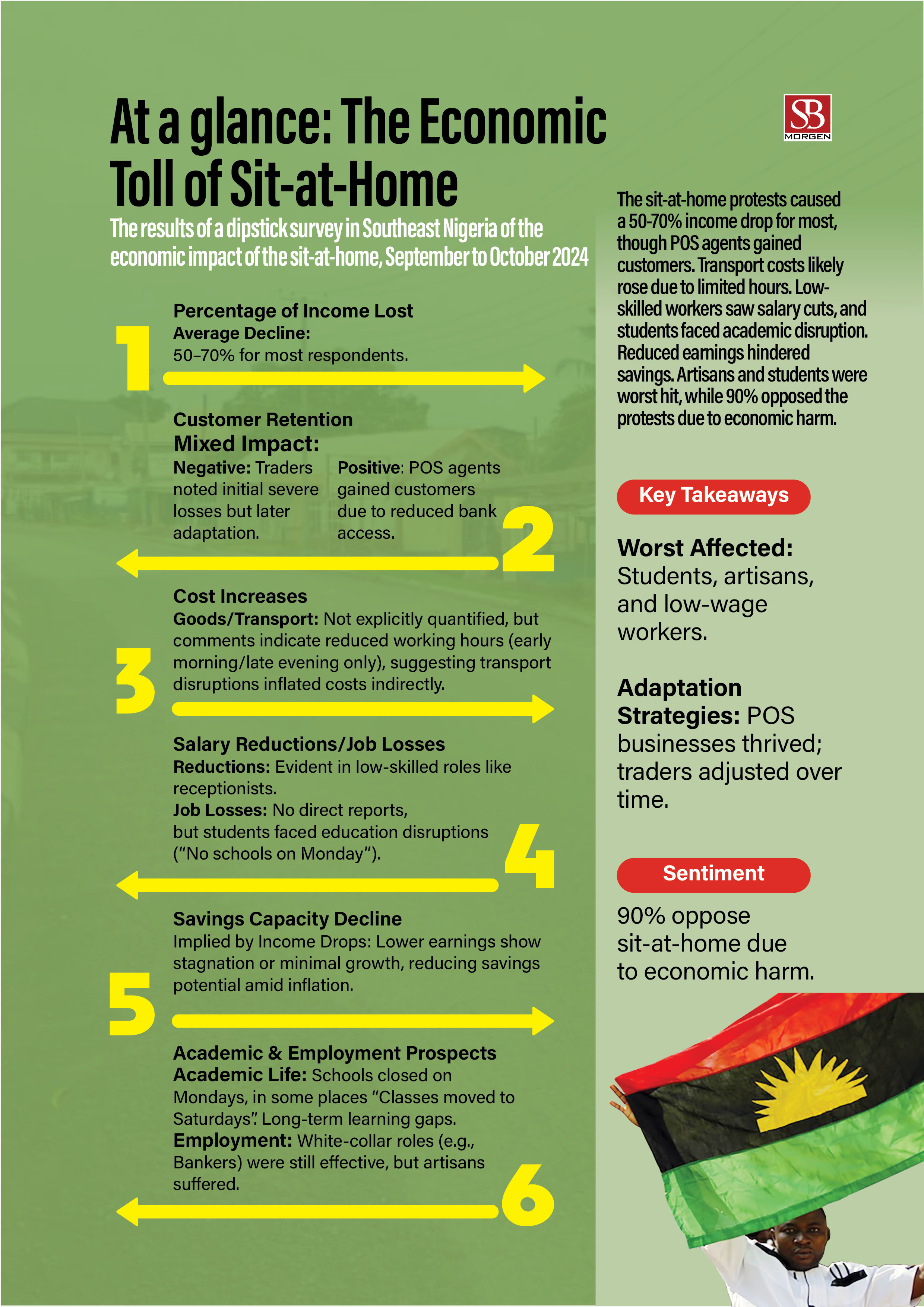
His continued detention provided the direct fuel for IPOB’s infamous Monday sit-at-home order, which is regarded as the most economically destructive civil action in the Southeast since the end of the Nigerian Civil War, 55 years ago. The economic damage attributed to this policy has been staggering. According to SBM Intel’s reporting, the policy cost the region an estimated ₦7.6 trillion ($5.22 billion at November 2025 conversion rates) between 2021 and 2025. MSMEs face yearly losses of ₦4.6 trillion, agricultural output has dropped by 30%, and over 40,000 pupils are routinely prevented from attending school. The enforcement of these orders has also been brutal, documented in 332 incidents and 776 deaths, leading to a deep erosion of social cohesion.
Mr Kanu’s conviction covers core terrorism counts that carry some of the harshest penalties under Nigerian law, with several potentially punishable by death. These convictions stemmed from actions that prosecutors argued fuelled attacks on security personnel and critical infrastructure. The charges included secessionist broadcasts, incitement to attack security forces, directives targeting politicians, threats against foreign embassies, and the smuggling of a high-powered transmitter. His speeches were explicitly cited as fuelling attacks, including threats against the Murtala Muhammed International Airport in Lagos.
However, the severity of the sentence has raised profound questions concerning justice and political perception. Just 24 hours before Kanu’s sentence, an ISWAP commander responsible for mass killings received only 20 years. This contrasting leniency is compounded by the fact that the state is currently negotiating with bandits in the Northwest and reintegrating “repentant” Boko Haram fighters in the Northeast, while simultaneously imposing a life sentence on the face of IPOB. This has created the perception that Kanu’s punishment is not merely about national security but relates to the fundamental “Igbo question” — the place of the Southeast within the Nigerian federation. For many in the region, IPOB represents unaddressed political grievances.
With IPOB’s history of reprisals and a landscape already destabilised by violence from its militant wing, the Eastern Security Network (ESN), as well as splinter groups and economic collapse, the question is no longer if the sentencing will trigger unrest, but when and how intensely. The Southeast risks sliding into a deeper, more combustible phase of crisis — one that no court judgement alone can resolve. To mitigate this risk, the government must pair its legal victory with essential non-legal interventions, including political engagement to address root grievances, strategic community rebuilding efforts, and a comprehensive economic strategy to unwind the sit-at-home economy and reverse its devastating effects.