
ISWAP leaders wanted for wasting time
Nigeria declares top ISWAP leaders wanted after intelligence from recovered equipment reveals hideouts in Borno.

The Nigerian Army has declared top ISWAP leaders, including governor Abu Musa Al-Mangawi Baa Shuwa and deputy Muhammad Jidda, wanted after intelligence from recovered terrorist equipment identified key hideouts in Borno. Meanwhile, clashes between security forces and suspected bandits in Kebbi State left at least 10 police officers, 17 suspected bandits and two civilians dead. The incidents highlight continuing security challenges in Nigeria’s northeast and northwest, where terrorist and armed groups remain active.
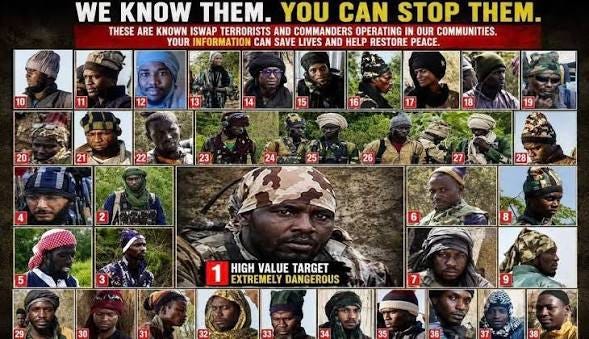
Nigeria’s security apparatus is confronting a dual challenge that is growing in both complexity and cost. The northeast and northwest present different manifestations of the same underlying problem: a state that possesses increasingly sophisticated tools but has not yet built the architecture to convert them into durable security outcomes.
In Borno, Operation Hadin Kai recently declared 38 senior ISWAP commanders wanted following the recovery of technical equipment and digital media during operations in the Abadam and Kukawa axis. Forensic analysis of that material enabled military intelligence to map terrorist hideouts and identify senior operatives, including ISWAP governor Abu Musa Al-Mangawi Baa Shuwa and his deputy Muhammad Jidda. The intelligence achievement is real: mapping the leadership structure of an insurgent organisation can create opportunities to disrupt its command, financing and logistics networks.
The harder question is what comes after the names are published. No senior ISWAP figure has been captured because an ordinary farmer saw a wanted poster and walked into a barracks with actionable intelligence. This is because ISWAP has spent more than a decade constructing an environment in which informing on militants carries a credible risk of death. Suspected informants have been executed publicly. Communities believed to have assisted security forces have faced reprisals after troops withdrew. A farmer who knows where a commander is hiding has to weigh the potential government reward against the probability that the same armed group that controls or regularly passes through his community will find out. In that calculation, silence is a rational survival strategy, not a failure of civic spirit.
The intelligence problem is therefore not only identifying the target. It is building a sufficiently secure reporting architecture through which civilians can provide information without exposing themselves or their communities to retaliation. That challenge is compounded when operational information is itself poorly protected. A memo reportedly warning of planned attacks in parts of Adamawa and Borno recently circulated widely enough to trigger an investigation into how it became public. Sensitive intelligence only has operational value when it can be protected until security forces are ready to act. When it leaks, the state effectively notifies its adversary of what it knows, while simultaneously signalling to potential informants that their identities may not be safe either. The result is a circular problem: militants intimidate communities into silence, while leaks and weak information security undermine whatever confidence remains between civilians and the state.
The situation in Kebbi is different but related. The principal threat there is not a locally generated insurgency so much as armed pressure moving through porous border corridors from Zamfara and the wider Sahelian routes. The confrontation along the Sakaba axis illustrates this. Security forces intercepted a heavily armed group that had reportedly crossed from Zamfara, moving through the Sangeko Gap towards Makuku. Residents estimated the attacking column at more than 200 men, moving in three formations and spending the night in the forest before the assault.
If that account is accurate, the operational signature looks very different from a conventional cattle-rustling gang. A force of that size, capable of coordinating cross-border movement, assembling for an offensive operation and sustaining a prolonged engagement, suggests a level of organisation, command and logistics that demands serious attention from security planners. The casualty figures reinforce that concern. The confrontation left 10 police officers, 17 suspected bandits and two civilians dead. It is one thing to confront small groups conducting opportunistic raids. It is another to encounter a large, organised formation capable of fixing and overwhelming a security contingent in open terrain.
The name Lakurawa is increasingly used as a broad label for various militant groups operating in the northwest. That creates a problem for policymakers. Grouping all armed actors under the same name can obscure important distinctions in ideology, command structures, financing, and external connections. The key question for the security establishment is whether these formations remain essentially criminal organisations motivated by ransom and territorial control, or whether parts of the network are developing into ideologically driven formations with external links and more sophisticated capabilities. The response to banditry is not the same as the response to a jihadist insurgency with transnational connections and ideological recruitment. Confusing the two produces the wrong tools for both.
The Kebbi engagement also exposed a persistent weakness in Nigeria’s security operations: the poor integration of air and ground assets. Mobile police confronted the attacking force largely on their own, while aircraft under Operation Fansan Yamma struck the group near the Sangeko Gap. Air and ground operations do not appear to have been fully synchronised. Air power is most effective when integrated into a single operational plan in which intelligence, reconnaissance, ground manoeuvre and strikes operate within the same tactical window. When they run on separate clocks, security forces may intercept a militant column without aerial reinforcement, or aircraft may strike after a ground unit has already been overwhelmed. Nigeria possesses the assets. The recurring problem is converting them into a unified operational advantage.
The broader lesson from both theatres is that Nigeria’s security challenge can no longer be measured by the number of troops deployed or the number of names on wanted lists. The quality of intelligence, the protection of sources, the speed of conversion from intelligence to action, the integration of agencies and the control of cross-border movement are now equally important variables. In Borno, improving intelligence capabilities is necessary but not sufficient. A wanted list contributes to security only when it leads to the disruption of command structures, the dismantling of logistics networks and the protection of communities from retaliation. In Kebbi, the scale of organised armed formations moving across the Zamfara corridor demands that border security be treated as a regional rather than state-level problem. Containing the threat in one state without addressing the corridors through which militants move will only displace it.
The experience of the northeast is the most relevant warning. It demonstrates how difficult and expensive it becomes to dismantle an insurgency once it has established territorial influence, local intelligence networks and a culture of fear within rural communities. Nigeria should not need to relearn that lesson in the northwest.