
Jousting
The Kano State Governorship Election Petitions Tribunal has sacked Governor Yusuf Abba of the New Nigeria People’s Party, declaring Nasir…

The Kano State Governorship Election Petitions Tribunal has sacked Governor Yusuf Abba of the New Nigeria People’s Party, declaring Nasir Gawuna of the All Progressives Congress as the winner of the 18 March governorship poll. In Ondo State, the House of Assembly has instructed its Clerk to address allegations of gross misconduct against Deputy Governor Lucky Aiyedatiwa. In Edo State, a dispute has arisen between Governor Godwin Obaseki and Deputy Governor Philip Shaibu, with the latter seeking a court order to prevent his removal. The Edo State Government has also issued a letter for the relocation of Philip Shaibu’s office.
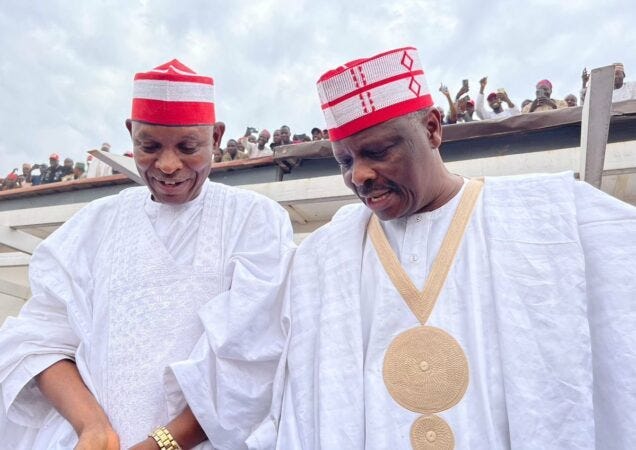
In many countries, rivalry between elected officials usually starts and stops at the presidential level. In Nigeria, it goes a lot deeper into the federating units. State governors within their jurisdictions are as powerful as the president and more often than not, demonstrate it to their deputies. Of the three states, the exceptional case, Kano, merits some commentary. The Kano ruling, legal niceties notwithstanding, represents the culmination of a months-long effort by the president and his allies to clip and contain the political reach of the 2023 NNPP presidential candidate, Rabiu Kwakwanso. For all the talk about the heavy regional concentration of his election tally in February, the former governor polled the single largest bloc of voters in any single state nationally, cementing his comeback as a formidable political force and dealing a near-fatal blow to the street credibility of his successor and former protege turned hated rival and Tinubu ally, Abdullahi Ganduje. Furthermore, he has not been shy about making the kind of political noise indicating that another presidential run in 2027 is a distinct possibility. Current governor Yusuf Abba is Mr Kwakwanso’s close associate and many view him as an extension of Kwakwanso’s political interests. An extended Abba run as governor would have put Kwakwanso in a politically advantageous situation to build a war chest for 2027. The tribunal decision has, at least, temporarily forestalled that possibility. The situation in Edo and Ondo border significantly on succession. In Ondo, long-term ailing Rotimi Akeredolu was brought back to Nigeria from his medical treatment in Germany over fears that his deputy would declare him unfit for office. Mr Akeredolu’s loyalists feared being schemed out of state power and had to act before it was too late. In Edo, the crisis is a lot more futuristic: Edo’s next guber elections will take place in 2024 without Obaseki on the ballot. His deputy, Philip Shaibu, is angling to succeed him, which has not gone down well with Obaseki who favours other candidates. These seemingly irreconcilable differences are commonplace in Nigeria where deputies are often seen as the first-line replacement of their principals. However, such replacements on the ballot hardly come to fruition. Nigeria has a storied history of deputies trying to replace their principals through the polls and failing to do so at the most basic level: party primaries — which seem more of a tougher hurdle than the general elections. More often than not, in heightened political rivalries such as these, the governors get their way as they control the state houses of assembly. The current situation in Edo and Ondo won’t be any different.