
Lower tanks
Nigeria’s daily petrol consumption dropped to 52 million litres in July from 64 million, according to the Nigerian Midstream and Downstream…

Nigeria’s daily petrol consumption dropped to 52 million litres in July from 64 million, according to the Nigerian Midstream and Downstream Petroleum Regulatory Authority (NMDPRA). President Tinubu’s removal of fuel subsidy caused national petrol price hikes of over ₦600 per litre. National Bureau of Statistics (NBS) reported that petrol prices in some states exceeded post-subsidy rates in July 2023: Borno at ₦657.27 per litre, Abia at ₦643.15 and Gombe at ₦642.22, representing a 9.5%, 7.13% and 6.9% increase above ₦600.35 respectively. Edo, Kwara and Benue had the lowest prices at ₦530, ₦535.44 and ₦537.00 respectively.
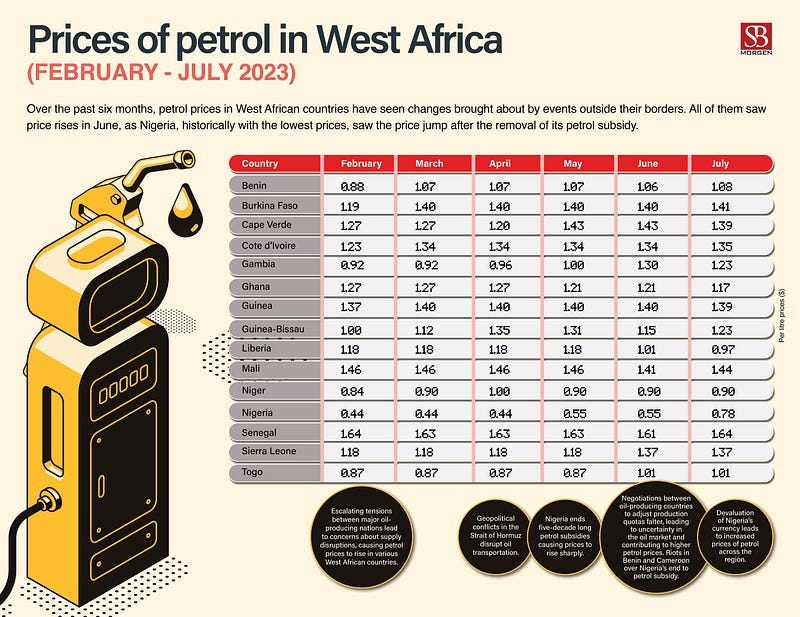
Initial reports following the petrol subsidy removal were that daily consumption had fallen to as low as 46 million litres, compared to the high of 71.4 million per litre consumed in March. This new report that daily consumption remains as high as 52 million litres is a surprise because, in cities like Lagos, there are fewer cars on the road and fewer queues in petrol stations as consumers struggle to afford the product at current pump prices. In some quarters, there is a suggestion that Nigeria is still subsidising the product to an extent, and there is room for arbitrage which is still enabling the smuggling of products to neighbouring countries. The projection of a decrease in daily consumption figures is entirely logical and based on two factors: first, the cross-border smuggling that leads to less consumption within the country, and second, the genuine demand for petrol within Nigeria is likely to decrease as Nigerians adapt to the new prices. It is, perhaps, time to liberalise the importation and/or generation of petrol. Rather than a licensing regime, where the government selects who can import fuel, the government should simply limit itself to setting the standards and allowing whoever can meet those standards to import the fuel, fostering competition in the market. The commitment to market-driven prices and subsidy removal cannot be part way. It has to be all the way. It is the only way Nigerians can be assured of receiving the best value for their money for fuel at any given time. As much as it was important for Nigeria to remove the fuel subsidies that kept petrol prices at unsustainably low prices, it is equally vital for the government to make sure that it develops a framework that creates a fuel pricing range that keeps the Nigerian economy from facing energy poverty. Energy poverty is a situation where people lack access to reliable, affordable, clean energy services. This can usher in high unemployment rates, reduced productivity, lost jobs, lower economic growth, higher costs and environmental damage as poor people who can’t afford liquid fuels and electricity resort to using polluting fuels, such as firewood or charcoal, to save money. Nigeria is at a point where its economic growth is mainly dependent on how successfully it reinvents itself as an export-oriented economy, which is partly dependent on how competitively priced its products are, and this has a lot to do with the cost and availability of energy around the country. Reduced competitiveness will make it an unattractive venue for investment and make even locally-made goods and services prohibitively expensive for Nigerians.