
Mega growth? Or just a headline?
Côte d’Ivoire approves a 114.8tn CFA plan to reach upper-middle-income status, targeting 7.2% growth by 2030.

Côte d’Ivoire is advancing an ambitious economic agenda, with the Senate approving a 114.8 trillion CFA franc National Development Plan for 2026–2030 aimed at achieving upper-middle-income status under Alassane Ouattara. The plan targets 7.2% growth, driven largely by private investment. Meanwhile, reforms to public finance management are improving transparency, though gaps in cash management persist. The International Monetary Fund has endorsed the country’s progress, reaching a staff-level agreement that could unlock $843.9 million. Despite global risks, strong reforms, rising revenues, and steady growth projections underscore resilience, though inflation and external pressures remain key concerns.
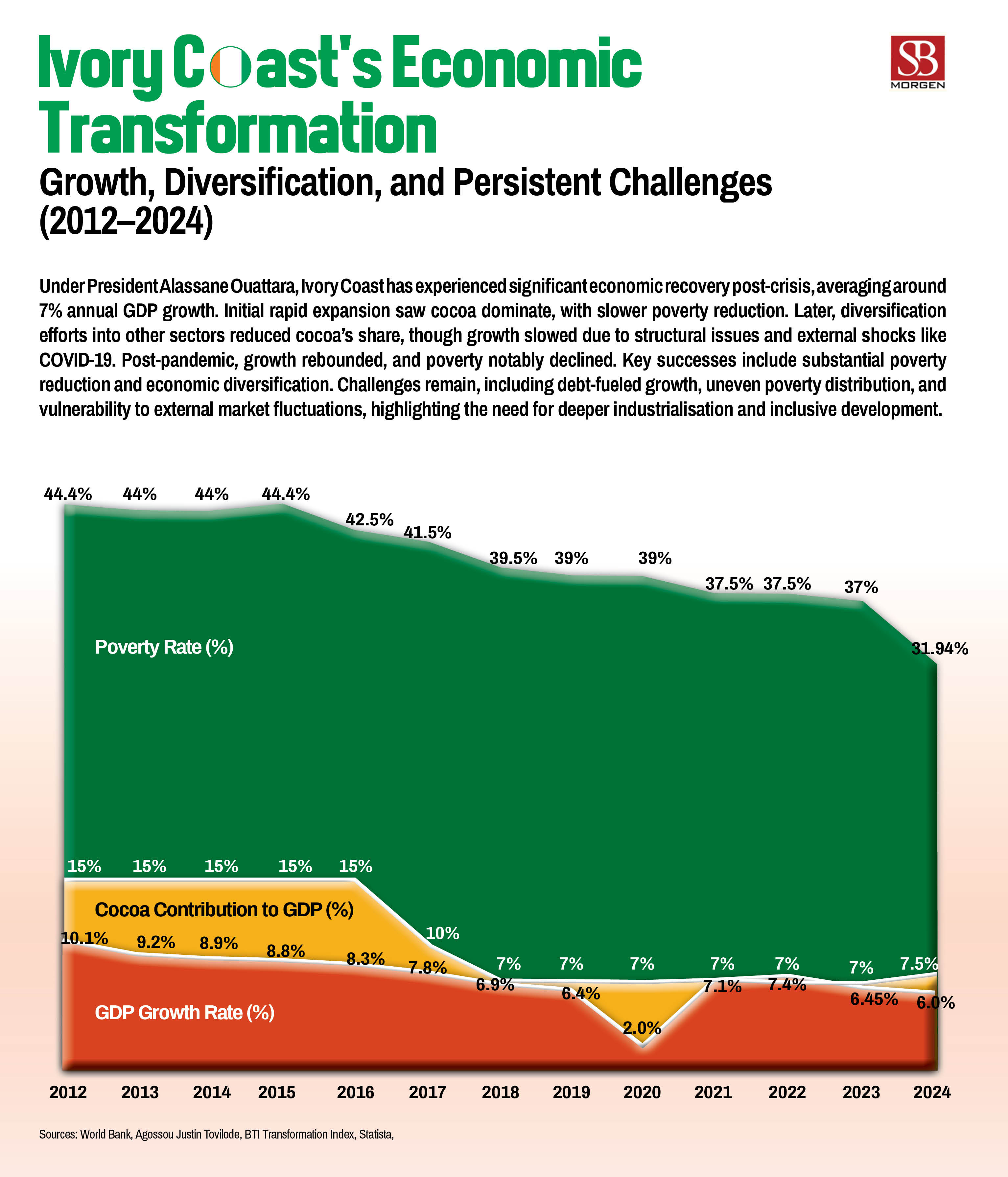
Côte d’Ivoire’s National Development Plan (PND) 2026–2030 is a bold and far-reaching blueprint designed to propel the West African nation into upper-middle-income status. With a staggering $209 billion target investment over five years, three times the country’s current GDP, the plan is poised to shape Côte d’Ivoire’s trajectory into the next decade. Yet, despite its ambitious targets, the plan’s feasibility hinges on critical factors, such as financing, fiscal discipline, political stability, and external risks.
Abidjan’s growth track record since emerging from recession in 2011 is indeed impressive. Its economy, which has almost tripled from $37 billion in 2012 to $99 billion in 2025, has been supported by a series of development plans. Each successive PND has set a clearer policy trajectory, guiding fiscal policy and signalling the sectors most attractive to private capital. Notably, the previous plans have achieved sustained growth, often outperforming the African average. The IMF’s recent endorsement, with a staff-level agreement on a $843.9 million disbursement, further affirms the credibility of Côte d’Ivoire’s macroeconomic management.
However, the scale of this new plan raises significant questions about financing feasibility. The plan relies on private capital for 70.2 percent of the total investment, a dramatic leap from the previous plan’s private share of 55 percent. This shift demands a surge in foreign direct investment, which hinges on factors outside Abidjan’s immediate control. Global liquidity conditions, post-Mali French banking appetite, and the commitment of international commodities players, especially in cocoa, oil, and gold, will all determine whether the ambitious private-public ratio is achieved. A slowdown in global investment appetite or regional competition, especially from Senegal’s hydrocarbon drive or Ghana’s gold-linked stabilisation, could blunt Côte d’Ivoire’s efforts.
Further complicating matters, the plan’s fiscal execution requires significant discipline. Côte d’Ivoire must boost its tax-to-GDP ratio from 14.9 percent to 18 percent by 2030, all while maintaining the WAEMU deficit ceiling of 3 percent. This effort will depend on the Medium-Term Revenue Mobilisation Strategy, an initiative tasked with expanding the tax base, not just raising rates. Any failure in tax compliance or cash management could undermine the entire plan, especially as infrastructure spending is front-loaded.
Political continuity is another crucial variable. President Alassane Ouattara, re-elected in 2025, will be 88 by the time the plan concludes. Thus, succession looms as a key risk, with political uncertainty potentially undermining long-term planning. Meanwhile, regional security issues, such as JNIM insurgency in the Sahel, also pose a threat to agricultural corridors crucial to the north. In sum, Côte d’Ivoire’s PND 2026–2030 is well-conceived, building on a solid track record of growth. Yet, the success of this plan will depend on a rare confluence of sustained private capital inflows, disciplined fiscal execution, and political stability.