
Military get big payday as strategy falters
DSS warns of Boko Haram attacks as troops repel a Zamfara raid and Tinubu approves military pay rises.

Nigeria’s security agencies have intensified efforts against insurgency, with the DSS warning of planned Boko Haram attacks in parts of Adamawa and Borno following the reported collapse of a ceasefire. In Zamfara, troops repelled a terrorist attack on a military base, killing several attackers, rescuing nine abducted civilians and losing one Army officer and one police officer. Meanwhile, President Bola Tinubu approved salary increases of 30% to 80% for about 250,000 military personnel, effective 1 September 2026, to boost troop welfare and strengthen the fight against insecurity.
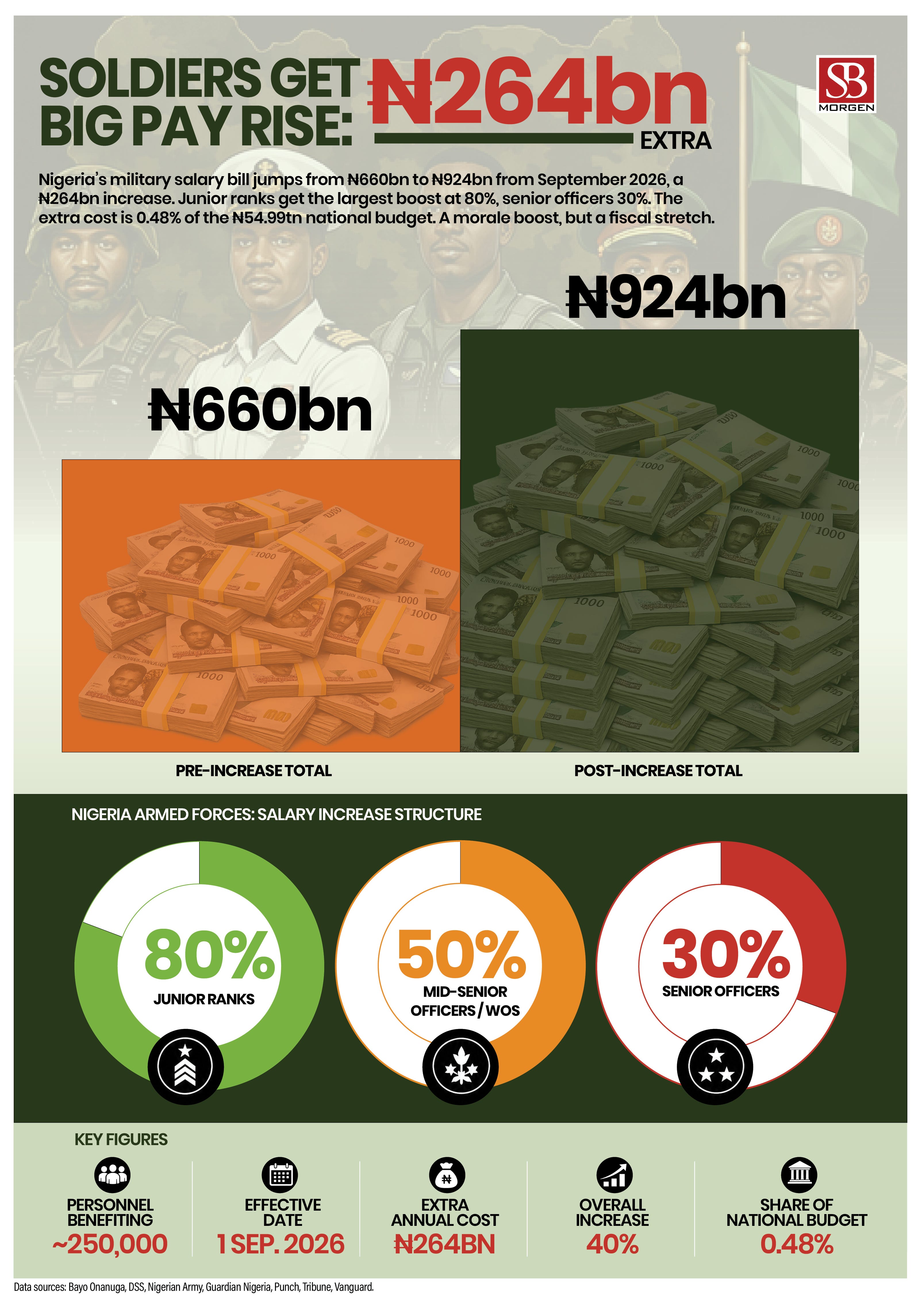
What a week for the military! On one hand, the Department of State Services issued a classified intelligence alert warning of planned Boko Haram attacks in Michika and Askira Uba local government areas following the reported collapse of a ceasefire arrangement with the Adamawa and Borno state governments. On the other hand, troops in Zamfara repelled a terrorist attack on a forward operating base, rescuing nine abducted civilians but losing one Army officer and one police officer in the process. And in what appears to be the administration’s preferred response to these twin challenges, President Bola Tinubu approved salary increases of between 30 and 80 percent for approximately 250,000 military personnel, effective 1 September 2026. The package will raise the annual military wage bill from ₦660 billion to ₦924 billion ($651 million). Taken together, the three developments point to a government negotiating from weakness in the North-East, absorbing mounting pressure in the North-West, and attempting to reinforce morale within its own ranks. Paying soldiers more is long overdue, but whether that alone alters the trajectory of Nigeria’s security picture is another question entirely.
The DSS memo, dated 27 July 2026, is a document that should chill anyone who reads it. Beyond flagging imminent attacks, it alleges that insurgents intend to abduct senior government officials, councillors, traditional rulers, religious leaders and residents. The terrorists reportedly deployed reconnaissance teams to monitor the affected areas ahead of the planned operations. Yet perhaps the most revealing aspect of the memo is what it leaves unsaid. The ceasefire whose collapse triggered the alert was reportedly negotiated with the Adamawa and Borno state governments rather than Abuja, but the document provides neither the terms of the arrangement nor the reasons for its breakdown. That omission is significant because sub-national accommodation deals have quietly existed for years across the Lake Chad theatre, often exchanging temporary peace for freedom of movement, financial inducements or restraint on insurgent activity. Such arrangements tend to collapse when one side concludes the bargain is no longer worth honouring. The reported targeting of district heads, councillors and pastors suggests retaliation against the very intermediaries believed to have brokered the deal. The Nigerian Army has since opened an investigation into the unauthorised release of the classified report, but the leak has already heightened fears across the North-East while exposing the fragility of informal security arrangements that have operated largely outside public scrutiny.
The Zamfara theatre reflects the same insecurity through a different lens. Troops of Operation Fansan Yamma successfully repelled a terrorist assault on the Kasuwar Daji forward operating base in Kaura Namoda, rescuing nine abducted civilians. But the operation came at a high cost, with one Nigerian Army officer and one police officer killed while two soldiers sustained gunshot wounds. The location of the attack places it within the operational environment historically associated with Bello Turji and Halilu Sububu, whose networks have repeatedly targeted military formations across Zurmi and Shinkafi and were responsible for the killing of dozens of civilians near Shinkafi in 2025. More worrying are reports suggesting that Sambisa-linked improvised explosive device specialists have begun transferring technical expertise into north-western bandit networks. Turji does not require ideological alignment with jihadist groups to benefit from their battlefield experience; tactical cooperation alone is sufficient to increase the sophistication of attacks. The military continues to hold strategic positions, including protecting the Sokoto-Gusau corridor, but each successful defence increasingly comes with casualties that underscore the growing operational costs of containing insecurity.
It is against this backdrop that the salary increase must be understood. The new package is structured to benefit junior ranks most heavily: personnel from Private to Staff Sergeant will receive an 80 percent increase, those from Warrant Officer to Colonel will receive 50 percent, while officers above the rank of Colonel will receive 30 percent. The weighting is deliberate. Junior soldiers bear the greatest burden of frontline operations and have long complained that poor remuneration contributes to absenteeism, weak morale and even low-level collusion with criminal actors. Retired Major General Bashir Galma described the move as “what we have been calling for a long time”, while the Chairman of the Senate Committee on Defence argued that the ₦924 billion personnel bill represents “a strategic national investment” rather than a simple budget adjustment. Those arguments are persuasive, but they explain only part of the decision.
The annual military wage bill of ₦924 billion now exceeds the combined budgets of several federal ministries and represents roughly 1.35 percent of Nigeria’s ₦68.32 trillion 2026 budget. It also adds ₦264 billion in recurrent expenditure at a time when debt servicing already absorbs nearly half of projected federal revenue. This is the second major remuneration intervention within a year, following the earlier announcement of a ₦100,000 monthly minimum for soldiers, and its timing inevitably invites political interpretation given the arrests of serving officers over an alleged coup plot in late 2025 and the approach of the 2027 elections. Improving troop welfare is necessary, but higher salaries cannot substitute for accountability. They do not address longstanding concerns over procurement failures, ghost defence contracts, weak command responsibility or the absence of meaningful consequences for operational setbacks, whether in Kasuwar Daji or in the circumstances that produced informal ceasefire arrangements in Adamawa and Borno. The government’s intelligence system clearly remains capable of detecting threats, yet preventing them remains the greater challenge. If improved pay is not matched by better equipment, stronger leadership, institutional reform and a coherent counterinsurgency strategy, the salary increase risks becoming a palliative that cushions dissatisfaction without resolving the structural weaknesses that continue to undermine Nigeria’s security campaign.