
Mission aborted
ECOWAS withdraws mission from Guinea-Bissau amid election dispute.

ECOWAS has withdrawn its mission from Guinea-Bissau after President Umaro Sissoco Embalo threatened to expel them. The team was deployed to resolve an election dispute and find a consensus on holding elections this year after Embalo postponed the general elections from November 2023 to 30 November 2025. The opposition opposed the delay, arguing his term had expired, but a Supreme Court ruling extended it until September. ECOWAS had drafted a roadmap for the 2025 elections but was forced to leave. The bloc will present its report to the ECOWAS president and propose an inclusive and peaceful election agreement.
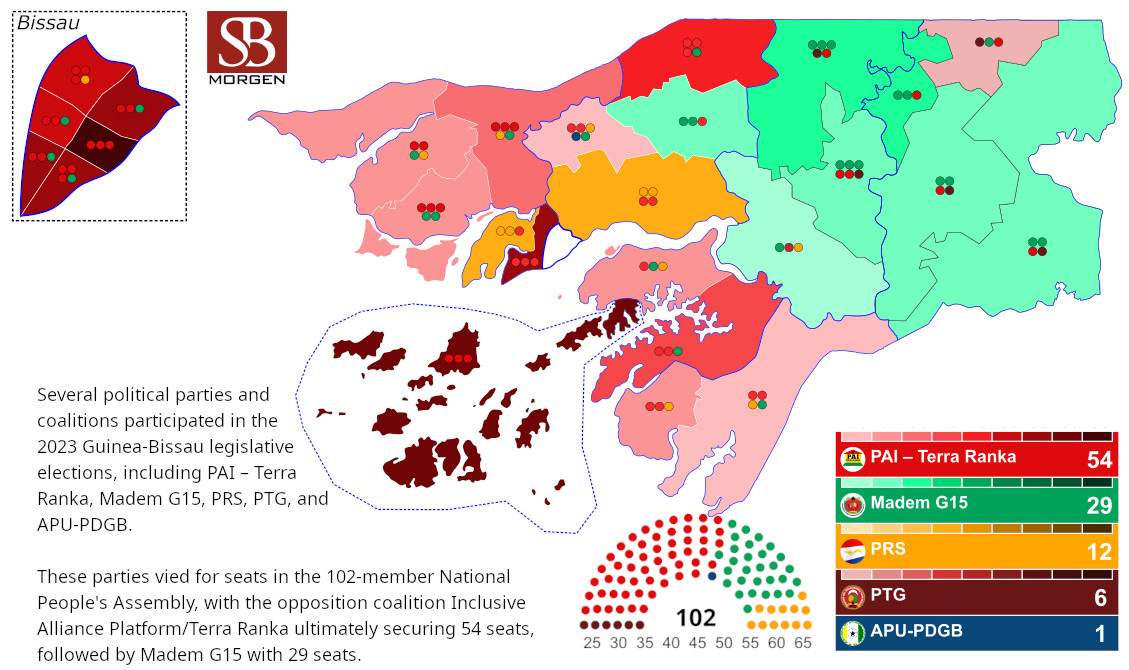
Guinea-Bissau is entrenched in a profound political and institutional crisis rooted in the structural challenges common to many post-colonial African states: an underdeveloped economy, over-reliance on external aid, fractured elites, a politicised military, and governance deficiencies. However, Guinea-Bissau's situation is uniquely marked by a history of instability since its 1974 independence, with frequent coups and assassinations. During one such constitutional crisis, spanning 2014 to 2016, Umaro Sissoco Embaló initially rose to prominence as prime minister, appointed by President José Mário Vaz, before eventually becoming president.
According to Guinea-Bissau’s constitutional framework, Embaló’s five-year presidential term, which began in February 2020, officially expired on 28 February 2025. This expiration marks a pivotal moment, as Embaló, despite no longer holding legal authority as president, has refused to step down, creating a profound constitutional crisis. The results highlight that some opposition parties, including the African Party for the Independence of Guinea and Cape Verde, PAIGC, have declared that Embaló “will no longer be considered as such after 27 February 2025,” signalling a rejection of his continued claim to power. However, Embaló’s refusal to cede office has plunged the country into uncertainty, with no clear mechanism to enforce constitutional norms amid weakened institutions.
Compounding this crisis, the four-year term of Guinea-Bissau’s parliament expired concurrently, leaving the country without a functioning legislative body. Embaló has ruled by decree for over a year, a practice that began after he dissolved parliament, as noted in the web results. This move has centralised power in his hands, bypassing democratic checks and balances and drawing sharp criticism from opposition groups. The PAIGC, a major political force and a historical powerhouse in Guinea-Bissau, has demanded new presidential and parliamentary elections “within 90 days and not only on 30 November, as the President has suggested” (implied from the web results’ mention of opposition timelines and Embaló’s proposed election date).
This demand reflects the opposition’s urgency to restore democratic legitimacy and prevent Embaló’s prolonged grip on power. However, it also underscores the lack of consensus on electoral timelines, with Embaló’s 30 November 2025 proposal seen as a delaying tactic. The heart of the conflict is Embaló’s obvious intent to maintain his presidency indefinitely and block political rivals, particularly Domingos Simões Pereira of the PAIGC, from ascending to key positions.
The web results do not explicitly mention corruption allegations against Pereira. However, they note the broader political polarisation and Embaló’s efforts to monopolise power, including his idiosyncratic interpretation of the constitution to appoint prime ministers and centralise control. Embaló’s actions—ruling by decree, rejecting opposition demands, and marginalising other political entities—suggest a strategy to suppress dissent and consolidate authority within himself and his hand-picked cabinet, notably the MADEM G15 faction he joined after breaking away from the PAIGC.
His background as a former brigadier general and prime minister from 2016 to 2018 under President José Mário Vaz reinforces his reliance on military and personal networks to sustain power, a tactic consistent with Guinea-Bissau’s history of praetorian influence and coups. On the ground, Guinea-Bissau faces severe consequences from this crisis, indicating ongoing tensions around the end of Embaló’s term, with the Supreme Court’s role in validating elections and candidates becoming a flashpoint.
Opposition parties fear that Embaló’s control over institutions could lead to the rejection of their candidates, interpreted as an attempt to eliminate rivals ahead of the presidential elections expected in 2025 and legislative elections in November. This polarisation has paralysed political stability, with the country’s elites—Embaló and his allies versus the PAIGC and other opposition groups—locked in a power struggle that mirrors Guinea-Bissau’s long history of instability since 1974, marked by coups, assassinations, and governance deficits.
The economic and social ramifications are stark. Guinea-Bissau’s underdeveloped economy, over-reliance on foreign aid, and volatile political structures are exacerbated by this leadership vacuum, potentially deterring international cooperation and investment, as seen during past crises. Embaló’s “Embaloism”—described as a governing style of “order, discipline, and development”—has failed to translate into institutional stability, instead fostering accusations of authoritarianism and undermining the multiparty system established in the country.
ECOWAS may have tried to rectify its previous mistakes by preempting the political crisis before it amounts to an overthrow of the government. However, with Embalo’s moves, it is a little too late. During the same period, the ECOWAS envoy was expelled from Guinea-Bissau, while Embaló, who had undertaken over 300 international trips during his tenure, travelled to Moscow. There, President Vladimir Putin pledged Russia’s support for Guinea-Bissau. This development deepens ECOWAS’s ongoing crisis, as its perceived weakness fuels instability. The bloc's failure to assert control has encouraged external geopolitical actors to interfere in domestic affairs—a trend first established in Mali and Niger. Without decisive action, ECOWAS risks further fragmentation and diminishing regional influence.