

Edo State Governor, Monday Okpebholo, has suspended all unregistered vigilante groups in the state, following the 27 March lynching of travellers in Uromi, Esan North East LGA. The victims, mostly northerners, were set ablaze by an angry mob after a vigilante group allegedly found firearms in their truck. Meanwhile, in Benue State, thousands protested rising herdsmen killings and kidnappings, blocking major roads and demanding government action. The Olena community has been under siege for four days, with several killed and many abducted. Protesters claim electricity cuts precede attacks. Intelligence reports warn that criminal herders are shifting focus southward, escalating Nigeria’s pastoral crisis.
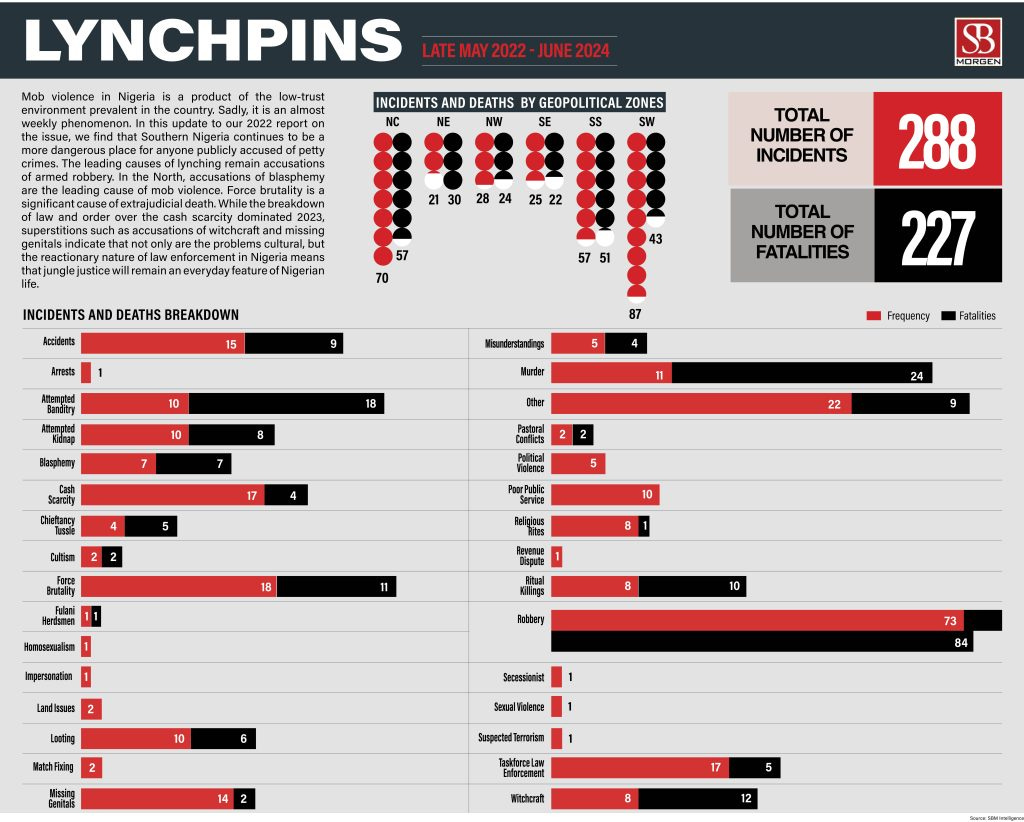
The recent killings in Uromi, Edo State, where a mob brutally murdered innocent travellers, represent more than just another tragic episode in Nigeria's security crisis. They expose the fundamental failure of the Nigerian state to fulfil its most basic constitutional obligation: the protection of lives and property. As documented in our report, which was published the day before the tragedy in Uromi, this incident is not isolated but part of a disturbing pattern where governance failures have created vast ungoverned spaces across the country, increasingly controlled by armed non-state actors.
The state's progressive loss of legitimacy lies at the heart of this crisis. When aggrieved citizens routinely take justice into their own hands - whether through mob violence or vigilante groups - it signals a complete breakdown of trust in public institutions. The statistics are damning: between May 2022 and June 2024 alone, SBM Intel recorded at least 288 incidents of mob violence resulting in 227 deaths. These numbers reveal a society where extrajudicial justice has become normalised, not because Nigerians are inherently violent but because the state has consistently failed in its role as an impartial arbiter and security guarantor.
The government's response to the Uromi lynchings has been characteristically inadequate. While well-intentioned, Governor Okpebholo's ban on unregistered vigilante groups ignores the stark reality on the ground. Nigeria remains severely underpoliced, with just one officer for every 700 citizens - far below the UN recommended ratio of 1:400. Vigilante groups have emerged precisely to fill this security vacuum. Without addressing the root causes - inadequate policing, proliferation of arms (both local and imported), and systemic failure of justice mechanisms - such pronouncements are doomed to fail.
Perhaps most troubling is the government's inconsistent response to security crises across different regions. While the Uromi killings prompted immediate condemnation and policy announcements, the chronic violence in Benue - where attacks attributed to herders have claimed countless lives - continues to receive lacklustre attention despite mass protests. This disparity sends a dangerous message that some Nigerian lives are valued more than others, further eroding national cohesion and trust in government.
As we have suggested repeatedly, the solution requires more than symbolic gestures. It demands a fundamental recommitment to the social contract between state and citizen. This means proper funding and reform of security institutions, consistent application of justice regardless of region or ethnicity, and serious action on arms proliferation. Until Nigeria's leaders address these systemic issues with the urgency they deserve, the cycle of violence and extrajudicial justice will only intensify - a situation that ultimately serves no one's interests and threatens the very foundations of the country.