
Nest egg
Nigeria’s contributory pension assets reached ₦21.14 trillion ($12.44 billion) by the end of August 2024, marking a ₦345.65 billion…

Nigeria’s contributory pension assets reached ₦21.14 trillion ($12.44 billion) by the end of August 2024, marking a ₦345.65 billion increase from July. The number of Retirement Savings Account (RSA) holders grew to 10.46 million. The Nigerian government remained the leading borrower of pension funds, with ₦13.40 trillion allocated to securities, primarily Federal Government bonds at ₦12.59 trillion. Money market instruments accounted for ₦2.04 trillion, and domestic shares for ₦1.94 trillion. In Q2 2024, total contributions to RSAs were ₦377 billion, with the public sector contributing ₦217 billion and the private sector ₦160.83 billion.
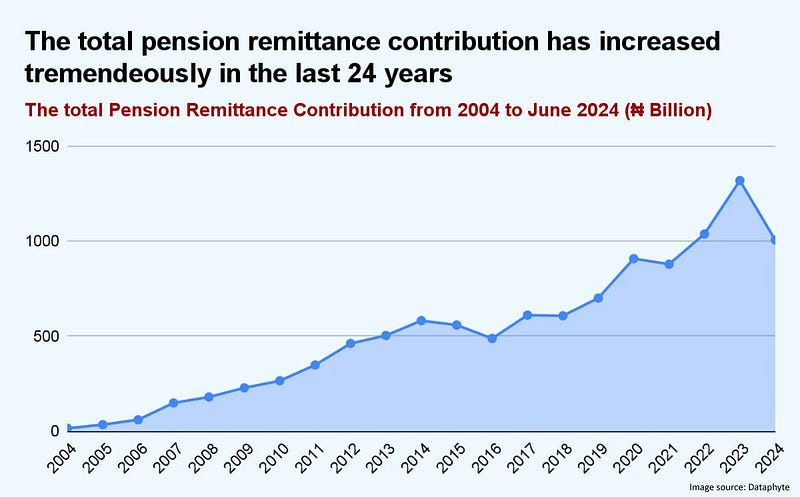
Taken in isolation, the pension industry has performed well since the current Contributory Pension Scheme (CPS) was established in 2004 by President Obasanjo’s administration to replace the Defined Benefit Scheme (DPS), which had completely collapsed, particularly for government workers. This collapse occurred because the DPS relied on the discretion of employers to set aside and invest money regularly — something that various tiers of government failed to do. With the passage of the Pension Reform Act (PRA) in 2004, it was hoped that the long queues of retirees seeking their monthly pension benefits would be eliminated for good. Till its amendment in 2014, the country operated under an outdated scheme plagued by a lack of accountability, transparency, mismanagement of funds, and corruption. Since the amendment, the industry now operates in a highly regulated environment, making it a significant player in financial services. Today, most private sector workers have been signed up, along with many government workers, except for some sub-nationals (states and local government authorities) who have been denied access thus far. Growing from zero to ₦21.14 trillion in 20 years is indeed worthy of celebration. In addition to the ₦345.7 billion month-on-month growth, pension assets increased by ₦3.84 trillion, rising from ₦17.3 trillion in August last year. Over the years, the public sector has contributed more to pension schemes than the private sector. The growth in pension assets may have spurred the country’s insurance GDP growth rate, which rose from 8.34 percent in Q1 2024 to 13.3 percent in Q2. It also increased from 7.31 percent in Q2 2023. This sector’s growth has a multiplier effect on overall GDP through financial stability and domestic savings. Unfortunately, due to elevated inflation rates and regular naira devaluation, these savings have lost significant value, resulting in negative real returns per annum over the lifetime of the investments. Another issue facing the industry is the troubling rhetoric from legislators suggesting that accumulated pension funds should be used to invest in infrastructure and other areas of the economy without serious discussion about implementing structures to mitigate the risk of losses. Additionally, many believe that the ₦21+ trillion in pension assets are lying idle, while in fact, these assets represent the single largest investment in government debt securities. Attention should be paid to Retirement Savings Account (RSA) holders, as their numbers grew to 10.45 million in August, up from 10.42 million the previous month. The modest increase in participants can be linked to rising unemployment, a high cost of living, and increased awareness of pension assets.