
New wage, same woes
President Bola Tinubu has announced a new monthly minimum wage of ₦70,000 ($44.03) after meeting with union leaders Joe Ajaero, president…

President Bola Tinubu has announced a new monthly minimum wage of ₦70,000 ($44.03) after meeting with union leaders Joe Ajaero, president of the Nigeria Labour Congress and Festus Osifo of the Trade Union Congress. This follows six months of negotiations by the 37-man Tripartite Committee, which ended in deadlock with the government proposing ₦62,000 and the unions demanding ₦250,000. The new minimum wage aims to address workers’ concerns and promote economic growth. The announcement was made by Information Minister Mohammed Idris at the Presidential Villa, Abuja, bringing an end to the prolonged negotiations and setting a new benchmark for workers’ compensation in Nigeria.
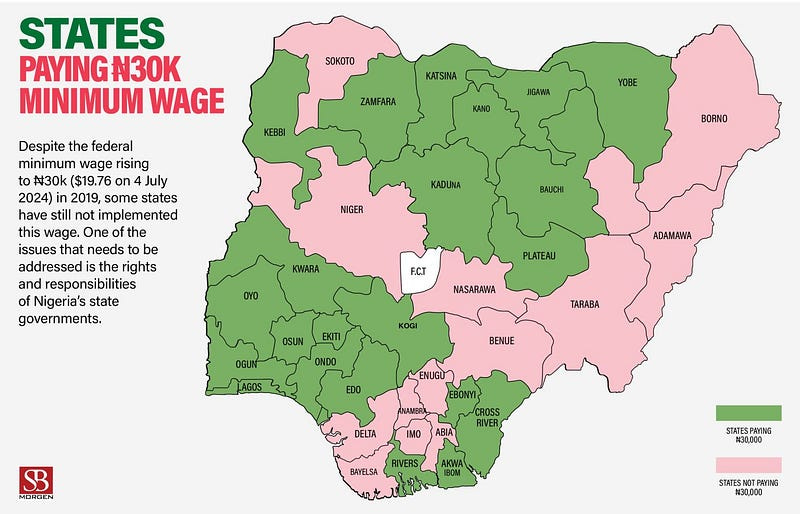
It is a relief that the government and organised labour agreed on a minimum wage that is more than double the previous level. While it is a good step, it does little to alleviate the suffering that Nigerians are experiencing because the cost of living expenses has risen exponentially in the last few years. Nigeria has a significant productivity problem, and little is being done to address or even discuss the matter. The current economic strategy centres around tackling inflation using monetary tools while the country’s farmlands and factories remain fallow due to insecurity, lack of power, and infrastructure deficits. As millions of Nigerians remain idle, critical skills that were informally passed on from generations are being lost and may never be replaced. That is the real problem and one that has to be tackled urgently, or else the agitations over the cost of living will not go away as the agreed new minimum wage level is still not enough to solve the cost of living crisis, not to mention that the aforementioned lack of productivity also means that the government will struggle to generate the funds to meet its new commitments. As things are, almost half of the 36 states never implemented the ₦30,000 wage, and given their position during the negotiations, it is unlikely that most states will be in a hurry to move to ₦70,000. The discontent that will create, coupled with the disappointment many will feel when they find that their “improved pay” will not solve their problems, are likely to create new problems entirely or simply worsen the existing ones.