
Niger gets a coup
Niger President Mohamed Bazoum has been removed from power, by a group of soldiers in the West African country, hours after holding the…

Niger President Mohamed Bazoum has been removed from power, by a group of soldiers in the West African country, hours after holding the president in the presidential palace. Colonel Amadou Abdramane and nine officers cited deteriorating security and bad governance as reasons for ending the government. Niger’s borders are closed, a curfew has been imposed around the country, and all institutions are suspended. The soldiers opposed foreign intervention and pledged to respect Bazoum’s well-being. The Economic Community of West African States (ECOWAS) dispatched Benin President Patrice Talon to lead an intervention mission to Niger following a meeting with Nigerian President Bola Tinubu.
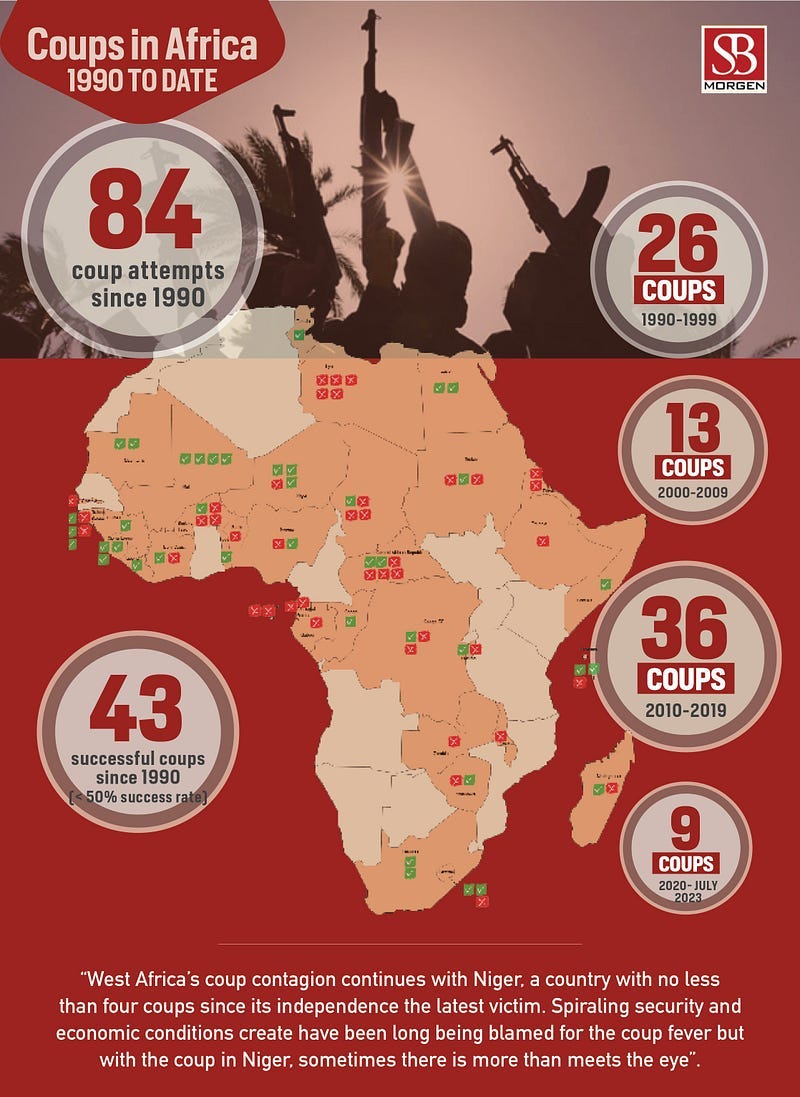
The Russia-Africa Summit kicked off this week in St Petersburg with Niger’s flag flying outside, but the country was ominously absent in the seating arrangements for the event, indicating that either their delegation had left in a hurry or had not made it at all. This may be because the coup that affected important parts of Niamey’s capital occurred the night before the summit. A coup by the presidential guard has not happened in a while in the region. Perhaps more than a testament to political instability, it tells the story of poor commitments to professionalise armed forces. However, professionalising the armed forces is one thing. Making the ground less fertile for coups is the other. This is the most pressing challenge that leaders in the subregion, now clearly the coup belt of Africa, have shied away from facing squarely. Niger faces rising living costs, government incompetence, and corruption, which may provide a convenient excuse for the coup. Although the coupists blame their action on the spiralling insecurity along the country’s borders, the immediate cause is more parochial. A few weeks ago, Mr Bazoum finalised plans to retire most senior officers in the military, some who have been in position for over a decade. The suspected brains behind the coup, Gen. Omar Tchiani, and Niger Army spokesman, Colonel-Major Amadou Abdramane, are said to be at least two of the more than 10 generals who would have been affected by such changes. For now, international legitimacy would be hard to come by. For Niger’s immediate neighbours, Burkina Faso could not be as bothered as Nigeria because it is in the same fix as Niger. Nigeria’s leadership of the Economic Community of West African States (ECOWAS) is probably still too young to steer the community in the right direction, and the delegation sanctioned by President Tinubu to intervene in the crisis in Niamey is unlikely to be effective. This leaves the initiative with Niger’s international partners. However, the US and France’s condemnation of the coup is interest-driven. Niger is a strong ally in both countries’ regional security initiatives and provides a significant chunk of uranium used in French energy needs. The reaction to the latest coup pales compared to how the coup in Chad in 2021 was received. That coup happened while Mali was having its successive coup moments. French President Emmanuel Macron, condemning Mali, rushed to N’Djamena to restate French support for young Mahamat Idriss Déby, who took over the government, sidestepping the constitutionally provided line of succession. This inconsistency fuels anti-French sentiments in the region, spurring young officers to engage in hostile government takeovers and denounce France as a viable tool for achieving domestic legitimacy. Bazoum had survived a coup in March 2021 when the military almost scuttled his inauguration. At the time, he was rumoured to be the candidate Abuja preferred over Mahamane Ousmane, Paris’ candidate. Bazoum has, so far, held a middle ground in relations between Nigeria and France. All the same, the economy remains a mono-economy largely based on uranium exports, which have gained significance due to the war in Ukraine, and this is another reason the West is concerned. A Niger that realigns towards Beijing and Moscow threatens Washington’s growing Sahelian counterterrorism footprint (a US drone base is based in eastern Niger) and could impact French energy security. This is the seventh coup attempt in Africa since 2020. Recent events in Burkina Faso, Chad, Guinea, Mali and Tunisia have highlighted the rapid decline of democracy on the continent. ECOWAS is freaking out because leaders think, with some justification, that a coup wave is sweeping through the region. Under President Tinubu, Nigeria has adopted a more hands-on posture in two months than the former government did in eight years. President Muhammadu Buhari led from the back in tackling the takeovers in Bamako, Conakry, and Ouagadougou. Now, Abuja appears committed to taking a stand on events in a national capital less than a thousand miles away. While the UN Security Council jostles to deliberate over the coup well into the weekend, any possible consensus on a resolution of condemnation would be heavily diluted by Russia, whose flags are now being hoisted in Niamey by the coup supporters. We can anticipate how France, Niger’s former colonial overlords, would relate with the new junta in light of its economic and security interests in the country. With the US preferring to sub-contract its foreign policy in the region to France, it does not seem that much will change. After a while, the international community will get used to the new government, and the whole dance between ECOWAS and the junta over returning to civilian rule will resume.