
Heading in one direction
Nigeria's government borrowing jumped 75.6 percent to ₦40.38 trillion as it plans a Eurobond issuance.

Nigeria’s borrowing appetite continues to rise, with Central Bank data showing credit to the Federal Government jumped 75.6 percent year-on-year to ₦40.38 trillion in May 2026, reflecting increased reliance on domestic debt despite tight monetary conditions. Analysts warn the trend could crowd out private sector lending as banks favour safer government securities over business loans. Meanwhile, Nigeria is preparing to return to the international debt market, with the Debt Management Office seeking advisers for a planned Eurobond issuance under the 2026 external borrowing programme. The proposed bond will help finance the budget, refinance existing debt and support infrastructure, subject to market conditions and investor demand.
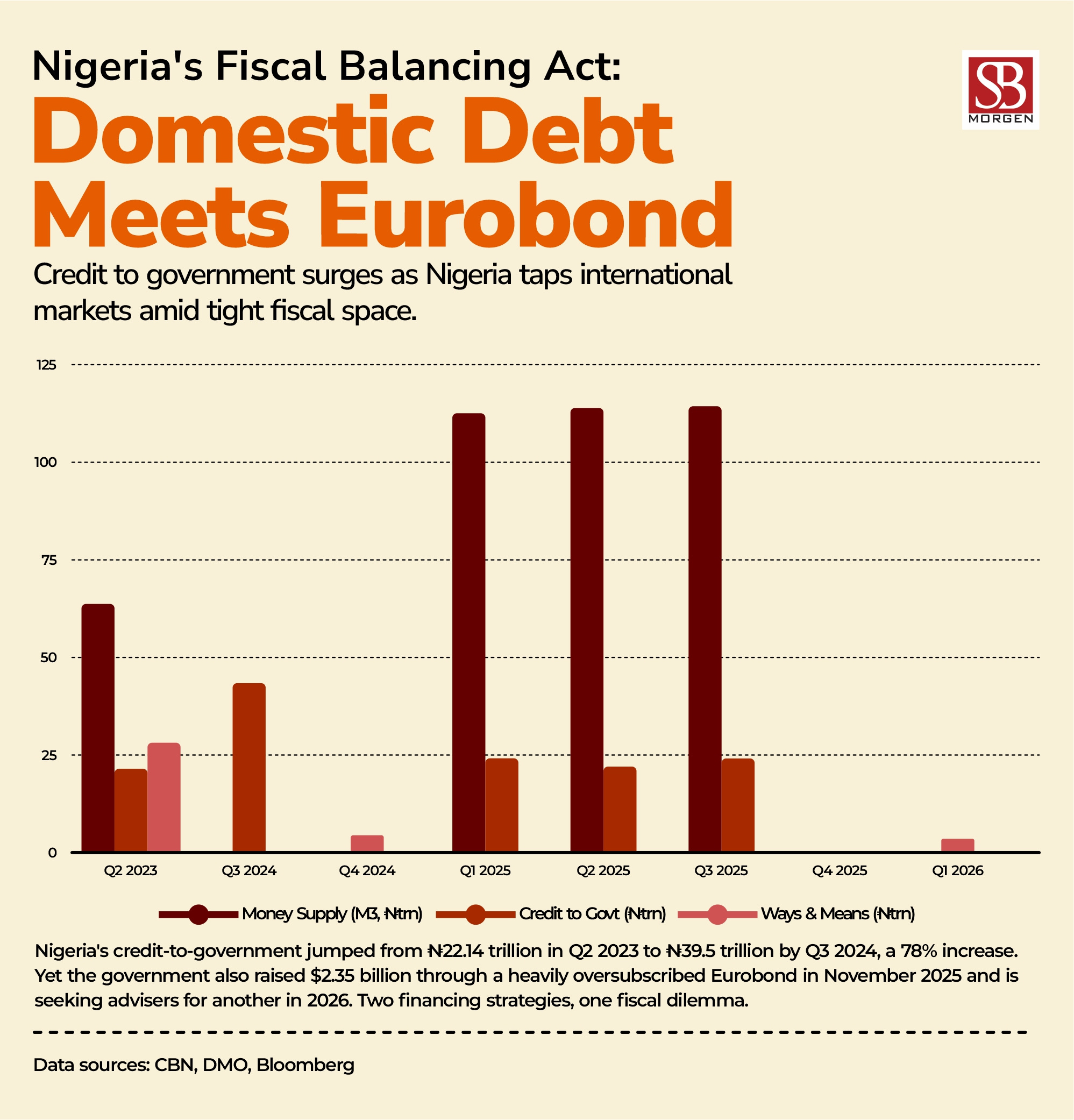
After Nigeria’s public debt climbed to a record high of over ₦159 trillion in 2025, many expected the government to moderate its borrowing appetite. Instead, the opposite has unfolded in 2026. The government has intensified borrowing across both domestic and external markets, signalling that debt financing remains at the heart of its fiscal strategy despite growing concerns about sustainability.
On the domestic front, data from the Central Bank of Nigeria (CBN) shows that credit to the government rose sharply to ₦40.38 trillion as of May 2026, nearly doubling from ₦23 trillion recorded in May 2025. This surge has been largely driven by the Federal Government’s aggressive issuance of Treasury bills. Between January and May alone, the government issued ₦11.4 trillion in treasury bills, the highest amount ever recorded in a five-month period. According to FMDQ data, outstanding treasury bills totalled approximately ₦17.4 trillion, underscoring the Federal Government’s growing reliance on domestic debt markets to finance its fiscal obligations.
Beyond the domestic market, the government is simultaneously activating multiple channels for foreign borrowing. A proposed $5 billion bond swap transaction is nearing completion, following the securing of a $1 billion facility from Citibank UK to finance the modernisation of the Apapa and Tin Can Island ports. In addition, a $516 million loan for the Badagry-Sokoto Superhighway is also under consideration. Based on the current pipeline of transactions, Nigeria appears to be on course to contract as much as $10 billion in new external debt in 2026 alone, with much of the borrowing expected to come at commercial rather than concessional rates.
Although Nigeria’s debt-to-GDP ratio remains below the commonly accepted threshold for developing economies, standing at roughly 36 percent, the pace and composition of new borrowing are prompting renewed debate over the country’s long-term fiscal sustainability. The concern extends beyond the headline debt ratio to the structure and cost of the obligations being accumulated. The experience of the Paris Club debt overhang, which constrained Nigeria’s public finances for decades before eventual debt relief, remains a cautionary reminder of how persistent debt burdens can limit fiscal flexibility and economic development.
Equally important is the question of debt affordability, particularly when measured against government revenues. While the Tinubu administration is betting on a broader revenue base through its tax reforms and an expanded tax net to improve fiscal receipts, concerns remain over whether revenue growth can consistently keep pace with rising debt service obligations. This is especially significant given that much of the country’s recent borrowing has been raised at relatively expensive market rates rather than through lower-cost concessional financing, potentially placing additional pressure on public finances in the years ahead.
Perhaps the most immediate economic consequence of this borrowing strategy is its effect on private sector credit. As government borrowing accelerates, banks have increasingly shifted their balance sheets toward lending to the sovereign at the expense of businesses. High-yield, short-term government securities now offer attractive and relatively risk-free returns, with three-month and six-month Treasury bills yielding around 16 percent. This has created a powerful incentive for financial institutions to channel liquidity into government instruments rather than extend credit to manufacturers, small businesses, and other productive sectors of the economy.
The resulting crowding-out effect is becoming increasingly evident. Instead of financing productive investment, a growing share of banking sector liquidity is being absorbed by government borrowing, reducing access to affordable credit for the private sector. At the same time, elevated interest rates continue to raise the cost of capital, limiting business expansion and investment decisions. CBN data also indicates that economic activity has contracted for two consecutive months, reflecting broader weakness across the economy. Meanwhile, manufacturers have increasingly scaled back inventory accumulation and delayed expansion plans as borrowing costs remain prohibitively high. Collectively, these trends point to an economy where public sector financing needs are increasingly competing with and potentially undermining the private sector’s capacity to drive investment, productivity, employment, and long-term economic growth.