
Nigeria's north endures a violent surge
Northern Nigeria faces a surge in coordinated attacks, with students abducted and soldiers killed, exposing severe security gaps across the region.

Nigeria has suffered a fresh spike in violence as coordinated attacks across the north left civilians, students, and soldiers dead or missing. In Borno, ISWAP executed a senior military officer after ambushing a convoy near Wajiroko, killing four soldiers and exposing gaps in counter-insurgency operations. Hours later in Kebbi, gunmen stormed Government Girls Comprehensive Secondary School in Maga, killing the vice principal and abducting 25 students despite recent troop reinforcements in the region. Around Lake Chad, more than 150 fighters were reportedly killed in a major clash between Boko Haram and ISWAP — one of the deadliest confrontations between the rival groups in years. Although security officials view the infighting as a temporary relief, it underscores the instability spreading across the region. In Kwara, three worshippers were shot dead when attackers invaded a church in Eruku and abducted several others, adding to the growing sense of insecurity across northern Nigeria.
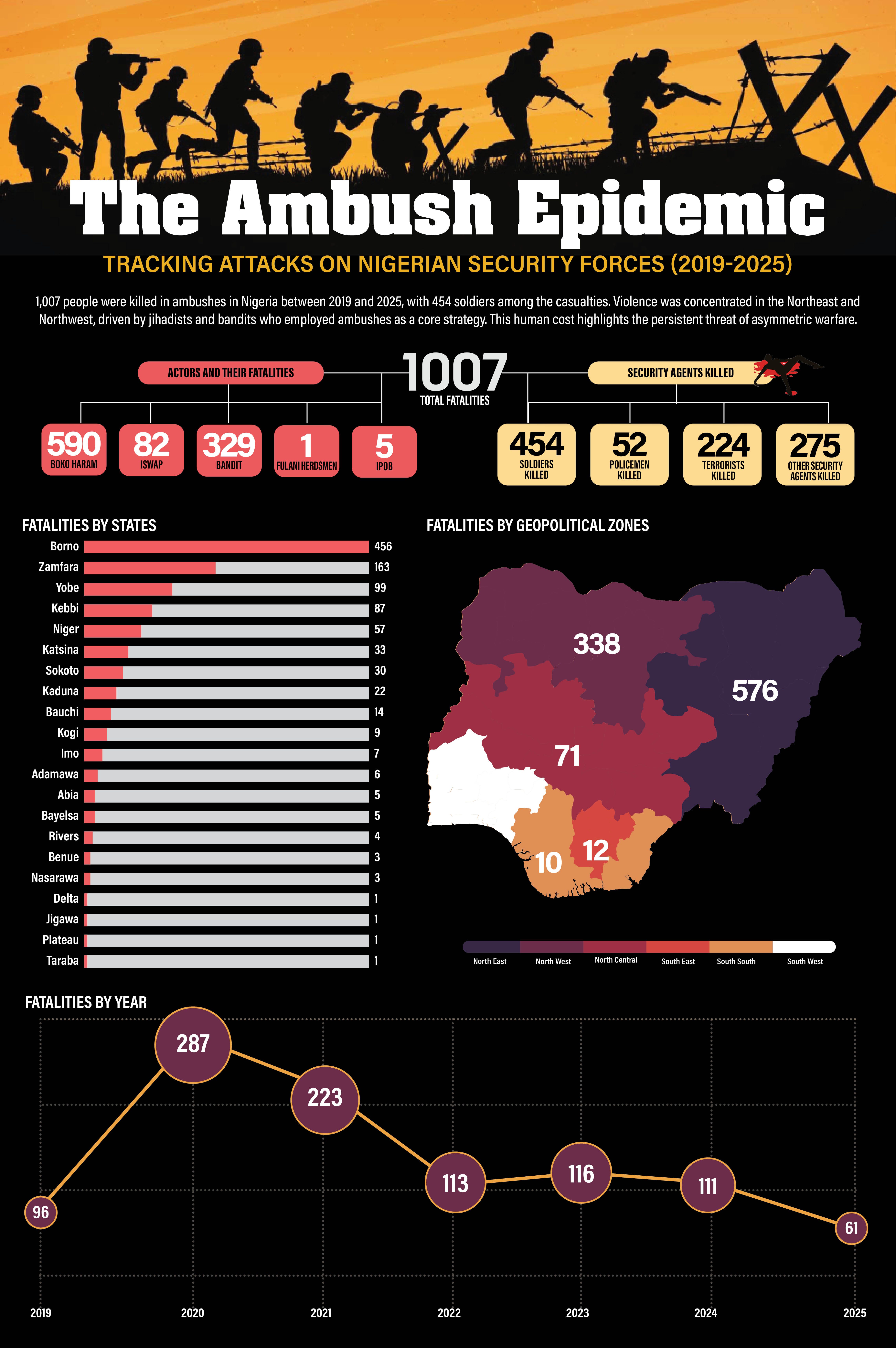
Nigeria’s deepening security crisis, evidenced by the wave of attacks stretching from Borno to Kebbi and Kwara, has decisively outpaced both government strategy and political will. As we discussed last week, while security officials hail the infighting between Boko Haram and ISWAP as “good news,” it primarily underscores the complete collapse of governance in territories where non-state actors are free to wage war without state interference. Large territories across northern Nigeria remain effectively ungoverned, and this was brutally illustrated in the execution of Brigadier General Muhammed Uba, commander of the 25 Task Force Brigade, which serves as the clearest indicator of this security breakdown.
General Uba is the highest-ranking officer killed in the 16-year insurgency. The sophistication of the ambush carried out by the Islamic State West Africa Province (ISWAP), which involved tracking, capturing, and publicly executing a senior commander, signals a troubling leap in the group’s tactical and intelligence capabilities.
This is not an isolated failure; it mirrors a consistent pattern, including the killings of Colonel Dahiru Bako in 2020 and Brigadier General Dzarma Zirkusu in 2021. Critically, ISWAP struck so decisively barely days after losing hundreds of fighters in a brutal clash with the Boko Haram JAS faction. This raises serious questions about the military’s strategy of “exploiting jihadist infighting.” Rather than weakening ISWAP, the chaos appears to have fuelled a retaliatory attack that has gravely damaged the military’s morale and optics. General Uba’s killing will inevitably become a recruitment tool across the Sahel, further boosting ISWAP’s legitimacy within extremist circles.
The Kebbi school abduction exposes an even more disturbing reality: the failure was not due to a lack of intelligence, but was a case of sabotage. Despite clear, credible warnings from the Department of State Services, security forces deployed to the school withdrew less than an hour before the attackers arrived.
This mirrors the tragic pattern seen during the mass abductions of 2020–2022 in Yauri, Kankara, Kagara, Jangebe, and Tegina, which only subsided when schools adopted stringent security protocols led by the NSCDC. The reemergence of mass school kidnappings is not because Nigeria lacks a security architecture; it is because key actors within it are actively undermining it. Unpunished failures, from the Yelewata massacre to similar lapses, have hardened into an institutional culture where wrongdoing carries no consequence.
Elsewhere, the killing at a church in Kwara fits into a documented escalation of targeted attacks on Christian communities across the Northcentral. Even more concerning, this attack occurred as international attention towards the plight of Christians in Nigeria’s Middle Belt intensifies. This development narrows the government’s room to manoeuvre in diplomacy and exposes the state to heightened external scrutiny.
Taken together, these incidents are not random. They signal a country where the state’s monopoly on violence is rapidly evaporating, intelligence is routinely ignored or weaponised, and political leaders remain unwilling to confront the institutional rot undermining national security. Until accountability becomes non-negotiable and strategy shifts from reactive firefighting to structural reform, Nigeria will continue to be outmanoeuvred by the very groups it claims to be defeating. This is no longer a regional problem; it is an existential one.