
Oil party
Nigeria’s oil production increased by 6.73 million barrels to 36.7 million barrels in May 2023, leading to a cumulative revenue of about…

Nigeria’s oil production increased by 6.73 million barrels to 36.7 million barrels in May 2023, leading to a cumulative revenue of about ₦1.27 trillion in the month under review, data from the latest Monthly Oil Market Report of the Organisation of Petroleum Exporting Countries for June 2023 revealed. In a related development, President Bola Ahmed Tinubu’s Policy Advisory Council has proposed that the Nigeria Customs Service (NCS), Nigeria Maritime Administration and Safety Agency (NIMASA), and Federal Inland Revenue Service (FIRS) be merged into the Nigerian Revenue Service, to enable the efficient collection of all direct and indirect taxes and government levies.
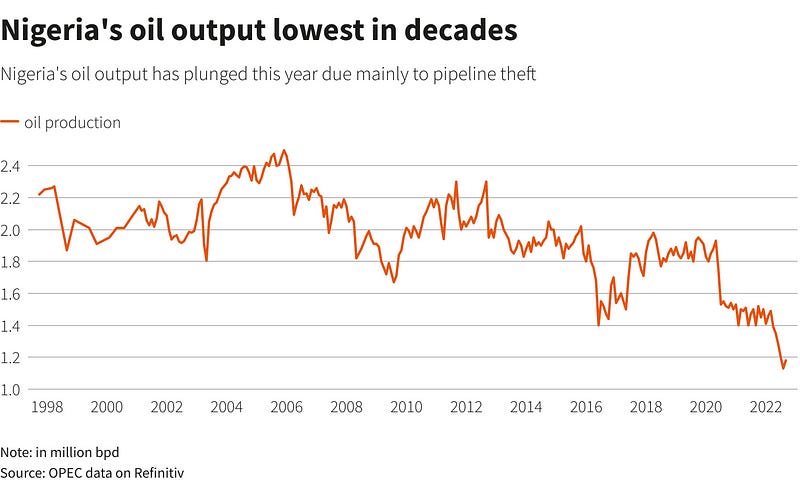
It is encouraging that Nigeria pumped almost 200,000 more barrels per day (bpd) in May than in April. The hope is that it begins a trend that takes Nigeria’s oil production as close as possible to its all-time peak of 2.2 million bpd in 2005. But let us consider the dimmer reality. May’s numbers largely rest on the back of the resolution of the industrial action by Exxon Mobil staffers over the size of their severance pay from the potential sale of the firm’s onshore and shallow water assets to Seplat. Effectively managing the ongoing divestment of Nigeria’s onshore assets to local investors will be one of the biggest headaches for Mr Tinubu’s economic team. They have not gotten off to a good start by setting a stratospheric production target of reaching four million bpd by ramping up modular refining–a goal that ignores the OPEC factor and structural changes in the global oil market. To put it plainly, save Nigeria leaves OPEC, finds ready buyers and is ready to deal with the economic shocks of suddenly becoming one of the world’s energy reserve producers (The Americans and Saudis have a ton of not-so-good experience being in that position), it is a pipe-dream. Notwithstanding the above, the daily oil production rise bodes well for the country as it rummages towards fiscal sustainability. President Tinubu’s initial moves have largely had analysts singing business-positive vibes. After eight years of ‘Buharinomics,’ the new administration has mostly held its own. Now comes the hard work of jumpstarting revenues. Crude oil production was a serious challenge during the latter years of the Buhari administration following widespread oil theft, vandalism and failure to invest in infrastructure. Taxation was a problem as early initiatives to deepen and broaden the tax pool were not sustained. It is in that context that the merger of revenue-generating agencies sits. Both the Customs Service and the Federal Inland Revenue Service are important sources of revenue, and a merger would enhance accountability, cut bloat, and (hopefully) keep the Customs Service more focused on its role as a trade facilitator, which it has ignored in favour of ‘generating’ revenue regardless of the cost on the economy or the quality of Nigeria’s export and import processes. The Orasanye Report–now in its 11th year of non-implementation–recommended some of these mergers. The new administration must implement some of these initiatives quickly before business returns to normal as it usually does in Nigeria.