
Oil theft
The Nigerian Maritime Administration and Safety Agency (NIMASA) has said that an oil rig that capsized on 15 August at Ovhor in Warri…

The Nigerian Maritime Administration and Safety Agency (NIMASA) has said that an oil rig that capsized on 15 August at Ovhor in Warri, Delta State, had been operating on the country’s waters illegally since 2016. NIMASA spokesman, Edward Osagie, said the Majestic Rig belonging to Depthwize Nigeria Limited lacked regulatory approvals. Meanwhile, the Nigeria Extractive Industries Transparency Initiative (NEITI) reported a ₦16.25 trillion loss due to crude oil theft and asset sabotage from 2009–2020, involving 619.7 million barrels. NEITI’s Executive Secretary, Ogbonnaya Orji, also revealed that ₦13.7 trillion was spent on subsidies between 2005 and 2021.
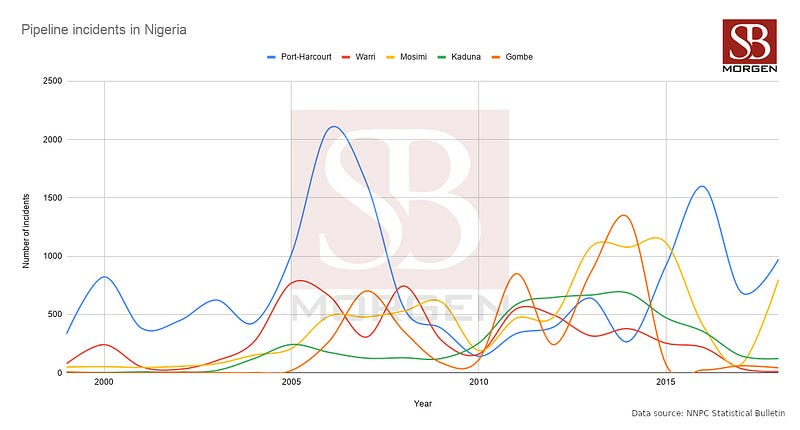
Two major pipelines carry Bonny Light for export: the Trans Niger Oil Pipeline and the Nembe Creek Trunk Line. No evidence suggests that the Trans Niger pipeline has been completely overhauled and re-laid since its construction in 1965. Even after the same pipeline was responsible for two massive leaks and explosions in 2008 that cost Shell image damage and liability reparation, the pipeline has continued to rupture and leak oil. Shell consistently asserts that saboteurs primarily cause pipeline vandalism in Nigeria. While they occasionally admit to ruptures resulting from ageing, such as the 2008 incident, the question arises: Why have measures not been taken to lay pipelines that would prevent vandalism? As proven by research into oil theft in the Delta, there are low and high-pressure points in these pipelines. Only when the pressure is at a certain level can it be punctured and tapped. When there is a rupture, the solution is to clamp or patch the puncture. The Nembe Trunkline, which is just 13 years old, has leaked so often that force majeure has been declared on the oil supply through the line several times. Shell also manages this pipeline. The war on theft needs a financial commitment that includes overhauling old pipelines like the Trans Niger and modernising pipeline transportation for oil and gas in Nigeria. So, the question arises: Who will provide the funding when international oil companies are eager to exit the country and the NNPC has a history of misusing funds and prioritising poorly? Events like this are an indictment on the NIMASA and its sister agencies, especially the Nigerian Navy, that unregistered vessels are not only operating in the country’s waters without detection but are contributing heavily to the country’s economic insecurity. The most obvious testament to that receding state capacity came between 2021 and 2022 when the Buhari Administration appointed Tantita Security Services to protect oil pipelines from theft. Two weeks ago, it was involved in a war of words with the Nigerian Navy when it derailed the MT Praisel Vessel with naval officers on board on suspicion of oil theft. So far, even though it appears like the several agencies charged with mitigating oil theft are “working,” the excitement over turf wars remains, largely due to the agencies operating in silos. As is usually the case in Nigeria, stakeholders issue standard denials once there is a disaster. Seplat, which operates the oil block on behalf of the NNPC/SEPLAT Joint Venture, has denied ownership of the rig, pointing out that Depthwize Nigeria Limited, a contractor, owns the rig. It is shocking for NIMASA to state that the rig has been operating illegally for seven years while it has the power to shut the rig down. Announcements that a capsized boat or detained vessel has been operating illegally for years are hardly the gotcha moment that government officials would like to believe they are because such announcements expose the state’s limited capacity to enforce its own laws and secure its territory. This entire sequence of events suggests that there is complicity on the part of both NIMASA and the Nigerian Navy. These agencies are responsible for regulating and enforcing the law in the maritime sector, and their failure to do this with oil rigs that are taller than five-storey buildings and sited on open waters cannot be ascribed to mere incompetence. This is a case of regulatory failure, and it should be addressed with the prosecution of this case and a wholesale audit of the regulatory regime responsible for this failure. There should be oversight from independent agencies to counter the complicity that is costing the country trillions of naira. Improved oversight would not be a panacea, but it will show if the government is serious about protecting Nigeria’s oil and gas resources. Sadly, as is usually the case, it is unlikely that anyone would be punished for the gaps noted, and business will continue as usual.