
Oil without borders
Nigeria’s palm oil imports from Malaysia, a top global producer, have surged by 353 percent in the first four months of 2023 despite local…

Nigeria’s palm oil imports from Malaysia, a top global producer, have surged by 353 percent in the first four months of 2023 despite local players ramping up production, data from the Malaysian Palm Oil Council shows. The country’s palm oil import from Malaysia increased to 92,961 metric tons (MT) between January-April 2023, from 20,513 MT in the corresponding period of 2022, indicating a 72,448 MT increase. Experts have said that despite the government’s moves to restrict forex for crude palm oil, oil palm imports are still on the rise due to the demand-supply gap.
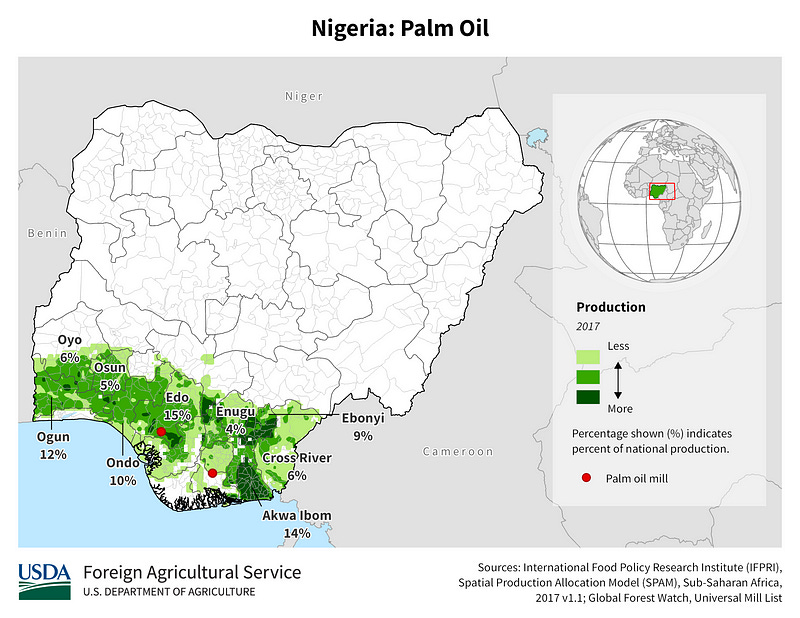
Nigeria’s palm oil industry story is a sad tale. Before the discovery of crude oil in commercial quantities in Nigeria, palm oil was a major agricultural export crop and a top foreign exchange earner for the country well into the 1950s and 1960s. Then, Nigeria was the largest palm oil producer in the world, and there are debates about whether Indonesia and Malaysia imported their first oil palm seedlings from Nigeria in the 1960s (the oil palm tree is endemic to West Africa). According to the United Nations Food and Agriculture Organisation (FAO), Nigeria had an estimated 12.2 million productive oil palm trees in 1980. Data from the United States Department of Agriculture estimates that in 2019, Indonesia produced 42.5 million tons, 58% of global production, while 19 million tons came from Malaysia — 26% of the global supply. Other major palm oil producers include Thailand, Colombia and Nigeria, though all three produced less than three million tons that year. Currently, Nigeria is the largest consumer of the product in Africa, consuming approximately 2.5 million metric tonnes yearly. In comparison, domestic production is less than 1.3 million metric tonnes, leaving a deficit of more than 1.2 million metric tonnes, according to the president of the National Palm Oil Produce Association of Nigeria (NPPAN), costing $600 million yearly. On the one hand, the aggressive production in Indonesia and Malaysia has caused the devastation of forested areas. On the other hand, Nigeria’s production is significantly underwhelming, rising from 530,000 tons in 1960 to just 1.3 million metric tonnes in 2020, a growth of only 145% in 60 years. The shortfall in local supply is being met with importation from Malaysia, which is unfortunate because Nigeria accounted for 48% of palm oil sold globally as of 1973, with an average planting population of 143 trees per hectare. But 75% of the oil palm trees in Nigeria are dead or non-producing trees, leading to a $10 billion annual loss in revenue. By 2023, this number had fallen to 8.4 million productive trees. In 1980, Nigeria consumed 900,000 metric tonnes of palm oil; in 2020, consumption had risen to 1.8 million metric tonnes. When the Nigerian government focused on banning the import of essential items or restricting access to foreign exchange for their imports, they used this as a cover for failing to tackle the real problems. However, economic realities rarely respect government fiat, and banning or restricting items does not remove the economic realities of demand and supply. The only impact such a move will have is ultimately raising the price of the import of palm oil and the products it serves as an input for, increasing already debilitating inflation. Noteworthily, tapping the palm wine Nigerians love might affect oil palm production in many ways. Palmwine tapping can cause damage and diseases to the trees leading to reduced yield because the trees are diverting their energy towards producing wine rather than producing oil. As efforts are underway to increase the rate of oil palm production, it is crucial to check the tapping of palm wine to keep the trees productive. We believe that Nigeria’s initial focus should be on getting items cheaply to Nigerians, irrespective of where the items are sourced from, especially when such items feed into essentials like food, hygiene, industry, and medicine like palm oil does.