
Oily target
The Nigerian National Petroleum Corporation (NNPC) Limited announced an increase in oil production to 1.8 million barrels per day, with a…

The Nigerian National Petroleum Corporation (NNPC) Limited announced an increase in oil production to 1.8 million barrels per day, with a target of 2 million by year-end, a significant growth from October’s OPEC-estimated 1.3 million barrels per day attributed to collaborative efforts with joint venture operators, production-sharing partners, security agencies, and government efforts. Meanwhile, the NNPC has said one of its subsidiaries, NNPC Gas Marketing Limited, has agreed to supply 100 million standard cubic feet of gas daily to Dangote’s $20 billion refinery for 10 years, supporting power generation and feedstock needs while billionaire Aliko Dangote is raising funds to step up production at his refinery.
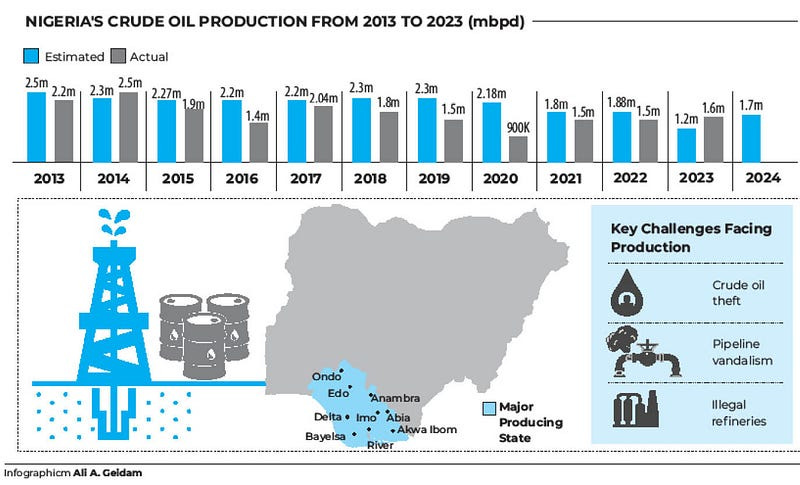
As a member of OPEC, Nigeria operates under certain rules. One of these is the “declaration of cooperation,” where member countries and partners agree to coordinate supply to stabilise the market — especially after oil prices famously plunged into negative territory during the 2020 COVID lockdown. Each member’s production quota is decided during OPEC meetings in Vienna. At the June 2024 meeting, Nigeria was assigned a quota of 1.5 million barrels per day from January to December 2025. For years, crude oil theft and pipeline vandalism have made it nearly impossible for Nigeria to meet its quotas, with production dropping to below one million barrels per day at one point in 2022. This led the NNPC to declare an emergency. But recently, the NNPC announced a production boost to 1.8 million barrels per day, translating to 1.55 million barrels excluding condensates. This marks the first time Nigeria has hit its OPEC target in about four years. The increase even exceeds the quota by 50,000 barrels. However, the NNPC has not clarified when exactly this production surge occurred. OPEC’s records show Nigeria’s output averaged 1.32 million barrels per day in September 2024, which was lower than in August. So, there’s some uncertainty about these figures. Meeting the OPEC quota might work in Nigeria’s favour during negotiations for quota allocation since it serves as a basis for negotiating a higher quota for Nigeria. On the other hand, it can be argued that Nigeria is not violating its OPEC quota and that the oversupply is strictly meant for local refiners. Several Nigerians equate higher crude oil production to a better standard of living for citizens. While this is partly true, years of recording production numbers as high as 2.5 million barrels per day teach us that more money does not equate to a higher standard of living, especially if corruption and mismanagement of resources prevail. The inability of previous governments to invest the oil wealth in infrastructure and the development of other sectors means that Nigeria is still vulnerable to the volatility of the crude oil market. While the Tinubu administration deserves some credit for working to free Nigeria from the stronghold of oil thieves, which gives Nigeria more room to settle its crude-backed debt, more must be done to ensure that citizens enjoy the returns of the commonwealth. It is also not time to fund frivolous projects and foreign trips with the revenue realised. On its part, the NNPC can no longer afford to continue its opaque practices. A name change and launch of more crude oil blends like Nembe and Utapate are not the only things Nigeria needs. The era of waste must end, and the NNPC must be transparent about its dealings. The Dangote Refinery adds a layer of complexity to Nigeria’s oil sector narrative. Despite its commissioning in 2023, the project has faced delays, cost overruns, and operational hurdles. Initially planned for Ondo State, the refinery relocated to Lagos due to a lack of cooperation from the state. The move, though strategic, drove up costs and necessitated renegotiations with stakeholders. The construction, which began in 2016, was delayed by three years, with costs soaring from $9 billion to $19 billion, driven by supply chain disruptions, scope changes, and the COVID-19 pandemic playing a significant role in these setbacks. Financial arrangements also shifted, with the NNPC reducing its initially planned 20% stake to 7.2%, reflecting funding constraints and concerns about the project’s viability. Operational challenges have been equally daunting, particularly securing a steady crude oil supply. Despite Nigeria being a leading oil producer, the refinery cannot rely on domestic crude and has had to source from international markets, putting further strain on Nigeria’s foreign exchange reserves. Prolonged delays in securing long-term supply contracts have resulted in paying higher spot rates, adding financial pressure. Regulatory and market resistance have also complicated matters. Concerns about market control, product quality, and pricing have strained relationships with the NNPC, the Nigerian Upstream Petroleum Regulatory Commission (NUPRC), and major marketers. Accusations of monopolistic tendencies and complaints about high costs further threaten the refinery’s competitive edge. However, there is a glimmer of hope. The refinery seems to be pivoting toward leveraging Nigeria’s abundant gas resources to mitigate past missteps with crude oil supply. This strategy offers a chance to capture a significant market share, particularly as Nigeria’s natural gas reserves remain underutilised. Nonetheless, the prospects of higher crude oil production in Nigeria mean that the prospects of getting crude oil from the NNPC are higher. In the meantime, Aliko Dangote might have to give up his dream of being Nigeria’s sole petrol supplier and take advantage of Nigeria’s location to other countries in the sub-Sahara African region; the politics of the oil industry is simply too intense.