
On a cocoa shopping spree
Côte d'Ivoire launches a costly cocoa buyback to support farmers amid plummeting prices and a devastating disease threatening future global supplies.

Côte d'Ivoire has launched an emergency cocoa buyback programme as mounting stockpiles, falling global prices, and a worsening crop disease converge to strain the world’s largest cocoa sector. The Coffee and Cocoa Council (CCC) said it would purchase up to 100,000 tonnes of beans by the end of March at the government-set price, after liquidity shortages and delays at the port of Abidjan disrupted payments to farmers. The scheme is expected to cost about 280 billion CFA francs ($460 million), with beans stored temporarily and exported when market conditions improve. The intervention comes as swollen shoot disease poses a growing structural threat to output. A study by non-profit Enveritas found that more than 41% of surveyed cocoa farms were infected in the 2024/25 season, putting roughly 15% of the national supply at risk. The virus, spread by mealybugs, reduces yields sharply and kills trees within a decade. While prices have eased after last year’s surge, analysts warn that disease-driven losses could keep global supply tight and prolong volatility.
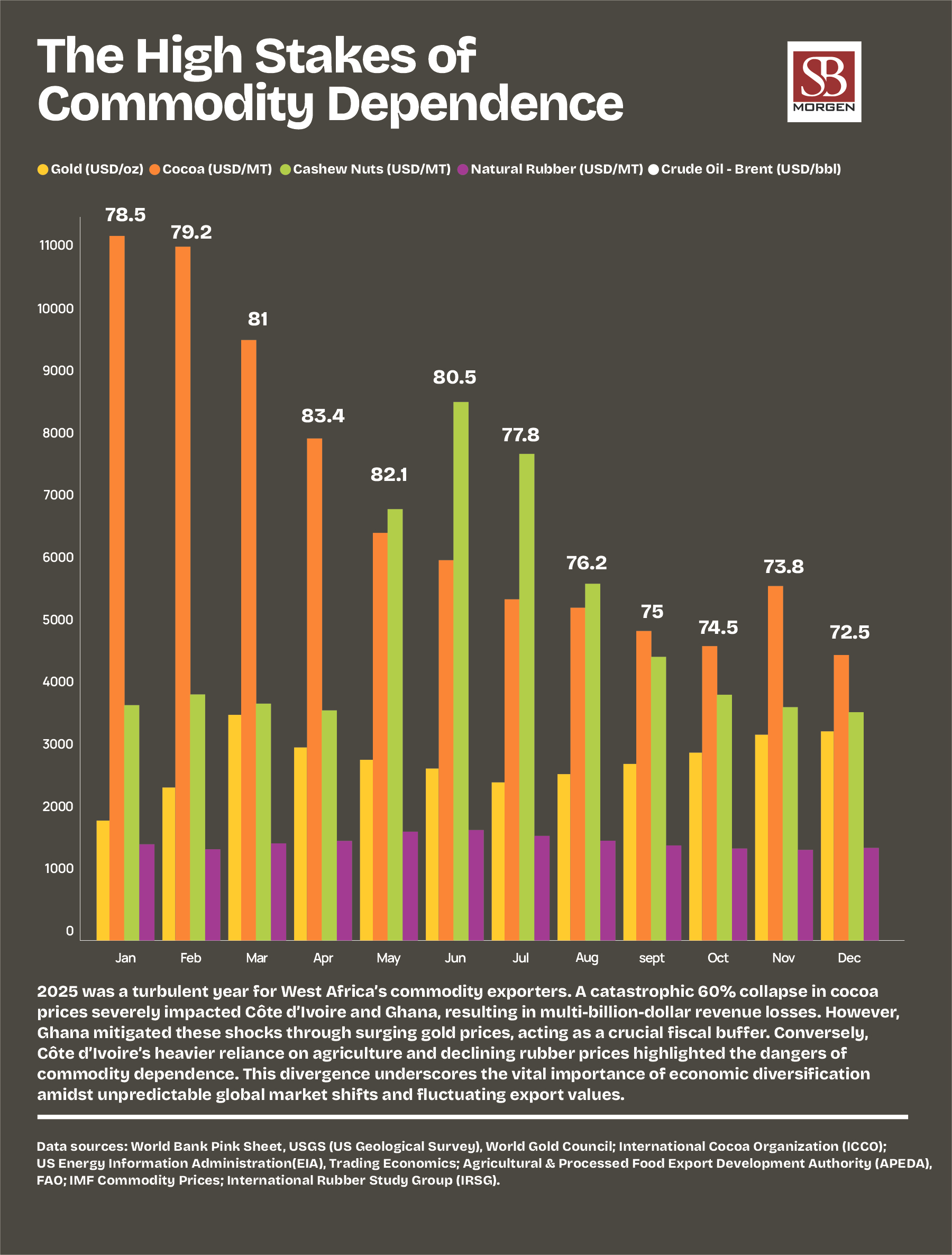
Côte d’Ivoire is stepping deeper into the cocoa market in a bid to prevent what officials fear could become a social and economic crisis. The planned buyback of up to 100,000 tonnes of cocoa beans by March 2026, at an estimated cost of 280 billion CFA francs, represents a forceful state intervention aimed at stabilising farmer incomes, restoring liquidity, and preventing a disorderly breakdown in the country’s most politically sensitive sector. For an economy that produces about 40 to 45 percent of the global cocoa supply, this is not simply commodity management. It is a macroeconomic and social stabilisation measure.
The move follows a sharp mismatch between administered pricing and market realities. In October, the Coffee and Cocoa Council set the farmgate price at a record level, even as global cocoa futures fell. The intention was to protect farmers from volatility. The outcome was the opposite. Buyers pulled back, demand weakened, and large volumes of cocoa accumulated unsold at ports and in rural warehouses. Payment delays across the supply chain are raising concerns about cash-flow stress, rising defaults among cooperatives, and the risk of unrest in cocoa-producing regions, where household incomes depend almost entirely on timely bean sales.
By stepping in as a buyer of last resort, the CCC is attempting to put a floor under prices and confidence in the marketing system. In effect, the Ivory Coast is acting as a price stabiliser in global cocoa markets. The logic is political as much as economic. A prolonged collapse in farm incomes would weaken rural consumption, increase poverty, and create fiscal pressures for the state. The buyback is therefore designed to break a negative feedback loop before it spills into broader social instability.
However, the limits of this approach are structural. Cocoa is a biological commodity with limited storage life and deep agronomic vulnerabilities. Unsold beans deteriorate quickly, reducing quality and effective supply. More importantly, the current surplus masks a more serious medium-term risk. Disease pressure is rising. The swollen shoot virus, spread by mealybugs, is advancing across cocoa farms. Field data from the 2024/25 season suggests that more than 40 percent of surveyed farms show signs of infection. The disease sharply reduces yields and kills trees within a decade, forcing farmers to replant or abandon the land.
This creates a paradox at the centre of the cocoa economy. In the short term, Côte d’Ivoire is managing excess supply and falling prices. In the medium to long term, it faces the prospect of structurally lower output driven by ageing trees, disease, and climate stress. Market interventions can stabilise prices temporarily, but they do not address the biological constraints that are steadily eroding productive capacity. Without large-scale replanting programmes, disease surveillance, and incentives to remove infected trees, buybacks risk becoming a holding action rather than a solution.
Ghana’s experience highlights the regional nature of the problem. As the world’s second-largest cocoa producer, it operates a similar marketing system and is facing comparable pressures. Purchases have slowed; around 150,000 tonnes remain with farmers, and uncertainty has contributed to short-term price volatility. Together, these dynamics explain why global cocoa markets are now characterised by short-term gluts alongside long-term scarcity.
For global manufacturers, the adjustment is already underway. Chocolate producers are reformulating products, reducing cocoa content, and shrinking pack sizes to protect margins. These moves reflect a value chain that no longer expects price cycles to resolve smoothly. Supply uncertainty has become structural.
For Côte d’Ivoire, the stakes are particularly high. Cocoa exports underpin foreign exchange earnings, rural employment, and fiscal stability. Yet repeated market interventions carry risks. Large buybacks tie up public funds, expose the state to price movements, and may discourage private buyers if the expectation grows that the government will always absorb excess supply. The challenge is balance. Short-term stabilisation is necessary to prevent social disruption, but it must be paired with long-term reform.
That reform must focus on disease control, accelerated replanting, and pricing mechanisms that more evenly share risk among farmers, buyers, and the state. Without this shift, Côte d’Ivoire risks managing volatility rather than reducing it. In that sense, the buyback programme is best seen as a bridge. It buys time in a market where the next shock is more likely to come from the trees than from the trading floor.