
On tenterhooks
The Kaduna State Government has lifted the 6 pm to 8 am curfew imposed on Kaduna and Zaria after violent #EndBadGovernance protests…

The Kaduna State Government has lifted the 6 pm to 8 am curfew imposed on Kaduna and Zaria after violent #EndBadGovernance protests. Meanwhile, terrorists loyal to Bello Kaura, a notorious bandit leader in Zamfara State, have killed several miners. Kaura’s group clashed with another faction led by Halilu Sububu, an infamous terrorist who controls mining sites in Bagega and Sunke and has taken over Anka communities, offering protection for gold mining support. Sububu is connected with jihadists in Niger, Mali, Libya, and Burkina Faso. He is also involved in weapons trading. The Nigerian military has declared him wanted for terrorism.
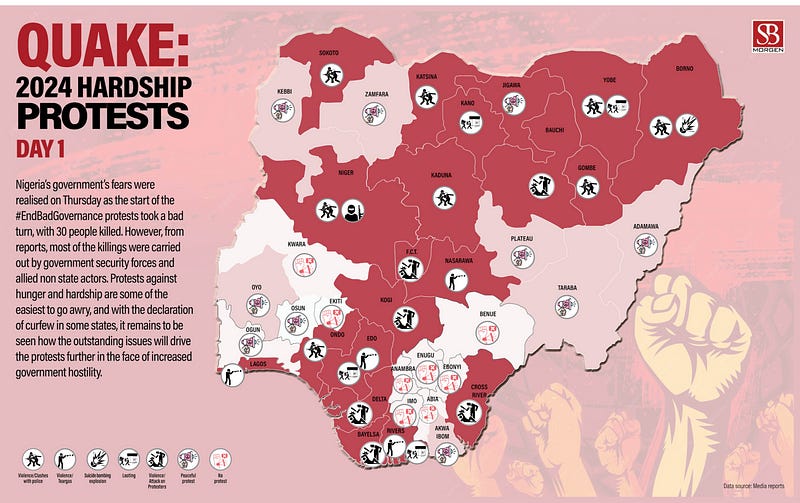
The curfew imposed on cities with the most protest activity was intended to curtail violence, but in reality, it had little effect, as it failed to stop protesters from leaving their homes. The protests only began to fade in the days leading up to 10 August, which was declared the terminal date for the #EndBadGovernance protests. Curfews and states of emergency are theoretically last-ditch efforts by governments to stop widespread unrest. But, in Nigeria, they are often the go-to tool after heavy-handed security responses that are usually disproportionate. The underlying issues that fueled the protests — high energy costs, soaring inflation, and worsening security — have not been decisively addressed, making a return to street-level demonstrations likely shortly. The recent killing of miners in Zamfara highlights the severe dangers of doing business in the region. Zamfara, rich in gold, has become a battleground for control over its valuable resources, with bandit warlords and foreign interests, including the Chinese, fueling turf wars and violence. The killings by terrorists loyal to Bello Kaura underscore the security threats plaguing Nigeria’s mining sector. Kaura and his rival, Halilu Sububu, have turned mining sites into battlegrounds, with Sububu even taking over entire communities in Anka to control gold mining. His ties with jihadists and involvement in weapons trading further complicate efforts to secure the region, underscoring the urgent need for a comprehensive approach to address these threats. Communities caught in the crossfire are forced to choose between collaborating with one bandit group, another, or the Nigerian security forces — all equally dangerous options, with non-alignment offering little safety. The presence of powerful non-state actors in mining areas disrupts operations, undermines state authority, and endangers lives. This instability deters investment, reduces mining output, and perpetuates poverty. Establishing law and order in mining regions is essential for Nigeria to exploit its mineral wealth and fully drive national development. Without security, the vast potential of Nigeria’s mineral resources will remain untapped, and the country will miss out on crucial economic benefits. A critical approach to combating illegal mining would involve identifying and curbing the influence of powerful political actors operating illegal mines. This top-down strategy will make the Tinubu administration’s plan to create a 2,000-man mining task force under the control of the Minister of Mines and Steel Development more effective. Given the threat posed by groups like those led by Bello Kaura and Halilu Sububu, the security system must be adequately funded and managed to ensure it can operate effectively in these remote and often lawless areas. Such a system would protect mining operations and restore the state’s control over these regions, thereby weakening the grip of terrorist groups and reducing their influence. Involving private sector partners in the funding and oversight of this security framework would bring in the necessary resources and expertise. In contrast, public sector involvement would ensure that security measures are aligned with national laws and human rights standards.