
Onslaughts
In Katsina State, an Air Force operation resulted in the death of 22 terrorists, including foot soldiers of terrorist kingpin Abdulkareem…

In Katsina State, an Air Force operation resulted in the death of 22 terrorists, including foot soldiers of terrorist kingpin Abdulkareem Lawal, popularly known as Abdulkareem Boss, who was accused of masterminding the killing of a Nigerian Police Area Commander in Dutsin-Ma on 5 July 2022. In Plateau State, suspected Fulani militia attacked Kuru Station, Wereng, Gwon, Gwa-Rim and Rinyan communities, leaving three people dead in Wereng community, Riyom Local Council. In Zamfara State, a gang of armed men carried out an attack that claimed the lives of at least 34 individuals, including seven soldiers, on 24 July.
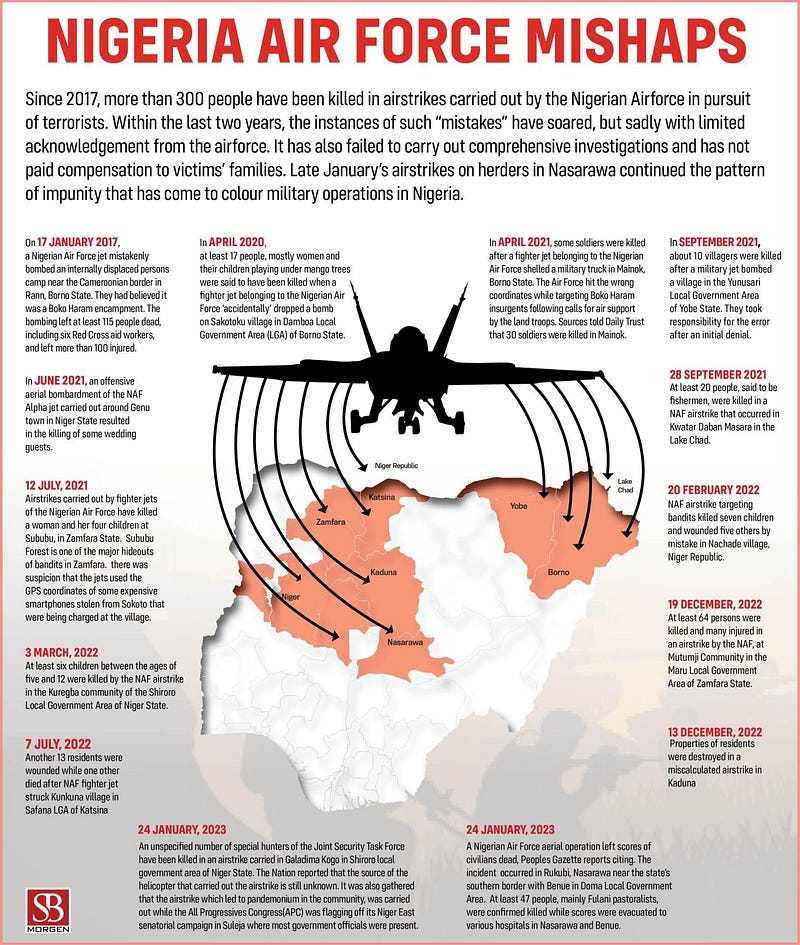
Whenever the story of Nigeria’s security crisis is told, precious little attention is paid to the environmental impact of the crisis, especially on wildlife and the country’s ecology. Dropping airstrikes, especially in forest areas, is a testament to several things, including a dysfunctional security system in which the military is called in more often than not to deal with internal security issues. The frequent use of airpower to achieve quick victories tells the story of the state of the army as one that is squeezed in, lethargic and ideologically focused on personnel preservation. It could also point to the perennial rivalry between the Nigeria Army and the Air Force, which in recent years, have seen the army up its agitation for an air wing. The past five years have shown that airstrikes and military options against banditry are not enough. Like the crisis in the Plateau, Nigeria’s security agencies have mentally moved into the territory of a stalemate with the bandits, which they sometimes use for covert operations. The situation is a little different on the Plateau: despite over two decades of clashes between indigenes and settlers, an accommodation has still not been found. From one perspective, it looks like a failure of several peace initiatives, which have always had the input of inter-faith communities. However, issues of identity, resources and ownership have coloured the crisis, fuelled by the consequences of a weak state whose helplessness in enforcing agreements or even court-based decisions undermines whatever verbal agreements or peace deals the warring parties sign. Army Chief Taoreed Lagbaja’s warnings to Mangu residents against self-defence put the government in a tough position, which it has no business being in, as it does many things, including giving life to the idea that the government’s failure to protect residents is a deliberate nod to their rivals who now engage in actions that could be termed ethnic cleansing in their nature. While some might assert that the news of the airstrikes in Katsina State shows that the military is committed to combating terrorism, we opine that to tackle the insecurity bug effectively, greater emphasis must be placed on addressing the underlying factors that fuel terrorism, such as poverty and limited opportunities. It is rather disappointing to see that there has yet to be significant progress made in solving the enduring conflict between farmers and herders in Plateau State, which has been escalating over the years and demands immediate attention. We suspect that ethnic preferences restrain the security agencies and the government, so the government must take strong institutional steps to resolve the issue and clarify that it is not guided by bias. Additionally, the government should prioritise enhancing security in regions like Zamfara State, where lawlessness prevails. With concerted efforts from the government, demands for state police must be met to tackle the root causes of violence and safeguard its citizens from harm.