
Osun’s bold step
Osun has officially cancelled right-of-way fees, allowing telecom companies and internet providers to lay fibre optic cables for free…

Osun has officially cancelled right-of-way fees, allowing telecom companies and internet providers to lay fibre optic cables for free. Governor Ademola Adeleke said the cancellation is part of a digital economy policy that will improve broadband penetration. According to the National Bureau of Statistics, there were 3.5 million active internet subscriptions in the state in Q1 2021. Osun will sign a Memorandum of Understanding with Oodua Infraco to immediately deploy fibre optics across the state, with the first phase covering 64 kilometres. It is also poised to be the first state to domesticate the Nigerian Startup Act.
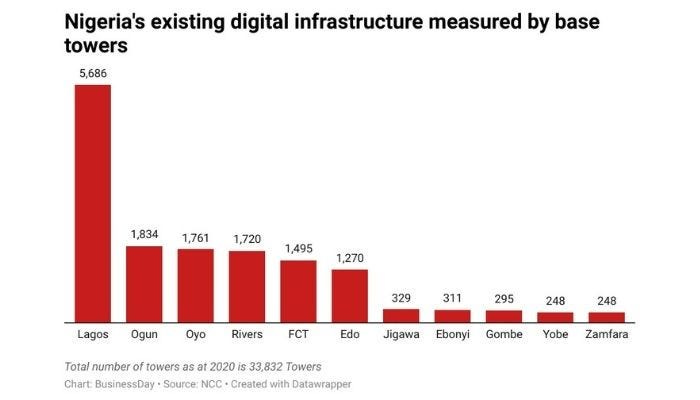
Osun is betting on the digital economy as an outlet and opportunity for its youthful population, which boasts 3.5 million active internet subscriptions. While removing right-of-way costs might not translate to cheaper data fees for locals, it should amount to increased coverage that public and private sectors in Osun would hopefully use to build up the state’s digital economy. Back in 2020, in response to some states increasing right-of-way fees to between ₦3,000 and ₦6,000 per linear metre, the National Economic Council, chaired by Vice President Yemi Osinbajo, resolved that telecom operators were to pay ₦145 per linear metre to lay fibre cable anywhere in the country. Unfortunately, the National Economic Council does not have powers of enforcement, so the charges are at the discretion of each state government. Ultimately, this move is crucial, not because of the state involved but because of the signal it provides. In a 2021 SBM Intelligence study, stakeholders identified the right-of-way issue as one of the limiting factors for broadband penetration in states. While some states have stubbornly insisted on this upfront revenue, others are beginning to see the wisdom in the long-term revenue that the broadband improvements can bring. Osun’s initiative is, therefore, commendable in this regard. However, in Osun’s case, it is unlikely that investors will move in until the court resolves the legal uncertainty around the occupant of the governor’s office. Nonetheless, it is a good step in the right direction.