
Pandemonium
Fierce clashes between Boko Haram and ISWAP militants near Marte, Borno State, have reportedly led to over 100 terrorist casualties. The…

Fierce clashes between Boko Haram and ISWAP militants near Marte, Borno State, have reportedly led to over 100 terrorist casualties. The conflict centred around turf control in the Lake Chad Basin, involving the Bakoura Buduma-led faction of Boko Haram and ISWAP. ISWAP’s retaliation for the abduction of its fighters and commanders by Boko Haram further escalated tensions. In another incident, clashes between rival militia groups in Benue State’s Ukum LGA resulted in eight deaths and widespread violence in Chiro and Gbeji villages. Nigeria’s Security and Civil Defence Corps confirmed the incident and initiated a search-and-rescue operation to address the situation.
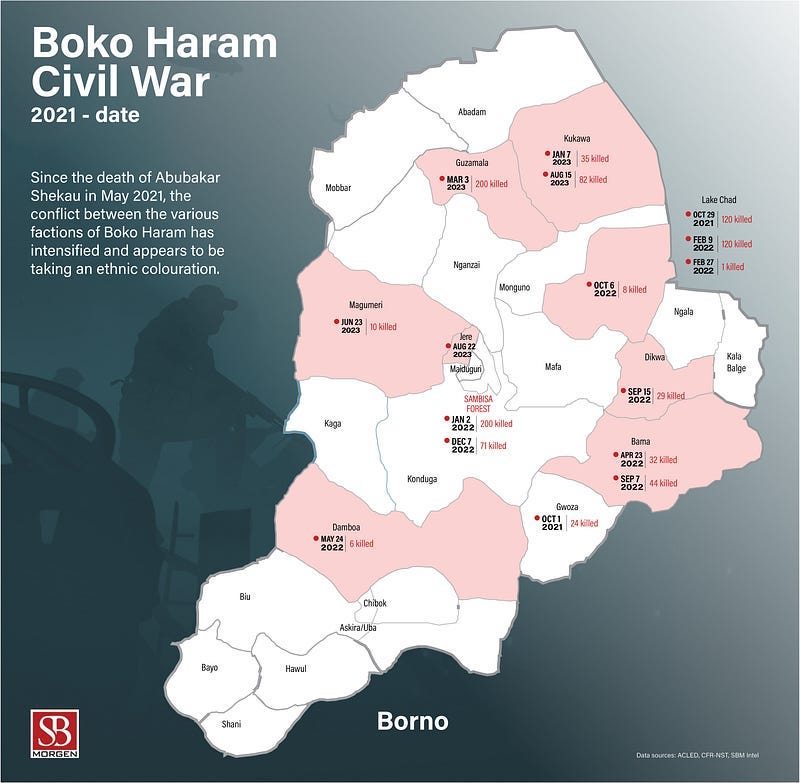
When longtime Jama’atu Ahlis Sunna Lidda’adati wal-Jihad (JAS) leader Abubakar Shekau was killed, SBM projected that his group would experience tougher times, especially with an ISWAP ascendancy — this has happened. The Mandara Mountains and Southern Borno communities that were JAS’ base have been occupied by ISWAP due to pressure from the Nigerian military in Lake Chad and the need for resources. Also, internal instability has blunted the group’s effectiveness. Before the latest clash, 82 JAS fighters were killed in a clash resulting from the killing of seven Boko Haram fighters from the Buduma ethnic group. The slain fighters were executed by their commander in Bukkwaram Island after their failed attempt to surrender to the Nigerian military. Following this, an ethnic crisis broke out among fighters from four ethnic groups — Hausa, Fulani, Kanuri and Buduma. Some Buduma militiamen accused the commander of harsh tactics due to their dwindling numbers. A meeting was called, and commanders of all backgrounds agreed that fighters could leave. However, Baduma Bakura, a Buduma fighter from Niger Republic’s Ali Mandula base, resisted, investigating his brethren’s deaths and threatening those leaving. In the ensuing argument, a Fulani fighter shot Baduma, sparking a clash that resulted in 82 fatalities. This signifies that the ethnic differences that led to the first Boko Haram split in 2012 continue to bog the group. While it could be a testament to one of the government’s strategies to degrade the group, it could also be a window to the obstacles of consolidating Islamist groups. Beyond differences in operational ideologies, African jihadist groups will always face the threat of factionalisation along ethnic lines in a continent where ethnicity ranks supreme over ideology. Ethnic differences were also largely responsible for the clash between the Chiro and Gbeji communities in Benue State. In both clashes, it is remarkable how weapons flowed freely for use by the combatants despite being under the security perimeter of the Nigerian military. If anything, it is, perhaps, the biggest indication that the attention given to stopping illegal arms has fallen short of the desired impact. Moreover, these events are products of large ungoverned spaces in these states, resulting from weak governance, porous borders or remoteness. These spaces can provide a safe haven for terrorist and militia groups by making room for attacks, weapons and new recruits because people who live in these areas may be vulnerable to radicalisation. The problem of ungoverned spaces is particularly acute in Boko Haram-ridden Borno State. The porous borders with Cameroon and Chad have also made it difficult to prevent the movement of terrorists and weapons. The government should strengthen the Nigerian military’s capacity, establish a state police system, improve border security, invest in development projects and promote dialogue and reconciliation with the region’s communities.