
Policy flare
The Federal Government will impose a $49 million fine on onshore oil and gas firms for flaring 24 billion Standard Cubic Feet (SCF) of gas…

The Federal Government will impose a $49 million fine on onshore oil and gas firms for flaring 24 billion Standard Cubic Feet (SCF) of gas, according to the National Oil Spill Detection and Response Agency (NOSDRA). Onshore companies flared 19.14 billion SCF of gas in January and 14.04 billion in February 2023, contributing 1.3 million tonnes of carbon dioxide emission, with a power generation potential of 2,500 gigawatt-hours. Offshore companies flared 25.8 billion SCF of gas, the equivalent of 1.4 million tonnes of carbon dioxide emission, generating 2,600 gigawatts-hours of electricity.
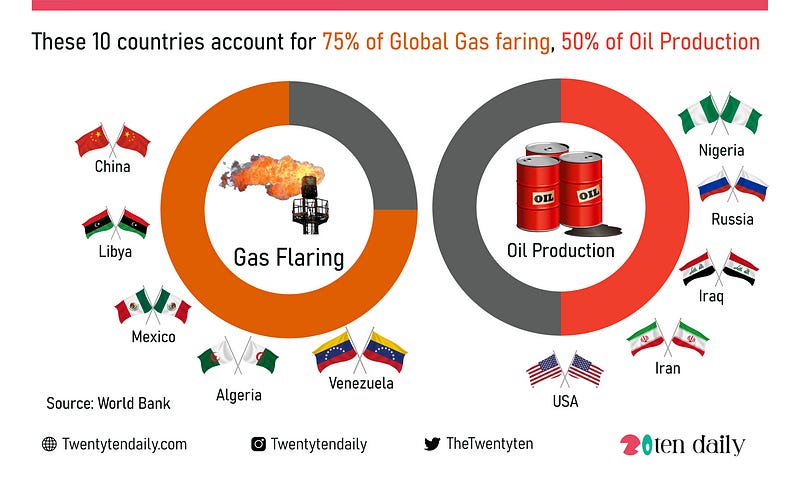
Gas flaring was first declared illegal in Nigeria in 1984. However, the country’s operators treat compliance as a matter of convenience and not necessity. Thus, the World Bank’s 2020 Global Gas Flaring Tracker Report fingered Nigeria amongst a group of seven countries which continue to light up the global map, year after year, for nine years. In the latest episode of this never-ending saga, the Buhari administration adopted a new Gas Flaring Policy in 2017, while it has pledged to end gas burning as a by-product of oil production by 2030 under its latest climate plan submitted to the United Nations. Gas is flared because it is not economically viable to transport it or reduce the pressure on the equipment used in drilling for oil. Nigeria has a gas market with growing demand and is bordered by countries with smaller gas reserves. Despite that, it is viable for Nigerian oil companies in the country to flare more gas than the entire country consumes. Mele Kyari, NNPCL’s Chief Executive Officer, said recently that Nigeria could transport 6.9 billion cubic feet (BCF) of gas daily, nearly equivalent to the country’s average production of over 7 BCF each day. Capacity speaking, Nigeria should be able to sell all the gas it produces within the Nigerian market and the West African region. Realistically speaking, Nigeria’s domestic gas consumption has been slightly above 1 BCF per day in recent times. In 2019, for instance, Nigeria consumed 427.43 BCF of gas or an average of 1.171 BCF daily. Within that same period, the country flared 466 BCF of gas for a daily average of 1.28 BCF. What the NNPC’s flare database reported was a much lower 244 BCF. Since the World Bank-funded Gas Flare Tracker was developed in 2012, the satellite-based operation has compiled higher rates of self-reported flaring, which the NNPC relies on. When the Nigerian government introduced regulation to increase the penalty on gas flaring in 2018, the discrepancy between both datasets grew exponentially. A March 2023 Guardian report found that margin to be 30%. By 2019, the data margin between both sources was 47.64%. A winning argument can be made that the international oil companies (IOCs) and the NNPC have been scamming Nigerians on flare reporting, but they are not solely to blame for flaring in the first place. Market incentives are askew. In 2019, for example, 57.79% of total domestic consumption was supplied to power generation companies at a flat rate of $2.50 per 1,000 standard cubic metres (SCM). According to the Henry Hub Natural Gas CVOL Index, a globally accepted market pricing standard, the going price for natural gas was $2.57. In seven of the 12 months in 2019, the price of an SCM of gas was above the government-fixed rate. In 2021, the Nigerian Labour Congress asked the government to fix the price of gas sold to electricity generation companies at $1.50, citing comments from the Labour and Employment Minister, Chris Ngige, that hinted at its possibility and an announcement from junior Petroleum Minister, Timipre Sylva, that the power generation’s gas component had been slashed to $2.18. For context, the Henry Hub price for that year was $3.91. Assuming this subsidy still holds, Nigerians cannot afford electricity still. The Nigerian Gas Company (NGC) is a legacy creditor to electricity generation companies, and that debt would take a mammoth effort to pay back. The generation companies cannot pay for the gas supplied because they did not receive full payment for the energy sold. The distribution companies cannot make full payment for the electricity it supplies because although they give estimated bills, they have never recouped the full value of the power their customers consume. The federal government said in January this year that Nigerians’ shortfall in electricity tariff owed was ₦2.5 trillion as of 2022. It is not good business practice for the NNPC ― a major shareholder in Nigeria Liquified Natural Gas Limited ― to allow the NGC, one of its subsidiaries, to supply much of the gas generated in its fields to the Nigerian market. The gas cannot be stored indefinitely because failure to remove it puts pressure on oil and gas wells and raises the occupational hazard profile of these mining sites. For the oil companies operating these fields, it is more economical for them to pay the flare penalties than be forced to compete in a market that neither has the infrastructure to process the commodity for export nor adequately fulfil domestic demand. In 2016, as part of its plan to deepen gas consumption and stop gas flaring by 2020, the Nigerian government launched the Gas Flare Commercialisation Programme (GFCP). Four years later, the now defunct Department of Petroleum Resources (DPR) said 200 bidders had expressed interest in the 45 flare sites ― 25.28% of all known locations it had put up for sale to investors who would market the wasted gas. Observations during the four-year hush period show many genuine investors did not like the economics of the flared gas market. Fast forward to 2022, the newly formed Nigeria Upstream Petroleum Regulatory Commission (NUPRC) relaunched the GFCP. In January, it had whittled down interested bidders from 300 to 139. Mischievously, it failed to publish the names of the successful investors and the number of sites it was giving out. While this tug and pull plays out, the reality is that many Nigerians do not have enough disposable income to create a consumption incentive for gas to stop being wasted. Positively, the World Bank’s report did note that Nigeria has reduced topline gas flaring by 70% over the last 15 years. This pace, however, remains too slow and betrays a lack of seriousness on the part of policymakers to fix the problem. Gas flaring is a practice that needs to stop, and as long as it is cheaper for oil companies to flare gas than to make the investments to either process it or dispose of it safely in an environmentally friendly manner, it will continue. The government must ensure that it hastens the implementation of the gas policy and do more to incentivise private sector participants to enter the LPG (cooking gas) space to improve domestic production, as this is the only way to guarantee affordable prices in the long term. The country loses $680 million to gas flaring annually, and the incalculable environmental impact of delayed action is too high for business as usual to persist.