
Powder keg
Dozens of villagers were killed and no fewer than 50 others severely injured after troops of the Nigerian Army mistakenly dropped a bomb on…

Dozens of villagers were killed and no fewer than 50 others severely injured after troops of the Nigerian Army mistakenly dropped a bomb on a group of religious adherents during a Maulud celebration at Tudun Biri, a community within Igabi Local Government Area of Kaduna State. The majority of those injured were children and women. The Kaduna State government, reacting to the incident, affirmed that the Nigerian Army has admitted to mistakenly carrying out the operation, which led to the death of the villagers.
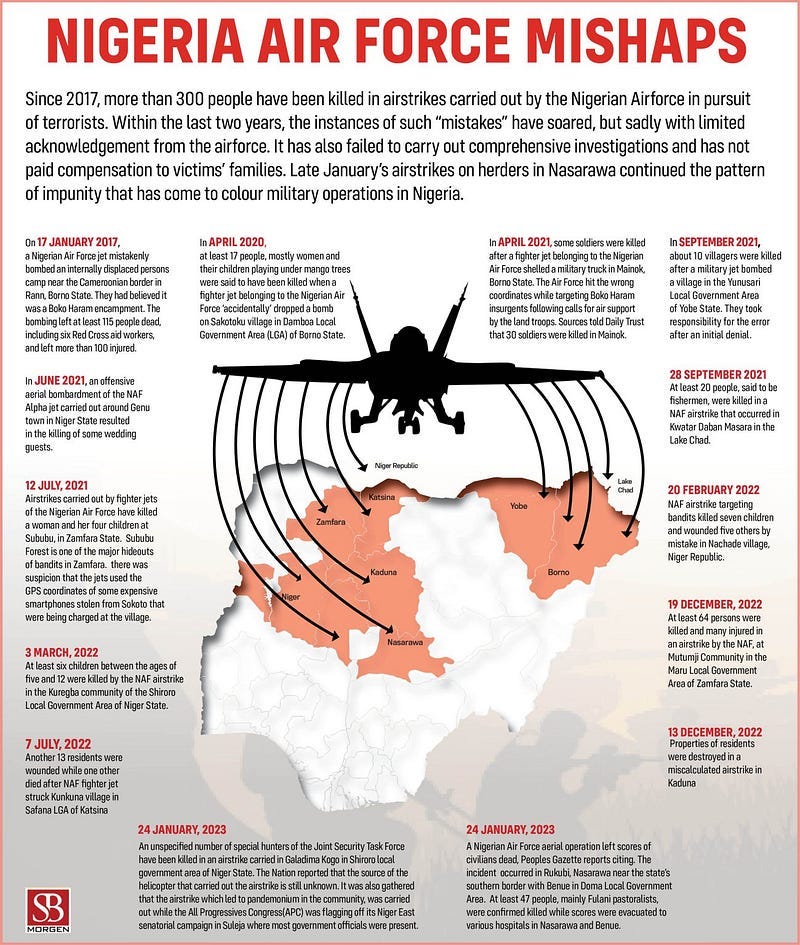
In a sombre incident during a Maulud celebration at Tudun Biri in Kaduna State, the Nigerian Army inadvertently dropped a bomb on a gathering of religious adherents, resulting in dozens of casualties, with children and women among the severely injured. One word that describes this is impunity. In light of the proliferation of multiple security challenges in the country, Nigeria’s security agencies have conducted operations with very minimal regard for rules of engagement, and at several times, carried out actions that border heavily on war crimes without the attendant consequences of ownership and accountability. Sunday’s drone strike in Tudun Biri is the 16th of such aerial mishaps (causing 515 deaths) by the Nigerian military since the Rann Bombing of 2017 in which more than 300 people were killed. Previously, such blunders were solely attributed to the Air Force. However, their disclaimer denying involvement in the Kaduna incident exposed the army’s culpability. The Nigerian Army, which recently established its aviation wing with assistance from the US National Guard, failed to heed the lessons of past operational mishaps that plagued the air force. There are precision intelligence shortcomings in the Nigerian army’s communication channels, which have contributed to flawed decision-making during operations. Clear communication is vital to ensure military actions are directed at legitimate targets. This latest incident would likely have gone unnoticed if not for the Air Force’s denial and the prompt intervention of the Kaduna State government. These airstrikes do not happen in isolation. The Nigerian state has perpetually been at war with itself since at least 2013 when the Boko Haram insurgency forced the military to begin operations in Borno, Adamawa and Yobe. Since then, the insecurity has spread across the country, especially in the North, and following the army’s strategy of preserving manpower and personnel in light of its extensive operational involvement in all 36 states, Nigeria’s skies have increasingly become a battlefield dominated mostly by fighter jets and unmanned aerial vehicles supplied from Turkey. The urgency of the security situation has also ensured a heavy decentralisation of decision-making, leading to faulty intelligence and lack of oversight, contributing to the accidental airstrikes. In 2023 alone, there have been no less than three incidents, and the frequency of such incidents can be directly traced to the institutional dearth of accountability–a problem which manifests in several ways, including through self-inflicted harm, as evidenced by the 2022-friendly fire incident in Borno, where 22 army soldiers died at the hands of the air force. Despite local condemnation and international scrutiny following this latest incident, there is minimal assurance that it will be the last. The absence of accountability will further diminish public trust in the military and government institutions. Transparent investigations and assurances of preventive measures are vital to rebuilding this trust, but it is uncertain that the government will spearhead that. The lack of transparent investigation and corrective measures may perpetuate a sense of insecurity among affected communities and the wider population, contributing to a cycle of fear and mistrust. While we can suggest that the Nigerian government initiates a comprehensive and transparent investigation, hold the perpetrators accountable and communicate concrete measures to prevent future incidents, the subsequent events suggest that the army is unwilling to take responsibility for compensating the victims’ families, a responsibility they readily shifted to the Kaduna State Government as the country prepares for the next “mistake.”