
Quiet purges
APC Chairman Abdullahi Ganduje resigned last Friday, citing health; however, insider sources suggest internal tensions and financial impropriety were true factors.

Abdullahi Umar Ganduje, National Chairman of the All Progressives Congress (APC) and former Governor of Kano State, resigned unexpectedly last Friday, citing health reasons. While his resignation letter focused on well-being, insider sources point to internal party tensions and allegations of financial impropriety as contributing factors. Reports suggest that some APC members were frustrated by what they described as excessive financial demands from Ganduje’s office, especially concerning ticket fees for FCT area council aspirants. Following his resignation, Deputy National Chairman (North), Ali Bukar Dalori, was appointed as the new APC National Chairman.
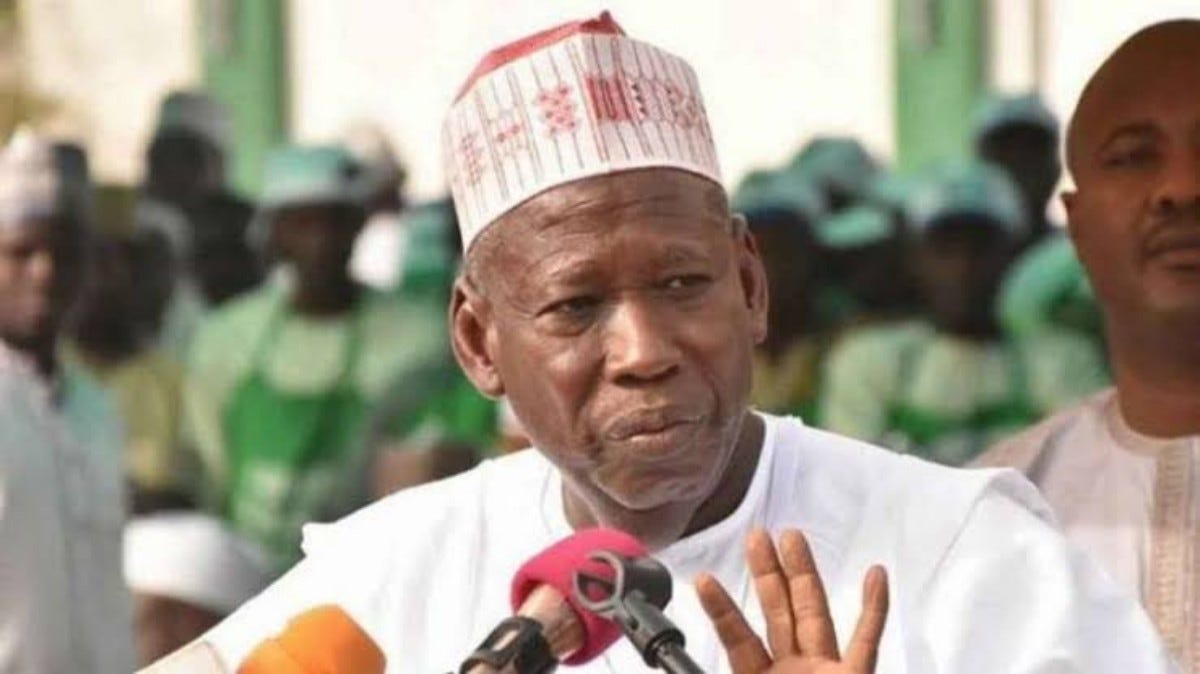
The sudden resignation of Abdullahi Ganduje as National Chairman of the All Progressives Congress (APC), officially attributed to health reasons, demands closer examination. While personal well-being was cited, the timing and surrounding circumstances strongly suggest a more intricate political manoeuvre within the ruling party.
Ganduje’s political career has been consistently shadowed by controversy. As governor of Kano State, he was implicated in a corruption scandal involving a widely circulated video purportedly showing him receiving cash bribes. Despite this, he retained political relevance, largely due to his loyalty to former President Muhammadu Buhari. His appointment as APC chairman in 2023 was itself contentious, viewed more as a political reward than a merit-based selection. His resignation continues a familiar pattern in Nigerian politics: leaders stepping down amidst scandal, only to re-emerge in different roles. It also exposes the APC’s ongoing struggle to reconcile competing regional and financial interests. What began in 2015 as a party championing anti-corruption has increasingly come to be viewed as a vehicle for elite bargaining.
In reality, Mr Ganduje’s departure follows growing internal dissatisfaction, particularly concerning allegations of financial impropriety and the imposition of excessive levies on party aspirants, most notably during the Federal Capital Territory (FCT) elections. This resignation also occurred shortly after a crucial APC meeting in the Northeast, where indications emerged that Vice President Kashim Shettima might be dropped as President Tinubu’s running mate in 2027. Collectively, these developments signify a considerable shift in the APC’s internal political calculations.
At the core of this repositioning is President Tinubu’s strategic focus on the Northwest, the region boasting the largest voting population and where his opposition is strongest. While he appears to be consolidating power in the South-South and gaining influence in the Southeast, the Northwest cannot be left to chance. Two political options seem open to the President. One involves selecting a Northern Christian running mate from the Northcentral region, thereby attempting to secure victory without significant reliance on the Northeast and Northwest—a scenario reminiscent of the 2011 elections. The alternative is to maintain the Muslim-Muslim ticket formula by choosing a new running mate from the Northwest, aiming to secure the region’s crucial vote. Should the latter path be chosen, the APC would likely need to rezone the party chairmanship to the Northeast, effectively displacing both Ganduje and Shettima in a single strategic move.
The appointment of Ali Bukar Dalori, the Deputy National Chairman (North), as Ganduje’s immediate successor suggests an attempt to maintain regional balance, at least for the time being. Whether this signals a long-term restructuring or merely a tactical pause remains to be seen. The APC’s northern bloc remains fragile, with leadership contests intensifying as the 2027 elections approach. The party’s ability to effectively manage these internal dynamics will be critical. If aspirants continue to perceive party leadership as exploitative, it could lead to defections or reduced mobilisation—both dangerous prospects, particularly after the APC lost several key states in 2023. For a party that rose to power on the back of disaffected politicians fleeing the PDP, history now offers a cautionary tale: internal strife, left unresolved, could ultimately become its undoing.