
Ramping up despite landslides
The DRC boosts copper exports and UAE trade to attract investment, while militia violence and mining disasters expose its severe security and regulatory challenges.

The Democratic Republic of the Congo is accelerating its integration into global mineral and trade networks, even as insecurity continues to undermine conditions on the ground. Kinshasa plans to export 100,000 metric tonnes of copper to the United States by the end of January, sourced from the Tenke Fungurume mine operated by CMOC Group in partnership with state miner Gécamines. The shipment aligns with Washington’s push to diversify critical mineral supply chains and follows Congo’s submission of a shortlist of state-backed mining projects to U.S. investors. Authorities say the move also reflects efforts to improve state oversight and revenue transparency in the sector. However, the export drive contrasts sharply with conditions in eastern Congo, where at least 200 people are feared dead after a landslide hit the militia-controlled Rubaya coltan mine in North Kivu. The tragedy highlighted the risks posed by armed groups, weak regulation and hazardous artisanal mining conditions. In parallel, Congo signed a Comprehensive Economic Partnership Agreement with the United Arab Emirates to boost trade, investment and cooperation across mining, agriculture and clean energy, underscoring its broader push to attract capital while navigating deep security challenges.
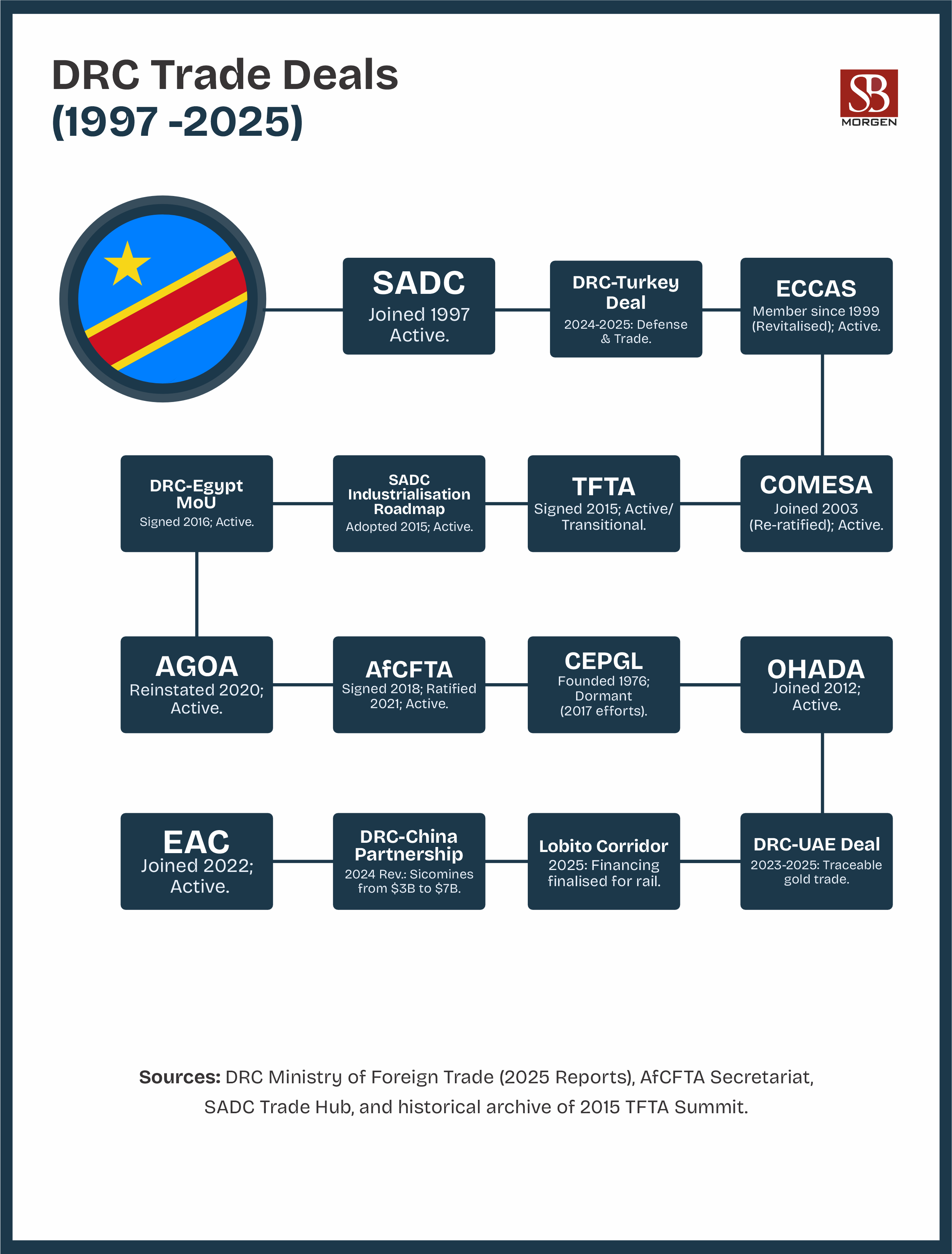
The DRC’s dual engagement with the United States via the 100,000-tonne copper export from Tenke Fungurume and the UAE through the Comprehensive Economic Partnership Agreement signals a sophisticated attempt to diversify its strategic alliances beyond traditional Chinese dominance. By supplying copper to the United States, Kinshasa is aligning itself with Washington’s Lobito Corridor strategy and its broader effort to de-risk critical mineral supply chains by reducing overconcentration in China. For the Congolese state, the shipment offers more than export revenue. It is a political signal that Congo can position itself as a central node in Western-aligned mineral flows, while retaining leverage through its geological scale.
Yet this outward momentum masks deep internal fragility. The Tenke Fungurume export, operated by CMOC in partnership with state-owned Gécamines, reflects progress in formal, industrial mining where oversight and logistics are relatively stronger. However, the tragedy at the Rubaya coltan mine in North Kivu, where fears persist that hundreds may have died in a landslide at a militia-controlled site, exposes the fault line beneath Congo’s mineral diplomacy. High-level trade agreements and state-backed project lists do not insulate investors from the realities of weak regulation, armed group control, and hazardous artisanal extraction. The reputational and ethical risks embedded in Congo’s supply chains remain acute.
This contrast underlines the core challenge facing Kinshasa. While authorities emphasise improved transparency and oversight to reassure US and Gulf partners, much of the mineral economy still operates beyond effective state control. Artisanal mining, particularly in conflict-affected eastern provinces, continues to be shaped by armed groups, informal taxation, and unsafe practices. Without sustained intervention, humanitarian disasters like Rubaya are not anomalies but structural features of the system. For external stakeholders, the lesson is clear. Due diligence cannot stop at government endorsements or export volumes. It must extend into the conditions under which minerals are extracted, transported, and traded.
The simultaneous courting of Washington and Abu Dhabi also illustrates how Congo is navigating the intensifying competition among external powers. The UAE agreement broadens the relationship beyond mining into agriculture, clean energy, and infrastructure, offering Kinshasa alternative sources of capital and political support. This diversification strengthens Congo’s bargaining position in an increasingly competitive global contest for access to critical resources. However, minerals remain the core asset underpinning these partnerships, and insecurity remains the core constraint on value creation.
For investors and partner governments, the counsel is to treat security and governance as integral components of any mineral engagement, not peripheral risks. Agreements should include explicit mechanisms to channel a portion of trade revenues into localised security reform, infrastructure development, and the formalisation of artisanal mining zones, particularly in provinces such as North Kivu. Without addressing the nexus between armed groups and illicit mining, Congo’s critical mineral exports will remain vulnerable to disruption and moral scrutiny.
Ultimately, Congo’s strategy reflects agency rather than passivity. Kinshasa is actively leveraging its mineral endowment to extract concessions and diversify partnerships. But the Rubaya disaster is a reminder that geopolitical alignment and export growth cannot substitute for on-the-ground governance. Until security, regulation, and community protection are embedded into the mineral economy, global supply chains will remain exposed to shocks that no trade agreement can fully absorb.