
Red flags
Ghana’s National Democratic Congress (NDC) elections director, Edward Omane Boamah, expressed concerns over the Electoral Commission’s…

Ghana’s National Democratic Congress (NDC) elections director, Edward Omane Boamah, expressed concerns over the Electoral Commission’s presentation of voter names who transferred across districts. He said the EC had asked all district offices to verify these names against their Form 1C or transfer request forms, as names found not originating from their offices could account for the discrepancies noted in the voter transfer process. For accuracy and transparency, the NDC has urged the EC to re-exhibit its “corrected” Provisional Voter Register at all polling stations. He emphasised the need for vigilance in monitoring the EC and New Patriotic Party (NPP).
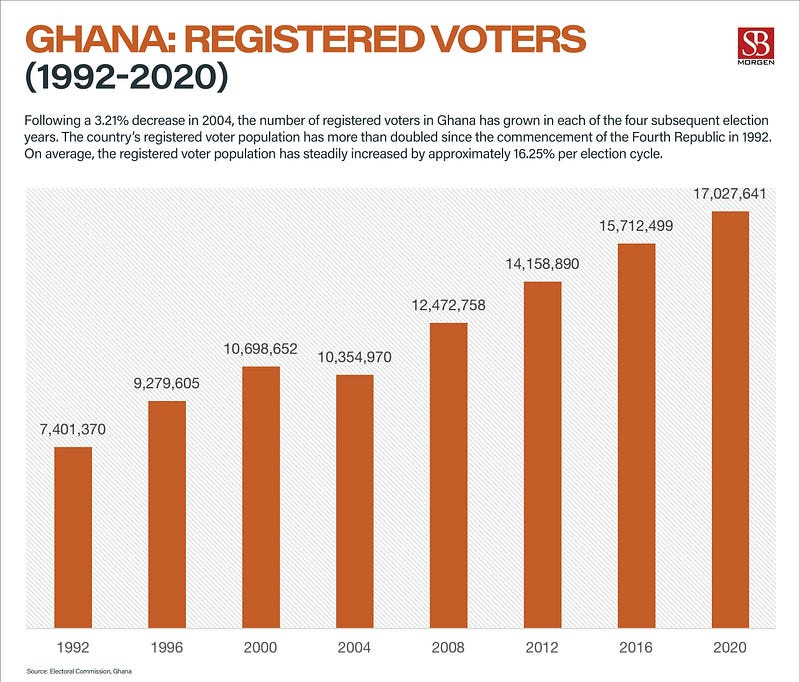
Voter registration errors have been a persistent issue in Ghana’s Fourth Republic since its inception in 1992. Despite over three decades of electoral reforms, minor errors continue to challenge the authenticity of the voter register, fueling scepticism, particularly from opposition parties. This ongoing issue remains a point of contention, with each election cycle marred by disputes over the accuracy of the electoral roll. Ahead of the 2020 elections, a completely new voter register was compiled, with additional layers introduced into the registration process to minimise these errors. However, despite significant investments in improving the system, opposition parties still point to errors in the current register, undermining confidence in the system’s integrity. Ghana’s upcoming presidential and parliamentary elections on 7 December are seen as a critical test for the Fourth Republic. The race between the ruling New Patriotic Party (NPP), represented by Vice President Dr Mahamudu Bawumia, and the opposition National Democratic Congress (NDC) candidate, former President John Dramani Mahama, is intensifying. For the first time in Ghana’s history, both main political parties are fielding presidential candidates from the northern part of the country, making this contest a “Battle of the Northern Giants.” Beyond the historic nature of the presidential race, the possibility of a third-party coalition adds an extra layer of unpredictability to the elections. A strong showing by a third force could push the presidential contest to a run-off, a scenario that would further test Ghana’s near two-party system. The composition of Ghana’s next Parliament will also be critical, as the last election yielded a hung parliament, with neither party securing a clear majority. The outcome of the parliamentary elections will have significant implications for governance, as the party that controls the most seats will wield considerable influence over the next administration. In the face of these challenges, the Electoral Commission (EC) must ensure that the electoral process is transparent, fair, and error-free. As the sole referee in this high-stakes contest, the EC’s role is vital in safeguarding the integrity of the election and maintaining Ghana’s reputation as a stable democracy in the West African region.