
Rising like dough
Nigeria’s annual inflation rate rose for the fourth straight month to 22.22 percent in April 2023 from 22.04 percent in the previous month…

Nigeria’s annual inflation rate rose for the fourth straight month to 22.22 percent in April 2023 from 22.04 percent in the previous month, according to the latest National Bureau of Statistics (NBS) inflation report. The food inflation rate quickened to 24.61 percent in April from 24.46 percent in the previous month. Similarly, on a year-on-year basis, the headline inflation rate was 5.40 percent points higher compared to the rate recorded in April 2022, which was 16.82 percent.
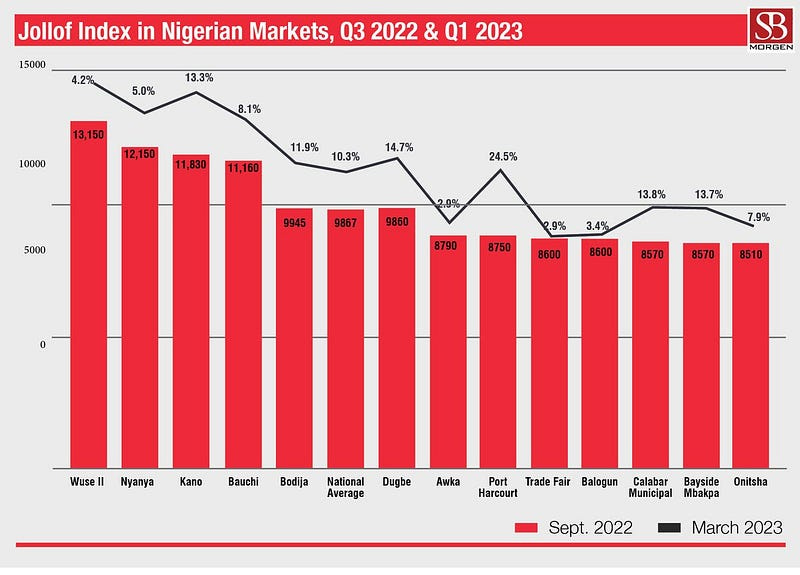
Nigeria is now experiencing galloping inflation, and the real risk is that we are already in stagflation — a situation in which the inflation rate is high or increasing, the economic growth rate slows, and unemployment remains steadily high. Save for the middling economic growth Nigeria manages to churn, it would be deep in stagflation. A 22% inflation rate puts the prices of goods and services on a terrifying escalator that makes people poorer and reduces demand, which hurts businesses, discourages investment and leads to job losses. Additionally, inflation at these levels makes it difficult for businesses to embark on investment planning crucial for a healthy, developing economy. Some Nigerians argue that the official inflation figures do not reflect on-the-ground realities. However, data from SBM’s Jollof Index suggests that not all items have risen that fast in the last year due to falling diesel (and, by extension, transportation) costs. For instance, comparing the cost of cooking a pot of jollof rice for a family of five in Q2 2023 (₦10,882) versus Q2 2022 (₦9,311) gives a year-on-year growth of 16.9%. Notwithstanding, inflation remains to hurtle away from the realms of affordability and needs to be halted. There are ways to check these price rises. Some traditional methods, such as raising interest rates, reducing the money supply and price controls for essential goods and services, might hurt the fragile economy. Despite the much-sung agriculture intervention success of the Buhari administration, the biggest component of its runaway inflation is food. This is particularly problematic in a country where food constitutes the biggest spending item for most households; the national average is 63% and reaches nearly 100% in some of the poorest districts. A better solution for Nigeria might be increasing short-term supply through importation while incentivising production cost reductions through targeted infrastructure spending and sectoral interventions. This will create a situation where increased supply at lower average production costs makes dropping prices logical and economically viable. Furthermore, trade barriers, ranging from unduly restrictive laws and practices by government officials, must be removed. Efficient port processes that make importing and exporting faster and cheaper are critical. The usual response by an individual to inflation is a push for more income, but at an institutional level for a country, it is best to also prioritise a significant reduction in production costs to keep prices low. The current fixation on agricultural self-sufficiency to the detriment of affordability is one of the pitfalls of the outgoing administration. The next administration will do well to reorient itself and focus on what is important in the Nigerian context — food at the lowest prices.