
Safe haven?
Islamist militants fighting in Burkina Faso are reportedly using northern Ghana as a discreet logistical and medical base, with sources…

Islamist militants fighting in Burkina Faso are reportedly using northern Ghana as a discreet logistical and medical base, with sources indicating Ghanaian authorities are overlooking insurgents crossing the border for supplies and medical care. Boniface Adagbila, Ghana’s ambassador to Burkina Faso, acknowledged that militants exploit the porous border, viewing Ghana as a “safe haven,” but denied any tacit non-aggression agreement. He emphasised joint efforts with Burkina Faso to counter the insurgents. However, Ghana’s security ministry rejected these claims in a statement, asserting no “non-aggression policy” or any implicit agreements with militant groups.
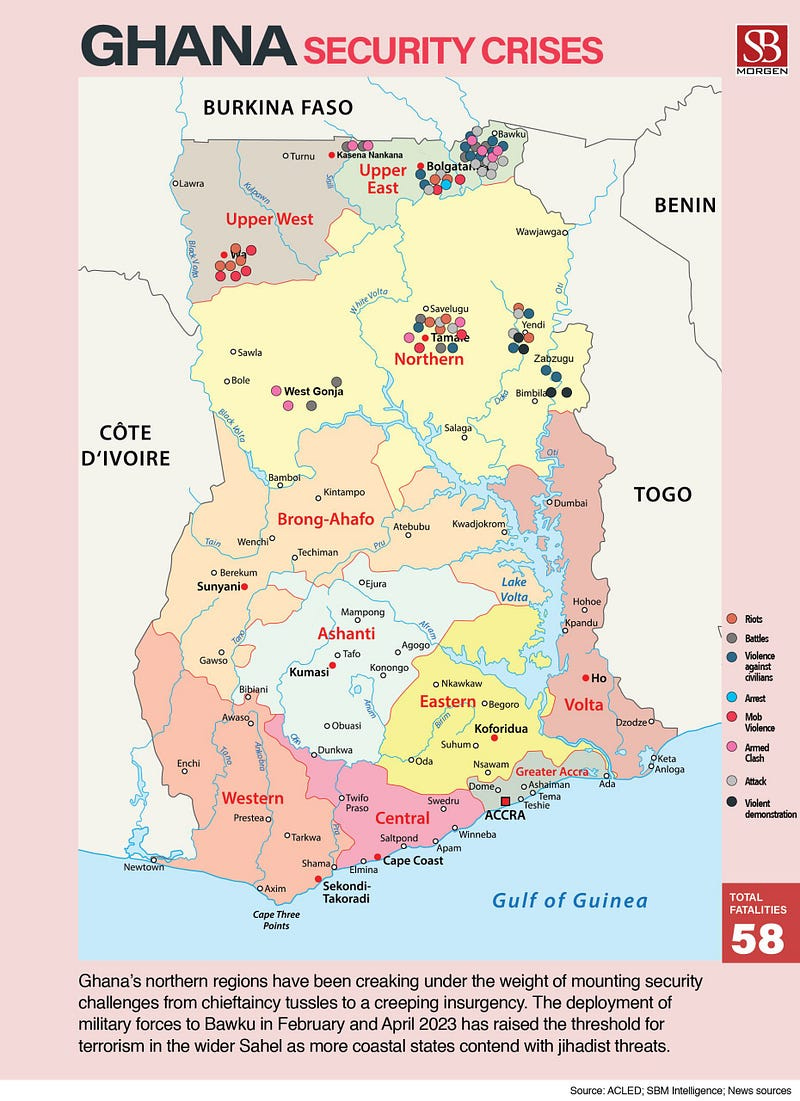
Reports of Jihadist presence in Northern Ghana have surfaced once again, marking at least the second such claim this year. This development comes as violence in Bawku, a prominent town in Northern Ghana near the Burkina Faso border, has escalated, with a recent death toll reaching 17. Bawku, long troubled by chieftaincy disputes, has become a fertile ground for potential Jihadist infiltration. With Ghana’s 7 December Presidential and Parliamentary elections just a month away, security concerns have intensified. Renewed curfews in Bawku pose serious risks to electioneering activities, heightening tensions in an already volatile region. Since the beginning of the year, the unrest in Bawku has claimed at least 30 lives, injured many and resulted in significant property destruction. Beyond the tragic loss of life and economic disruption, an estimated 64,000 registered voters in Bawku and parts of the North East region could face disenfranchisement, and with both leading presidential candidates hailing from Northern Ghana, the region is expected to be a crucial battleground in determining the outcome of the 2024 elections. Ghana’s Ministry of National Security has, however, categorically denied claims of Jihadist presence in the area, emphasising that there is no “non-aggression policy” or tacit agreement with militant groups. In a recent statement, the Ministry rejected any portrayal of Ghana as a “supply line” for insurgents, noting that the nation’s counter-terrorism efforts have been lauded by regional and global partners. Non-aggression pacts in this context may not exist officially, but unofficially, Accra having knowledge of, but failing to do anything significant about the jihadists’ presence not only suggests that there is an unofficial understanding between both parties but also leaves huge question marks about its security policy in its northern region. Despite the government’s denial, some security experts argue there is substantial evidence warranting concern. They warn that dismissing these reports may lead to unforeseen spillovers from Burkina Faso’s ongoing insurgency, especially with the escalating conflict in Bawku. In the past three years, warnings that Islamist militants increasingly have eyes on coastal West Africa have become a sort of self-fulfilling prophecy for various reasons ranging from the failure of the states south of the Sahel to take the threat seriously by breaking ranks, to the exit of Western counterterrorism forces whose results in keeping the problem in the Sahara was mixed at best. Last year, Ghana’s first public action against the security challenges in its northern region was the deployment of troops to Bawku. However, that deployment, as well as the reinforcement of troop presence in late October 2024, was heavily tilted towards calming the chieftaincy crisis in the area, and not necessarily to stop the jihadist advance. The thinking in Accra might be that if they keep looking away, the jihadists, especially JNIM will not attack Ghanaian territory. However, this would be dangerous because Benin, Ivory Coast and Togo all thought the same thing and realised only too late that playing the ostrich is only affordable in children’s storybooks, and not a real-life action policy in the face of a grave threat posed by JNIM and its Islamic State rivals in the Sahel. The region is plagued by a worrying lack of improved border security, and despite promises at successive ECOWAS defence summits to improve border patrol, hardly anything has been done in that regard. Accra would be best served by learning from the Ivorian example of directly addressing the problem in its northern areas through increased state presence and co-opting the youth population into more productive ventures before they could be reached by recruiters who work for armed groups.