
Scaling back
Ghana’s Finance Minister, Ken Ofori-Atta, has proposed a potential 30 to 40 percent nominal haircut for Eurobond holders as part of the…

Ghana’s Finance Minister, Ken Ofori-Atta, has proposed a potential 30 to 40 percent nominal haircut for Eurobond holders as part of the country’s external debt restructuring. He also suggested that coupon rates should not exceed five percent, with final maturities not exceeding 20 years. Ghana’s total outstanding Eurobond debt amounts to $13.10 billion, as reported in the 2022 Annual Debt Report. Additionally, the International Monetary Fund (IMF) has revised Ghana’s net international reserves, forecasting an increase to 1.4 months of import cover for 2023, up from the earlier estimate of 0.8 months. The IMF also adjusted the net reserves for 2022 to 1.2 months, anticipating further growth to 2.1 months in 2024.
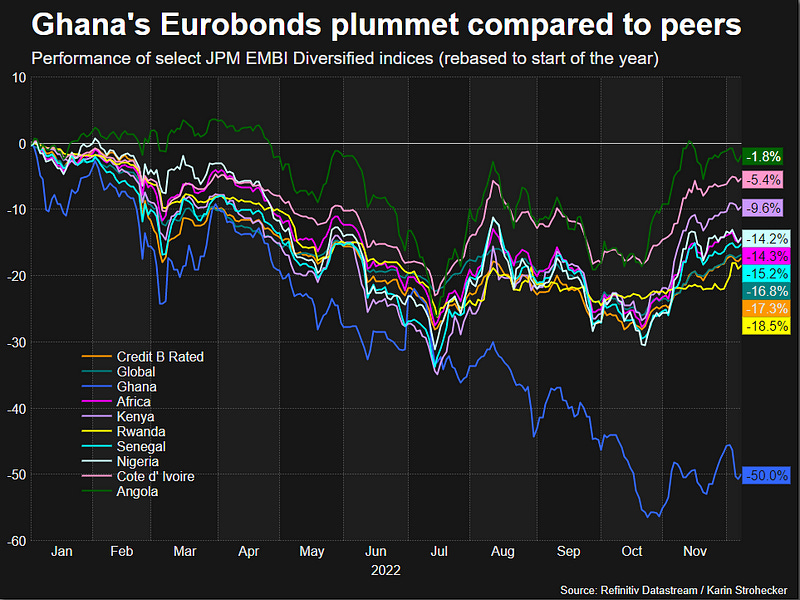
Ghana faces a monumental challenge as it navigates the intricate process of negotiating debt restructuring with its commercial creditors. The recent update from Finance Minister Ken Ofori-Atta indicates that Ghana has pinpointed bonds amounting to $14.6 billion in the external commercial sector eligible for restructuring. Additionally, in the bilateral sphere, the government is targeting $5.4 billion, making a total of $20 billion in Ghana’s external debt earmarked for restructuring. Authorities have meticulously crafted a debt rework proposal to free up a substantial sum of $10.5 billion between 2023 and 2026 to support its balance of payment financing for the period under review. However, this ambitious endeavour is likely to encounter resistance, particularly concerning the government’s pursuit of a 30 to 40 percent reduction in principal debt and further forgiveness in interest payments. Ghana’s sovereign dollar bonds experienced a significant decline on Tuesday following the government’s request for a percentage write-off on the principal and interest of its Eurobonds. Although the bonds partially recovered, they remained down by 1.5 cents to 2.5 cents on the dollar. Between 2023 and 2026, the IMF has tasked Ghana to obtain debt relief through external debt restructuring with an annual target of $3.5 billion. However, with a successful debt treatment, the government could encounter hurdles in terms of its debt servicing obligations over the next three years, potentially putting pressure on the country’s international reserves and its local currency, the cedi. The Black Star of Africa is expected to service maturing Eurobonds worth $1.9 billion (2023–2026), which is 60% of the total IMF bailout package. The government’s proposal to secure a significant reduction in principal and interest payments has met with scepticism and potential opposition from creditors. Balancing the necessity of debt relief with the concerns of creditors who may be wary of financial losses poses a significant hurdle.