
Sharing the pie
In July, the Federation Account Allocation Committee (FAAC) shared ₦966.110 billion to the federal, state and local governments from ₦1.74…

In July, the Federation Account Allocation Committee (FAAC) shared ₦966.110 billion to the federal, state and local governments from ₦1.74 trillion gross revenue. The federal government received ₦374.485 billion, state governments ₦310.670 billion and local councils ₦229.409 billion. State governments received 52% as grants and 48% as loans. While revenue fell 10.8% from June’s ₦1.95 trillion, disbursement slightly rose from ₦907.054 billion. The federal government granted ₦5 billion to each state and FCT for food distribution and five rice trucks per governor. Borno’s Governor Zulum shared plans for 100,000 rice bags, 40,000 maize bags and fertilisers.
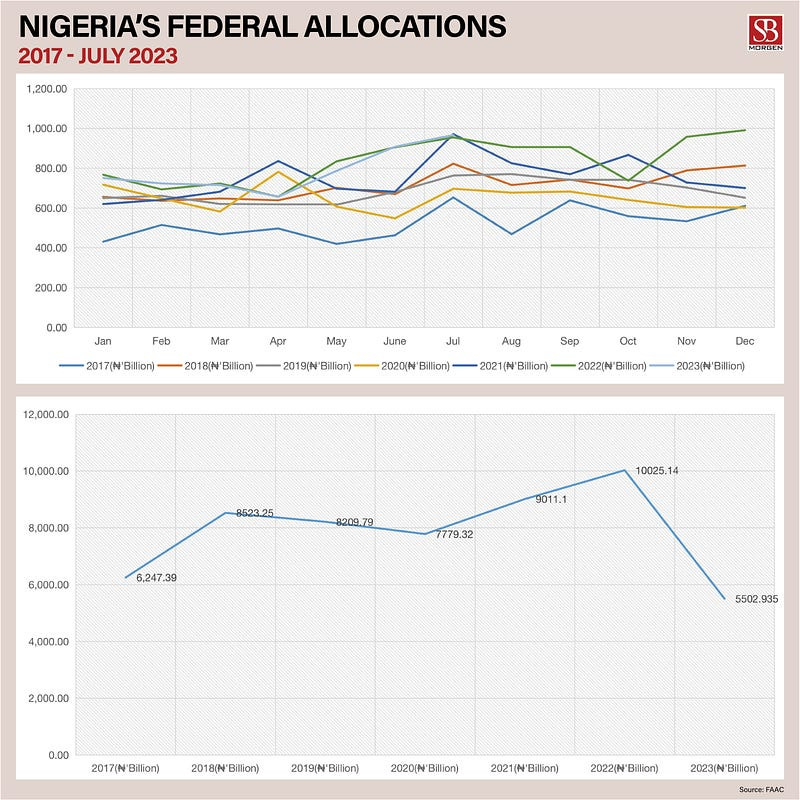
According to the Nigerian Upstream Petroleum Regulatory Commission (NUPRC), Nigeria’s oil output fell by 15.5% to 1.08 barrels per day (bpd) in July 2023. The decline in production appears to have impacted the revenues available to FAAC for sharing. It is annoying that the gains earlier recorded in June have been lost such that Nigeria continues to fail to reap the benefits of high oil prices, especially where there is a clamour for palliatives to ease the pains from recent petrol subsidy removal. A one-off release of palliatives worth ₦5 billion ($5.7 million) to states with an average population of five million people per state is inadequate, especially with the constant rise in inflation. Even if focused on the poorest tier, it cannot offer the basic level of food security. The federal government cannot afford to keep releasing one-off payments to each state. This will drain the treasury and not solve the underlying problem of food insecurity. A sustainable approach is needed. Despite what should be an increase in naira terms due to currency devaluation, a month-on-month reduction in government revenues is worrying. President Tinubu’s campaign touted one of his strengths to be his ability to raise government revenues. Now that ministers have taken office setting this revenue ball rolling is vital. Nigeria has a spending problem — yes. But crucially, it also has a revenue problem. and President Tinubu must find a way, despite the enormous constraints he faces, to solve it. The federal and state governments should focus on identifying sustainable ways to manage inflation by investing in agriculture, removing tariffs on food and alternative energy sources, creating credit purchase systems and improving the agricultural sector’s efficiency rather than engaging in a giveaway that does nothing to bring lasting change, the federal and state governments can build sustainable frameworks that help to create a more stable and prosperous economy for everyone.