
Shed blood
Armed men killed one worshipper and abducted three persons during an attack on the Christian Pentecostal Church in Logo Local Government…

Armed men killed one worshipper and abducted three persons during an attack on the Christian Pentecostal Church in Logo Local Government Area of Benue State. The following day, suspected Boko Haram terrorists attacked Dabna community in Adamawa State. Also, at least 10 persons were murdered in neighbouring Taraba by suspected herdsmen. On 4 April, gunmen in Kaduna kidnapped eight secondary school students and others in Kachia Local Government Area. At the end of that week, a violent clash between Hausa and Fulani residents in the Gwadabawa local government area of Sokoto resulted in undisclosed casualties.
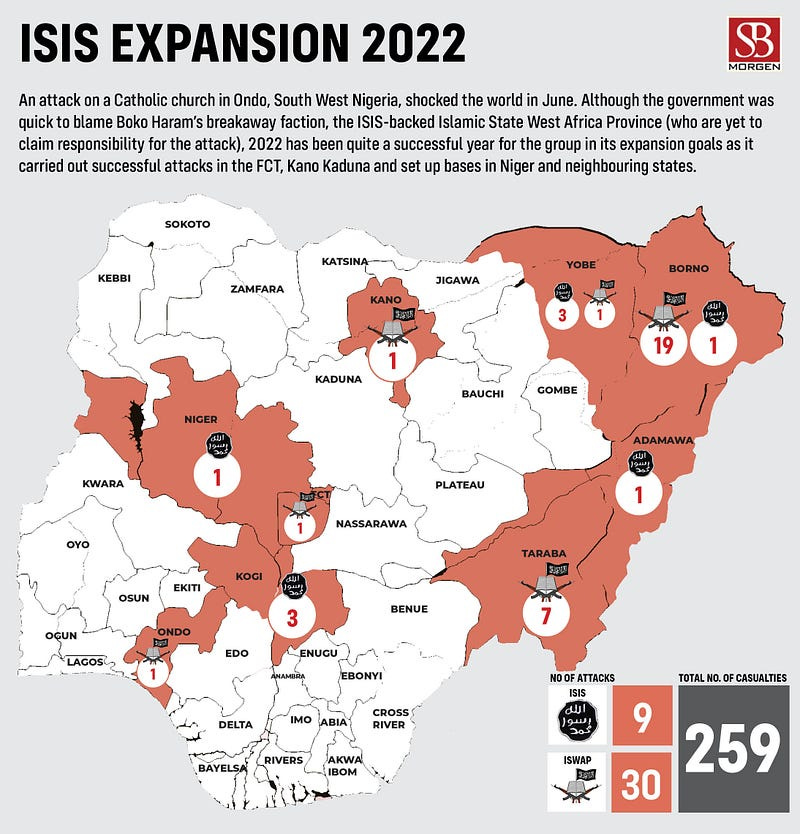
Nigeria’s security problems never really went away. The posturing by the security agencies in the run-up to the elections through the positioning of large armoury and heavy troop movement was symbolic: it was meant to conceal the cracks in line with the elite consensus that the show must go on on matters regarding power transfer. Those troop movements and heavy securitisation of the country were not meant to tackle insecurity. Furthermore, the reversal of the cashless policy that created a supply situation that made kidnapping for ransom somewhat untenable means an added constraint has been taken off the table. What has happened between the elections and now shows, very importantly, the government’s lethargy in dealing with the problem. In Benue and Kaduna, militant Fulani herders’ attacks have increased since at least the tail end of last year. No fewer than 672 people were killed in 85 attacks by the militants in 2022 alone. Many of the attacks took place in Benue and Kaduna. Terrorism is as much a problem in the North West and North Central as much as it is a problem in the North East, where although the Boko Haram threat has been reduced to rag-tag banditry as a survival mechanism in areas outside of Borno’s North, it’s deadliest splinter faction, the Islamic State West Africa Province (ISWAP), still portends a great danger for Adamawa and Taraba — where it launched several successful attacks in 2022 — residents. In a depressing turn of events, the government’s failure to tackle the security crises is leading to more inter-ethnic clashes. In 2022, the British Broadcasting Corporation (BBC) aired a documentary that showed that the fault lines between the Fulani and the Hausa in the North West are stark, which did just enough to expose the civil war between the two groups that has been going on for years, driven by the problem of banditry and petty cattle rustling. On this basis, perception is reality: the mere perception of government ineptitude when the Fulani are the aggressors has simply put a target on the average, innocent Fulani, and this situation is no less helped by the country’s perennial struggle with keeping up with a steady flow of small arms and light weapons which various government initiatives such as the setting up of the National Centre for the Control of Small Arms and Light Weapons, for instance, has failed to solve. Regarding solutions, it is somewhat odd that these attacks have not stirred a fevered discussion about state policing and how these institutions could be engineered to combat these threats effectively. Nigeria has a 370,000-strong police force to shepherd its 36 states as well as the national capital, and while this means we should have an average of 10,000 policemen per state, which is too little, it is not obtainable in practice because the economically vibrant states have a higher policeman-to-citizen ratio. It is unclear how inclined the APC president-elect is to support the establishment of sub-national police departments, but the states should force the issue and make state policing a priority for the coming administration.