
Shoot to kill
Amnesty International said in a report on Thursday that Nigerian police used excessive force and shot protesters while cracking down on…

Amnesty International said in a report on Thursday that Nigerian police used excessive force and shot protesters while cracking down on demonstrations in August over a cost of living crisis, killing at least 24 people n Kano, Katsina, Jigawa, Kaduna, Niger, and Borno states and arresting 1,200 protesters. On 3 August, police denied killing protesters but said seven people died, attributing four deaths to an explosive device planted by suspected Boko Haram militants, two deaths to a car accident and one to a local vigilante who was trying to loot a shop. The report stated that the police fired live ammunition at protesters at close range.
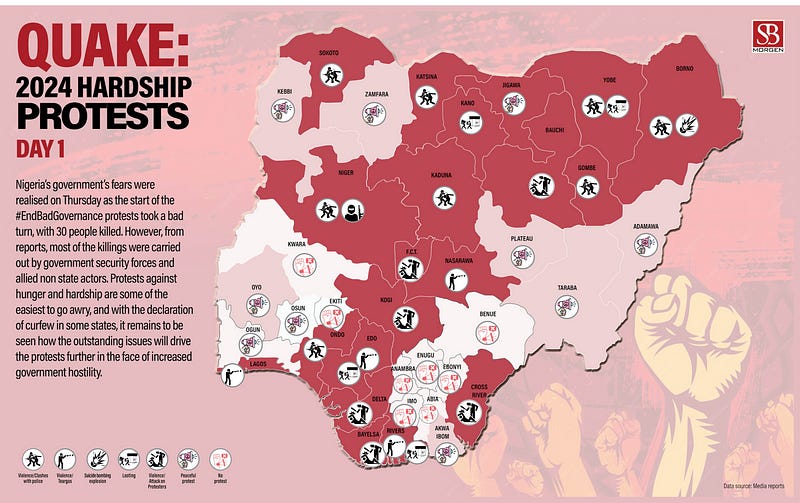
Amnesty’s report only confirms what many Nigerians saw on social media and, in some cases, on live television. As we highlighted in our appraisal of the protests, the federal government’s heightened rhetoric and activity to scuttle the protests in the lead-up opened up the space for a clampdown. In much of Nigeria’s history, such clampdowns were usually the military’s pastime, especially the army, whose imprints litter much of the country’s record of mass atrocities. However, recent events ranging from military over-engagement in internal security to the growing public disillusionment, even within its own ranks, have seen the police take on a more public role in ‘keeping the peace’. The heavy-handed response to the protests confirmed the shrinking of Nigeria’s civic space and underscored the eroding trust between the government and its people. As Nigeria’s elites continue to preach endurance to citizens while living comfortably, the foundation for trust in government — an essential element of nation-building — grows ever thinner. The police’s alternative version of events further cements the gaslighting policy that has tainted the official government response to civil protests. This is compounded by the regime-protection mentality that still lingers in security agencies, perhaps an after-effect of colonial rule. Consequently, agencies like the police and military are often seen protecting political elites at the expense of ordinary citizens despite being funded by public resources. The 2020 EndSARS protests emboldened security officials, who now know that, as long as they have the backing of politicians, there are no consequences for their actions. This sets a dangerous precedent where Nigerians continue to face harassment and violence at the hands of those meant to protect them. It also fosters an environment where the police, for a few thousand nairas, are willing to harass citizens or demand bribes at security checkpoints. The poor management of large gatherings has serious consequences — it not only detracts from the legitimacy of the protesters’ demands but also establishes the conditions for future confrontations, which will likely continue to undermine national stability. While these issues may seem small, they are far from insignificant. They play a key role in the risk assessments that foreign investors and businesses conduct when evaluating the Nigerian market. May the souls of the departed rest in peace.