
Sonko out, protests pour in
Senegal’s president sacks prime minister after debt row. Protests erupt in Dakar as IMF suspends $1.8 billion lending.

Senegal faces political uncertainty after President Bassirou Diomaye Faye sacked Prime Minister Ousmane Sonko and dissolved the government. The split followed months of tension between the former allies. Sonko had criticised Faye's handling of the country's worsening debt crisis in parliament. The IMF estimates Senegal's public debt at about 132 per cent of GDP and has suspended its $1.8 billion lending programme. Sonko took his removal calmly, but students backed him, and protests broke out in Dakar. No new prime minister has been named, raising concerns about governance and economic stability.
Senegal’s PASTEF movement has reached a breaking point. The alliance between President Bassirou Diomaye Faye and former Prime Minister Ousmane Sonko has collapsed under the weight of economic crisis, institutional rivalry, and competing ambitions. What began in 2024 as a nationalist, anti-colonial project aimed at reducing French and foreign influence has fractured into a battle over power, fiscal policy, and the future of the state.
The immediate trigger is Senegal’s deteriorating finances. The discovery of roughly $11 billion in previously undisclosed debt forced the International Monetary Fund to suspend its $1.8 billion lending programme and demand structural reforms before talks could resume. Those reforms mean subsidy cuts, reduced spending, and higher taxes, the same painful measures seen across the continent in countries that have turned to the IMF.
President Faye showed increasing willingness to accommodate parts of the IMF agenda to stabilise the economy and reassure financial markets. PM Sonko rejected it, preferring a populist approach instead: protect households from subsidy cuts and pursue former officials on corruption charges. Their disagreements paralysed policymaking and revealed a deeper conflict. Sonko continued to treat the presidency as an extension of PASTEF and himself as the movement’s real leader. Faye slowly asserted his independence.
The break came earlier this month, when Faye dismissed Sonko as prime minister and dissolved the cabinet. Sonko then moved fast. Days later, PASTEF MPs elected him Speaker of the National Assembly, placing him second in the constitutional line of succession. From there, he controls the legislature and its agenda.
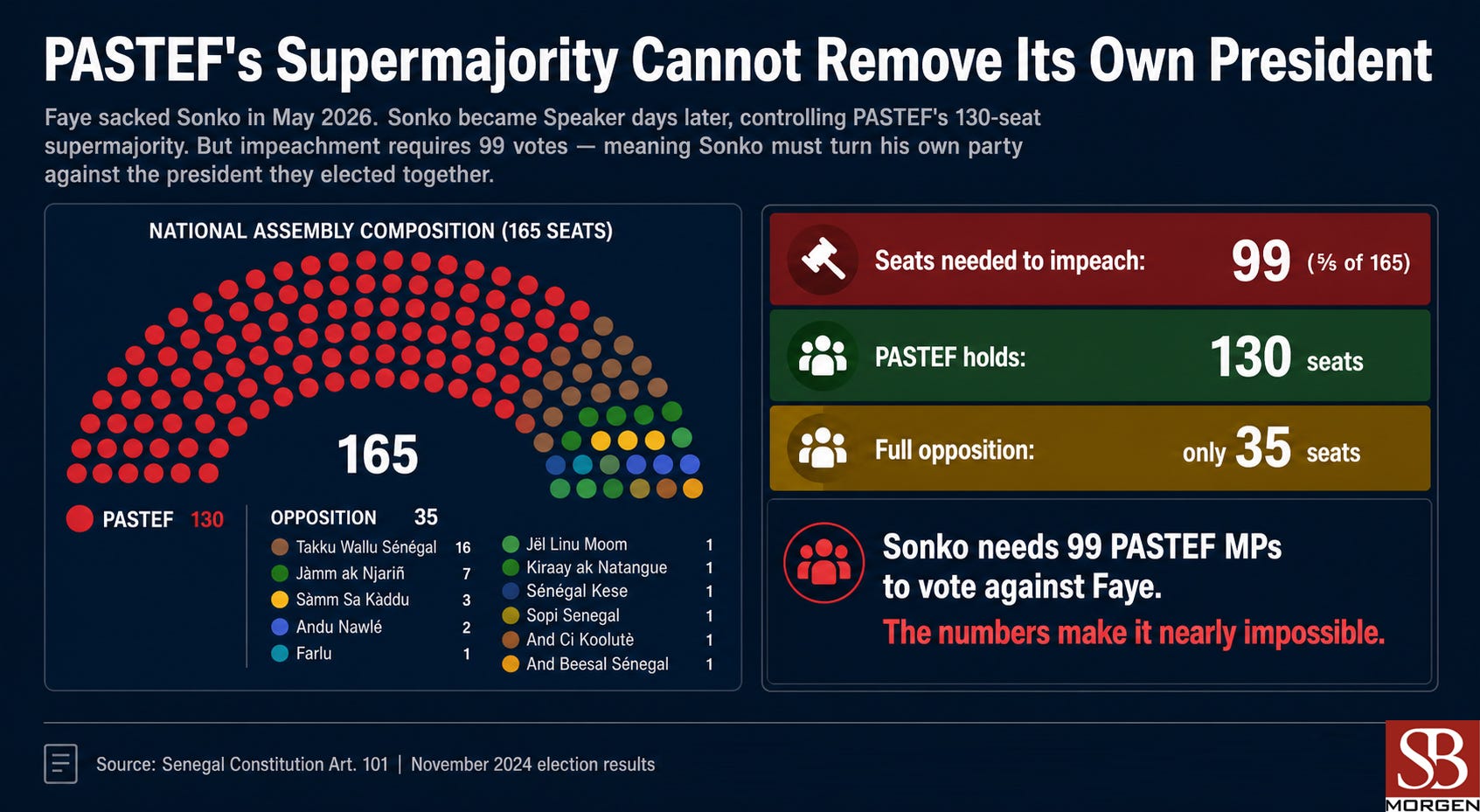
But the impeachment path that many observers have raised faces a critical obstacle. Under Article 101 of the Senegalese constitution, referring a sitting president to the High Court of Justice requires three-fifths of all members of the National Assembly, that is, 99 votes out of 165. PASTEF holds 130 seats. The entire opposition holds only 35. To remove Faye, Sonko would need to turn 99 of his own party’s MPs against the president they backed 18 short months ago. That is not a realistic scenario unless PASTEF fragments from within.
Faye has named technocrat Ahmadou Al Aminou Mohamed Lo as prime minister, signalling an attempt to restore investor confidence and revive IMF talks. But any serious fiscal reform will face resistance in a parliament that Sonko now controls. Faye cannot dissolve that parliament until November at the earliest. Senegal is therefore heading into months of gridlock, with the presidency intact but isolated, and the economy waiting for a resolution that neither side can deliver alone.