
Spilling away
The United Kingdom’s Supreme Court ruled that it was too late for Nigerian claimants to sue two Shell subsidiaries over a 2011 offshore oil…

The United Kingdom’s Supreme Court ruled that it was too late for Nigerian claimants to sue two Shell subsidiaries over a 2011 offshore oil spill they say had a devastating long-term impact on their coastal area. Oil production from Nigerian onshore and shallow-water fields is in decline as the bulk of production moves to offshore fields because of militancy, pipeline vandalism and oil theft. With International Oil Companies (IOCs) dominating offshore production, the Nigerian National Petroleum Company Limited (NNPC) struggles to maintain its share of the country’s oil output, raising concerns about the industry’s long-term sustainability.
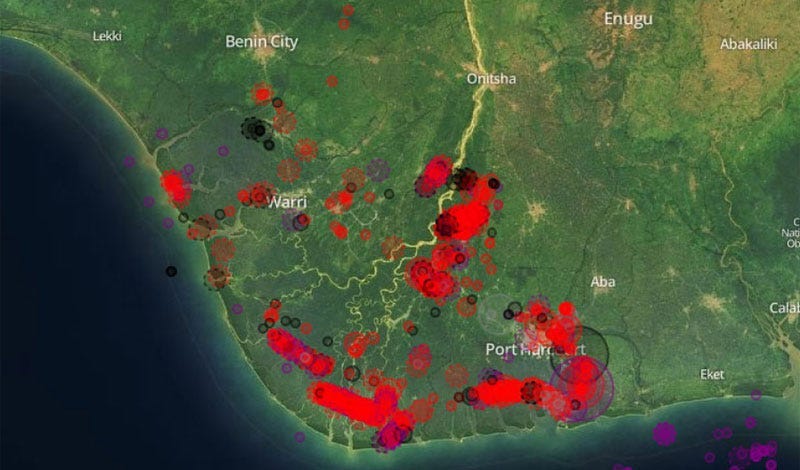
It is widely known that after six decades of oil exploration and 240,000 barrels of crude oil spilt annually, the Niger Delta, with its damaged farmlands, rivers, lagoons, illness and misery, is now one of the most polluted places on earth. On 20 December 2011, a Shell-operated floating production vessel discharged 40,000 barrels of oil into the Atlantic. Shell repeatedly denied the leak and refused to pay compensation or take serious remedial clean-up responsibilities. The spill “coated beaches in a film of black sludge with a rainbow tint,” according to one 2012 description. In a presentation to the country’s House of Representatives that year, the National Oil Spill Detection and Response Agency (NOSDRA) said the spill covered 950 km² of water surface. The then head of the organisation told the News Agency of Nigeria two years later that the oil spread over 100 nautical miles. Aside from refusing to take remedial action, Shell claimed it had prevented the spill offshore from spreading, and it could not have reached the shoreline. Whatever containment technology it used appears not to have worked as the contamination spread from Bayelsa to Delta to Akwa Ibom. A leading claimant in the case said 457 communities across six local governments were impacted with the spill reaching as far as Edo and Ondo years after the discharge. In the aftermath of the spill, whole communities were reportedly displaced, leaving their fishing gear behind and going into urban areas to learn how to live on land. The devastation to surface water was so bad that fisherfolks who use lanterns to go out at night in search of a catch were afraid to do so for fear of setting themselves alight. Abuja had to outlaw fishing off the coast of the Niger Delta for a while. Four years after the dust had settled in 2015, NOSDRA finally set its penalty against Shell at $3.6 billion. Half was designated for clean-up, while the other half was to be set aside for compensation. Knowing the extent of its power as the country’s primary oil player, Shell went to the Federal High Court in Lagos to challenge the fine. It did not succeed. Its subsidiary, Shell National Exploration and Production Company (SNEPCO), was asked to pay the fine. Angry at the perceived impunity of the oil giant, 27,800 victims from the communities mentioned above came together to sue Shell in London. A key argument of the claimants was that the Bonga offshore pollution was a “continuing nuisance” for which Shell was liable. Five years after its initial filing, the UK Supreme Court has had the chance to weigh in. The Bonga oil spill is a one-off for the judges, and the compensation claim for a one-off event is time-bound. The victims argue that the one-off incident remains a clear and present hazard in their environment because it has not been cleaned up. Although this is the reality, and the consequence of that one-time bomb continues to be felt, the court appears to be avoiding a legal situation where a community can sue for damage done aeons ago. The time statute for “continuing nuisance” in the UK is six years. In Nigeria, it is five. While understandable, it is unfortunate that the UK SC has maintained a limitation statute to a pollution claim against Shell in this case. The fact is that the spill, its impact and the devastation it caused are real. The claimants believe that the court has not barred them from claiming compensation for the damages that are datable to six years after the spill. Another case on determining the value of compensation for that one-off devastation and destruction is making its way to the UK Supreme Court, and Shell may yet be found liable. The case also brings to the fore, yet again, the inability of Nigerians to obtain justice from the domestic justice system against powerful actors like Shell, having to resort to suing in foreign courts. As the oil companies move away from onshore and shallow-water fields to offshore assets, they move without having to clean up the decades of environmental degradation their exploration and extraction activities have caused in the Niger Delta. It is a tragedy and a shame, with the Nigerian state being the primary one to blame for allowing this to continue. Also, Shell’s running battle with its Nigerian market, more than anything, highlights the experience of doing business in Nigeria. In its long-term corporate existence in the local market, more than half of it has been mired in allegations of physical and environmental abuse, often done in collusion with compromised state officials. The repercussion of this unholy alliance has led to its legal troubles in international courts (as outlined above) and partly explains its decision to divest from the market. However, the headache of dealing in a highly volatile situation, where sabotage and shakedowns are a daily occurrence has proven fertile grounds for moving assets offshore. In 2022, the Buhari Administration contracted ex-militant Government “Tompolo” Ekpemopulo to the tune of over a billion naira to protect pipelines from sabotage amid concerns over Nigeria’s dwindling oil production of which more than a quarter is lost to vandals and pirates. This has largely kept the peace despite wranglings from other militants, who have taken umbrage at the deal for leaving them out. Shell might be taking the jump due to the global pivot towards renewables. However, fossil fuels retaining their position as a key part of the energy mix means their Nigerian problem will not evaporate anytime soon. A pertinent question remains. Why has the government not forced Shell to take any measures towards obeying the Federal High Court ruling in Nigeria? The answer is simple. The government needs Shell to bring more fields in its lucrative Bonga block onstream. Shell can easily insert clauses into its deals to manage the continuing nuisance of uneducated folks instituting legal actions; all it would do is increase project costs and cause investment stress to the point where the government (as a joint venture partner) barely scrapes out a decent return. The sordid outlook for the Niger Delta, though, is that it could become a ghost region by the time a world does not need African-sourced oil in the firm grip of a green revolution.