
Starving and stunted
A General Household Survey by Nigeria’s National Bureau of Statistics reveals that nearly two-thirds of Nigerian households face hunger due…

A General Household Survey by Nigeria’s National Bureau of Statistics reveals that nearly two-thirds of Nigerian households face hunger due to financial constraints. The proportion of households unable to afford sufficient food surged from 37% in 2019 to 62.4% in 2023. Alarmingly, 12.3% reported going an entire day without eating. Food inflation, reaching a near 30-year high of 41% in June, has exacerbated the crisis, with 21% of households depending on support from friends or relatives. Malnutrition is rising, with 25% of children classified as underweight, up from 19% in 2019, underscoring the dire physical toll on vulnerable populations.
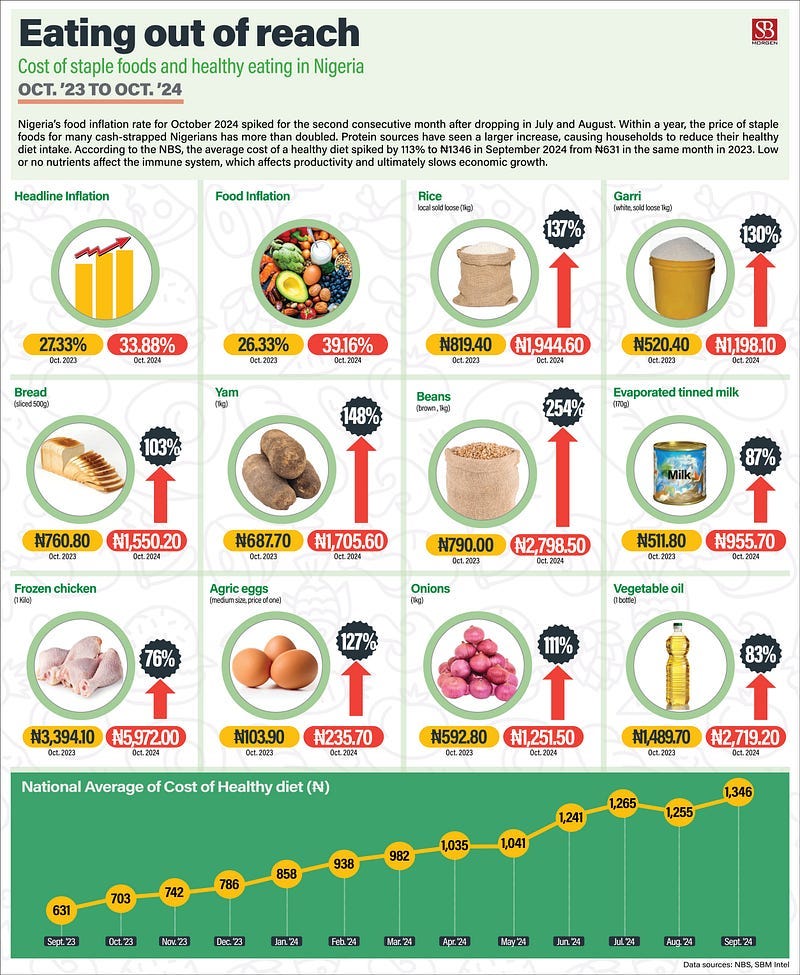
The data shows that food prices have significantly outpaced income growth over the past four years. Insights from our work with the Jollof Index over the last eight years highlight a troubling trajectory. Initially, Nigerians shifted to cheaper substitutes as staple foods became unaffordable amid a steep decline in purchasing power. However, even these alternatives have become too expensive, forcing many to skip meals or reduce the quality and quantity of their food. This shift has led to a rise in hunger and malnutrition. Poor nutrition weakens immune systems, disrupts productivity, and slows economic growth. Protein sources have seen the steepest price increases among five food groups. According to the NBS, the price of 1kg of beans surged by 254% to ₦2,799 in October 2024, up from ₦1,790 a year earlier. 1kg of frozen chicken nearly doubled to ₦5,972, while a piece of Agric egg spiked by 127%. This protein deficiency is already causing stunted growth, particularly among children. Proteins are essential for brain and cognitive development, fostering intelligence and creativity. Families are also cutting back on fruits, with only 38% of households consuming them, according to the NBS. Furthermore, more than one-third of households reported food shortages, especially in June, July, and August. This is notable because inflation dropped in July and August before peaking in September and October, suggesting a disconnect between inflation metrics and actual food accessibility. In recent years, persistent insecurity, supply chain disruptions, climate change, elevated energy prices, floods, weakened naira, and high farm input costs have constrained the agricultural sector’s growth to below 3%. The Farming Early Warning System Network recently predicted further deterioration in food security from November 2024 through May 2025, driven by poor harvest yields. This paints a bleak picture: food production will likely decline further unless policymakers urgently address the root causes of this crisis, including inflation, supply chain inefficiencies, and currency instability. Targeted interventions — subsidies, agricultural investments, and social safety nets — are essential to safeguard nutritional well-being and economic stability. Without decisive action, escalating food inflation will leave more Nigerians unable to afford the most basic human need — food. Tackling this issue must be the government’s top priority.