
State police now needs 24 states
Nigeria's Senate passes a state police bill, allowing states to create their own forces alongside the federal police.

Nigeria has moved a step closer to establishing state police after the Senate passed a constitutional amendment bill that would decentralise policing and allow states to create their own police services alongside the federal force. The proposal, approved with the required two-thirds majority through a manual voting process, now awaits endorsement from at least 24 of the 36 state Houses of Assembly before it can become law. The bill would empower governors to appoint state commissioners of police, subject to legislative confirmation, while the federal police retain responsibility for national security issues such as terrorism, organised crime and border security. To address concerns about political abuse, lawmakers included safeguards to restrict the use of state police against political opponents and to preserve federal oversight. Supporters argue the reform will improve local security and intelligence gathering, while critics remain concerned about potential misuse by state governments.
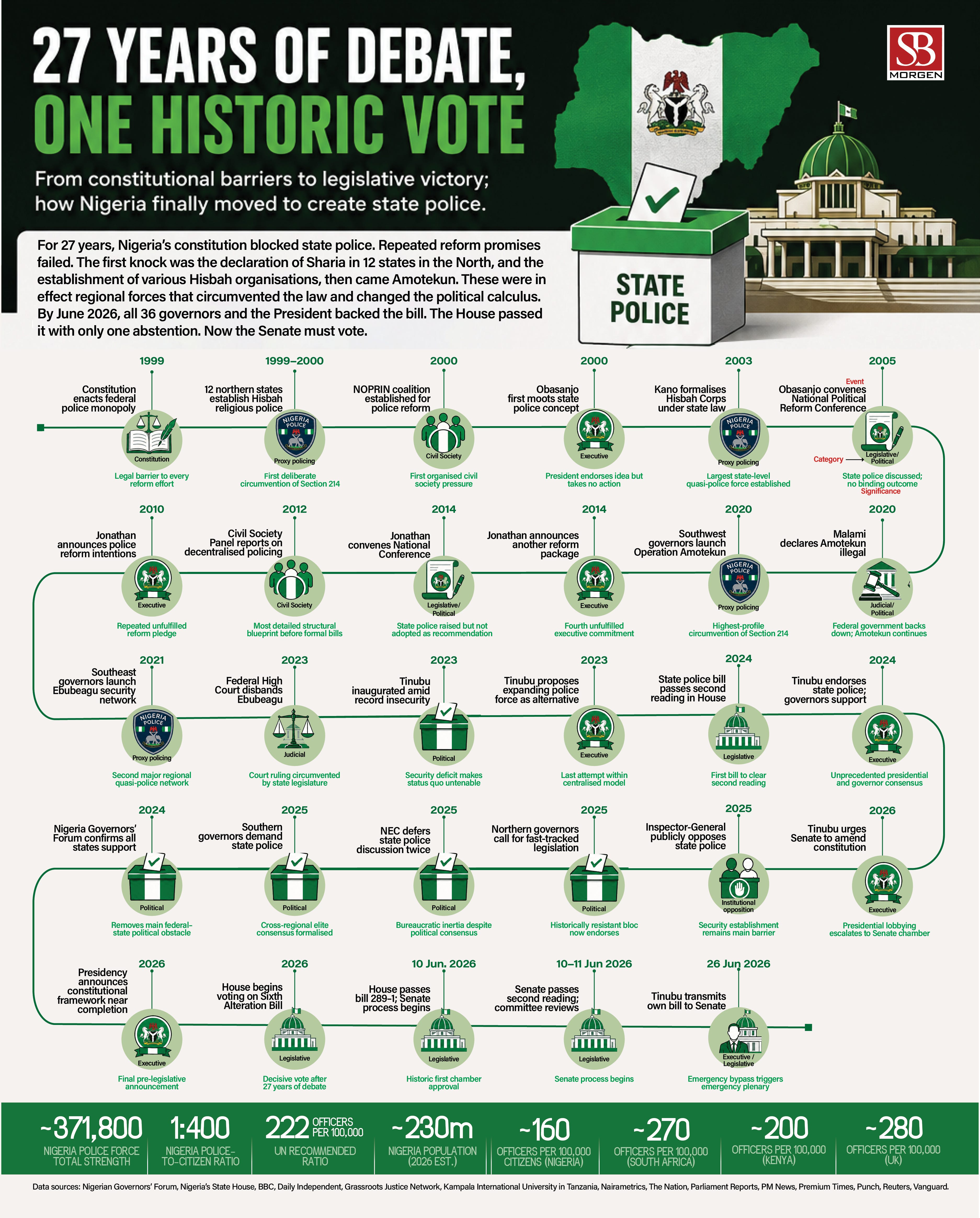
The passage of the state police bill in 2026 succeeded where previous attempts had failed because the security environment had finally overwhelmed the political opposition. The bill had failed in the eighth and ninth assemblies, with Northern legislators consistently leading opposition on the grounds that state police would be weaponised against minorities. That position was never principled. In 2003, Governor Ibrahim Shekarau transformed Kano’s Hisbah from a voluntary Islamic group into a state security agency, effectively creating a religion-based police force under gubernatorial authority, precisely the kind of decentralised coercive power Northern elites spent years insisting was too dangerous in secular form. By 2020, 23 states were running local security outfits, with Northern states operating vigilante committees and Kano maintaining Hisbah alongside federal police, all without constitutional authorisation. Northern political elites championed centralisation when they held federal power, but built parallel security structures at home regardless. The 2022 proliferation of northern state vigilantes under governors who publicly opposed state policing confirmed that decentralisation had always been happening; the argument was over control and legitimacy.
The security crises that broke that resistance are well documented. From the Northwest to the Northcentral and parts of the Southeast, mass killings, kidnappings, and banditry exposed the fragility of Nigeria’s internal security architecture, including attacks on worshippers in Kaduna and communities in Mangu and Bokkos. Beyond this, the absurdity of federal operational control over a country of over 200 million people spread across 36 states, in which a commissioner in Abuja must be consulted before a patrol responds to a village attack 600 kilometres away, had become indefensible. The immediate triggers were acute; the underlying structural case had been building for two decades.
The bill as passed is, however, deeply problematic in its architecture, and the enthusiasm surrounding it obscures risks that are likely to materialise. State governors currently exercise near-absolute control over state-level institutions designed to be independent. State Independent Electoral Commissions (SIECs) offer the clearest illustration: despite constitutional provisions for their independence, governors routinely determine outcomes, with ruling parties winning 100% of local government chairmanship seats across the federation. State police placed under gubernatorial direction will reproduce this pattern with armed personnel rather than electoral commissioners. The bill’s own escape valve, a provision allowing a Commissioner of Police to refer unlawful gubernatorial directives to the Nigeria Police Council, requires that commissioner to risk his career and physical safety to challenge his appointing authority. Whether that mechanism produces genuine independence will depend entirely on the Nigeria Police Council’s willingness to rule against sitting governors, an institution that has no track record of doing so and no structural insulation from executive pressure.
The timing compounds the concern. The bill arrives less than a year before elections. A senator has already publicly questioned whether security reform or electoral advantage is the primary motivation, noting that Nigerians had been complaining about insecurity for three years before the presidency moved. A governor who controls state police heading into a gubernatorial contest is not a law-enforcement reform; it is an incumbency-protection mechanism. The senators who passed this legislation would themselves be potential victims of governors deploying state police against political opponents during senatorial campaigns, a dynamic structurally identical to that which occurred with SIECs.
The more defensible architecture would devolve further rather than stopping at the state level. Traditional institutions remain embedded within communities in ways that local government structures, eviscerated by decades of gubernatorial capture, no longer are. Traditional rulers hold intelligence networks that connect communities to the wider republic in ways no externally posted officer can replicate. Community policing anchored in these structures, with state-level coordination rather than state-level command, and with independent human rights ombudsmen reporting to the legislature rather than the executive, would insulate operational decisions from gubernatorial interference far more effectively than a commission whose members are appointed by the same governors they are meant to constrain. The bill as written devolves coercive power without devolving accountability, precisely the combination that produces institutionalised abuse.