
Sudan’s rebels get a very bad report card
A UN mission accuses Sudan's RSF of genocide in Darfur, as the army links peace talks to full RSF withdrawal from occupied cities.

A UN fact-finding mission has accused Sudan’s Rapid Support Forces (RSF) of committing acts amounting to genocide during the capture of al-Fashir in North Darfur, citing mass killings, sexual violence and deliberate starvation, allegations the RSF denies. The findings come as Sudan’s military says it will only fully accept a US-backed peace proposal if the RSF withdraws from all cities it has occupied since 2023. The proposed plan includes a 90-day ceasefire and negotiations toward civilian rule, but key differences remain despite the RSF expressing support for the initiative.
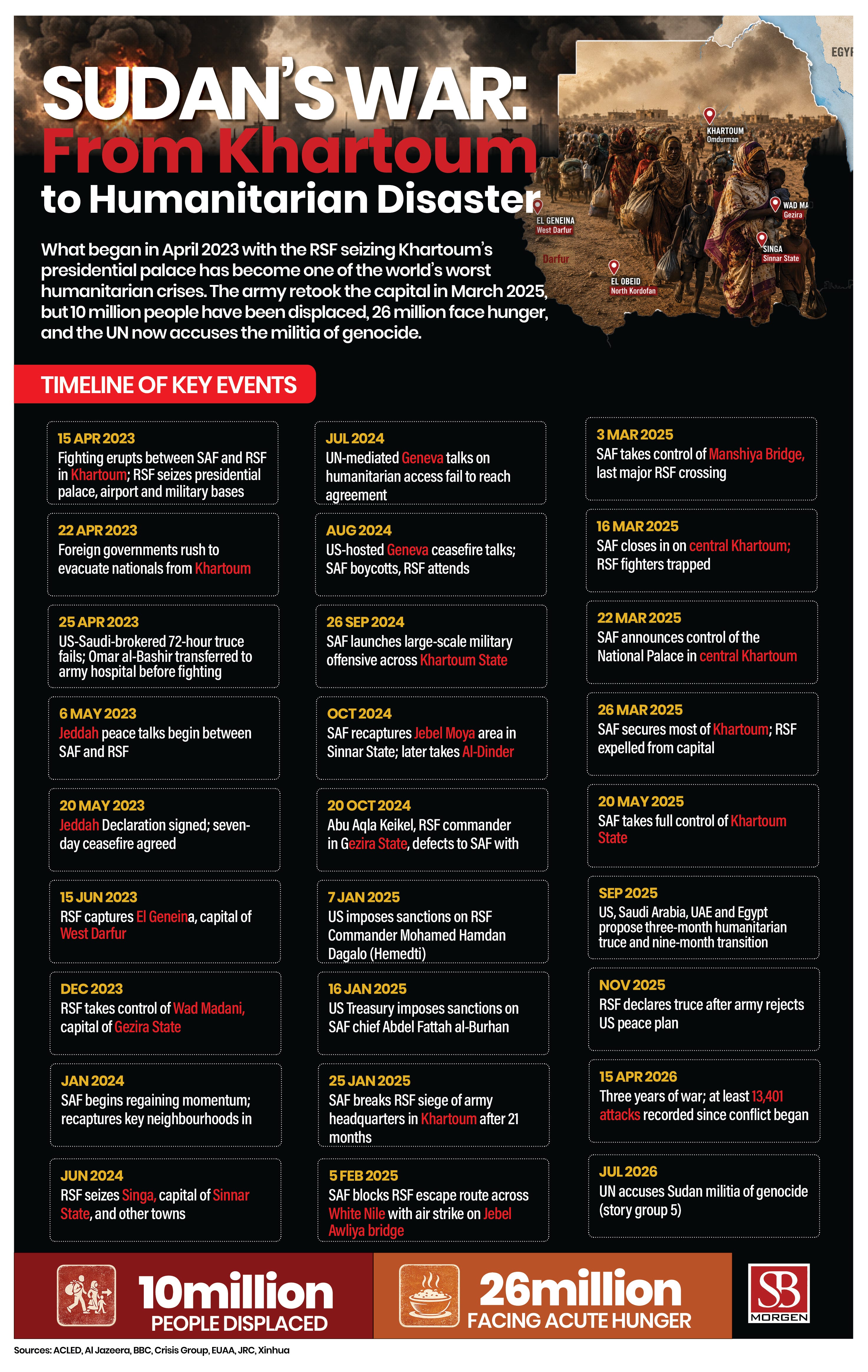
The Boulos Initiative represents the most credible diplomatic opening in Sudan since the collapse of the Jeddah peace process in 2023, but its prospects depend less on the framework’s design than on whether the warring parties’ military calculations have changed. Presented by U.S. Senior Adviser for Arab and African Affairs Massad Boulos, the proposal combines a 90-day humanitarian ceasefire, phased RSF withdrawals from key conflict zones under UN supervision, negotiations toward a permanent ceasefire, and a civilian-led political transition that excludes both Islamist elements associated with the former regime and militia leaders implicated in atrocities. Unlike previous mediation efforts, it attempts to sequence humanitarian relief, security arrangements and political transition into a single framework rather than treating them as separate negotiations.
What distinguishes the initiative is that, for the first time in months, both sides have expressed a degree of willingness to engage. The Sudanese Armed Forces (SAF) have offered conditional acceptance, while the Rapid Support Forces (RSF) have publicly welcomed the proposal. However, this convergence should not be mistaken for genuine consensus. The two parties are supporting fundamentally different versions of the same proposal, each believing it can improve its strategic position without making meaningful concessions. Amid the noise, U.S. mediator Massad Boulos has cautioned that “the claims that all substantive issues have been fully accepted are inaccurate, as are the claims that only one single issue remains. There are multiple substantive issues that have not yet been accepted or have been outright rejected” .
For the RSF, a ceasefire is attractive largely because it freezes an increasingly favourable battlefield reality. Following its capture of al-Fashir after months of siege and its expanding operations across Darfur and parts of Kordofan, the group now controls significant territory and has moved beyond conventional military operations to building parallel governance structures. Courts, taxation systems, checkpoints and local administrative mechanisms are gradually transforming military occupation into de facto political authority. A prolonged humanitarian truce would provide time to consolidate those gains, strengthen logistics, recruit additional fighters and reinforce international perceptions that the RSF is a legitimate negotiating actor rather than simply an armed insurgency. The experience of the Jeddah ceasefires remains instructive; previous humanitarian pauses were repeatedly used by both sides, particularly the RSF, to reposition forces rather than disengage from combat.
The Sudanese Armed Forces view the proposal through an entirely different strategic lens. General Abdel Fattah al-Burhan has consistently argued that the conflict cannot end through coexistence with the RSF but only through its complete military defeat. Consequently, the military’s demand that the RSF withdraw from every city occupied since May 2023, disarm, demobilise and submit to reintegration under state authority effectively transforms the ceasefire proposal into a demand for surrender. Such conditions may satisfy the army’s domestic political constituency, which increasingly favours outright military victory, but they leave little room for a negotiated compromise. Reports of back-channel discussions on force separation suggest that some flexibility may exist privately, yet public rhetoric continues to harden as each side seeks to preserve domestic legitimacy.
Complicating the diplomatic landscape further is the United Nations’ determination that the RSF committed genocide against the Masalit population in Darfur. A UN Fact-Finding Mission report concluded that “the scale, coordination, and public endorsement of the operation by senior RSF leadership demonstrate that the crimes committed in and around El Fasher were not random excesses of war” but “formed part of a planned and organised operation that bears the defining characteristics of genocide”. Although the RSF rejects the findings, the conclusion that genocidal intent represents the only reasonable inference fundamentally alters the political environment surrounding peace negotiations. It significantly strengthens the legal basis for future prosecutions before international courts and increases pressure on external actors accused of supporting the RSF, particularly the United Arab Emirates. More importantly, it narrows the political space for compromise. Any agreement that appears to legitimise commanders accused of genocide risks becoming politically unacceptable both inside Sudan and internationally. Conversely, insisting that accountability precede negotiations may remove whatever limited incentive the RSF still possesses to participate in a peace process. The genocide finding, therefore, introduces a difficult tension between the pursuit of justice and the urgency of ending active hostilities.
This dilemma illustrates why Sudan’s conflict has become increasingly resistant to conventional mediation. The underlying drivers extend well beyond immediate military confrontation. Competition over natural resources, decades of political and ethnic marginalisation, fragmented state institutions and the collapse of Sudan’s civilian transition have created structural incentives for continued conflict. Neither side believes it faces imminent military defeat, and neither trusts that the other would honour any agreement reached. In such an environment, ceasefires become tactical pauses rather than pathways to durable peace.
The repeated failure of previous mediation efforts reinforces this assessment. The Jeddah negotiations produced temporary humanitarian ceasefires that quickly collapsed. The African Union-led Addis Ababa initiative failed to establish sustained dialogue between the parties. Sudan’s own transitional authorities proposed ceasefire frameworks that the RSF rejected outright. The Boulos proposal benefits from more structured sequencing and stronger international engagement, but it still confronts the same central obstacle: neither belligerent currently sees sufficient strategic advantage in making irreversible concessions.
The regional implications of continued conflict are equally significant. Sudan has become a critical node within the wider security crisis affecting the Sahel and the Lake Chad Basin. Weapons trafficking networks stretching through Libya, Chad and Sudan continue to supply armed groups operating across West and Central Africa, while extremist organisations exploit state fragility to strengthen recruitment and logistics. The discovery of foreign fighters and transnational terrorist facilitators in conflicts across the Sahel illustrates how instability in one theatre increasingly reinforces insecurity elsewhere. A prolonged Sudanese conflict therefore threatens not only Sudan’s territorial integrity but also regional counterterrorism efforts.
For Nigeria, these dynamics create both security and diplomatic challenges. Although geographically removed from Sudan, Nigeria remains vulnerable to the secondary effects of arms proliferation, irregular migration and extremist movements operating across the Sahel. As one of Africa’s principal diplomatic powers and a member of the UN Human Rights Council, Abuja may also face increasing international pressure to contribute to mediation efforts, support accountability mechanisms or participate in future peacekeeping operations. Yet with persistent domestic insecurity, fiscal constraints and ongoing counterinsurgency operations against Boko Haram, ISWAP and bandit groups, Nigeria has limited capacity for sustained external engagement.
Ultimately, the Boulos Initiative represents the best diplomatic opportunity currently available, but it remains vulnerable to the same structural forces that undermined previous peace efforts. The UN’s genocide finding has increased international pressure for accountability while simultaneously making political compromise more difficult. The RSF seeks to consolidate territorial gains under the cover of diplomacy, while the Sudanese Armed Forces continue to pursue conditions that amount to military capitulation. Until the incentives for continued warfare become less attractive than the costs of peace, Sudan is likely to remain trapped in a cycle where diplomatic initiatives temporarily reduce violence without resolving its underlying causes. The tragedy is that every failed negotiation not only prolongs one of Africa’s worst humanitarian crises but also deepens regional instability, making an eventual political settlement progressively more difficult to achieve.