
Suit overtaken
Court dismisses Governor Fubara's suit against 27 Rivers lawmakers, ending a long political crisis.

The Supreme Court dismissed Governor Fubara’s suit to remove 27 Rivers lawmakers who defected from the PDP to the APC. Citing “events overtaking the suit,” Fubara withdrew the appeal and was ordered to pay ₦4 million ($2,700) in costs. The ruling ends a prolonged political battle with his predecessor, now FCT Minister Wike. The crisis involved an Assembly fire, a budget dispute, and legal battles over the lawmakers' legitimacy. Despite their reinstatement, Fubara sidelined them, prompting judicial criticism for undermining the separation of powers by withholding funds and demolishing parts of the Assembly complex.
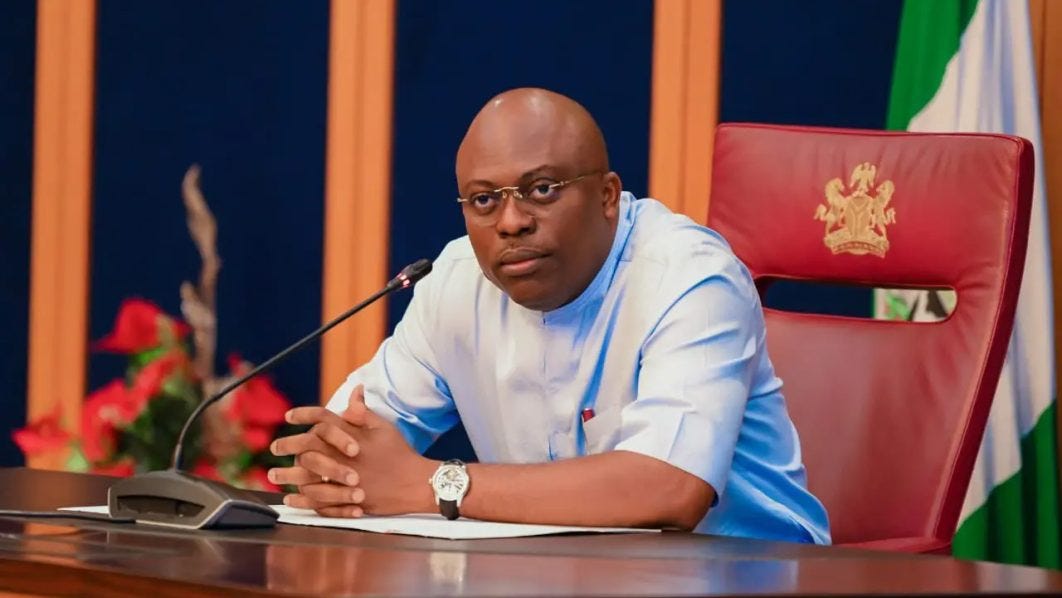
Governor Siminalayi Fubara's recent actions, particularly his defiance of court orders, have raised significant concerns regarding adherence to the rule of law in Rivers State. This defiance is set against his ongoing conflict with his predecessor and former political mentor, Nyesom Wike. There is speculation that Mr Fubara may have reached an understanding with federal authorities, potentially influencing recent judicial outcomes. If this is the case, it could diminish Wike's influence with President Tinubu, especially if Wike can no longer serve as a destabilising force within the opposition People's Democratic Party (PDP).
Mr Wike's political relevance could wane without this leverage, leaving him without a strong base in Rivers State. The Supreme Court's dismissal of Governor Fubara's appeal has been interpreted in various ways. The prevailing view is that the court rejected his challenge to earlier decisions by the Court of Appeal and the Federal High Court, invalidating the ₦800 billion budget passed by the Edison Ehie-led faction of the Rivers State House of Assembly and signed into law by Fubara. Notably, the Supreme Court's ruling emphasised that the 2024 budget expired on 31 December 2024, rendering further litigation moot.
Consequently, Fubara's withdrawal of the appeal appears to be a strategic decision rather than a legal defeat, acknowledging the need for governance to progress without being mired in protracted legal disputes. This situation also highlights a deeper constitutional crisis in Rivers State, particularly concerning the status of lawmakers who defected from the PDP to the All Progressives Congress (APC) amid the political rift between Fubara and Wike, now the Federal Capital Territory Minister.
While the Supreme Court's ruling did not directly address the legitimacy of these defected lawmakers, their position remains tenuous. Section 109 of the 1999 Constitution stipulates that legislators who defect from their political party without a division in the party automatically lose their seats. Although the Supreme Court and lower courts have upheld this principle in previous cases, the defected Rivers lawmakers continue to operate in a legal grey area, justifying their defection by citing internal party tensions. Another critical aspect of this crisis was the Federal High Court's ruling in October 2024, which ordered a halt to federal allocations to Rivers State due to irregular budgetary processes. This decision was later overturned by the Court of Appeal in December 2024, which ruled that a trial court had no jurisdiction over a state's appropriation matters.
This episode reflects the increasing judicial entanglement in political disputes, raising concerns about the courts being drawn into power struggles rather than serving as neutral arbiters. Ultimately, while the Supreme Court's ruling resolves the budget dispute on a technical level, it does little to untangle the broader political crisis in Rivers State. The legitimacy of the defected lawmakers remains unsettled, and the power struggle between Fubara and Wike continues to shape governance in the state. This ruling signals a momentary pause rather than a resolution, with further legal and political battles likely to emerge as the state's leadership struggles to assert control over its legislative and executive functions.