
Tension at the bench
Ghana's Chief Justice's potential removal sparks controversy. Critics argue due process was ignored; the Supreme Court will hear the case.

A legal and political controversy has erupted in Ghana over President John Mahama’s move to consult the Council of State regarding three undisclosed petitions seeking the removal of Chief Justice Gertrude Sackey Torkornoo. Critics, including MP Vincent Ekow Assafuah, argue the process is flawed, claiming the Chief Justice must be notified and allowed to respond before such consultations. Assafuah has filed a lawsuit and an injunction application, which the Supreme Court will hear on 2 April 2025. Chief Justice Torkornoo has also formally requested copies of the petitions and time to respond, citing procedural fairness and constitutional requirements.
The ongoing debate over Article 146 of Ghana’s Constitution has reignited concerns about judicial strength and independence, exposing deepening cracks in public trust. Article 146 outlines procedures for removing Superior Court Justices and Regional Tribunal Chairmen. For Justices (excluding the Chief Justice) and Tribunal Chairmen, the President refers petitions to the Chief Justice, who determines if there's a prima facie case. However, for the Chief Justice's removal, the President, consulting the Council of State, appoints a five-member committee. This difference is clear. Yet, the Minority in Parliament argues the President must consult the Chief Justice before initiating her removal—an interpretation legal analysts largely deem inconsistent with the Constitution. Critics view this as a political tactic to obstruct a constitutionally defined process.
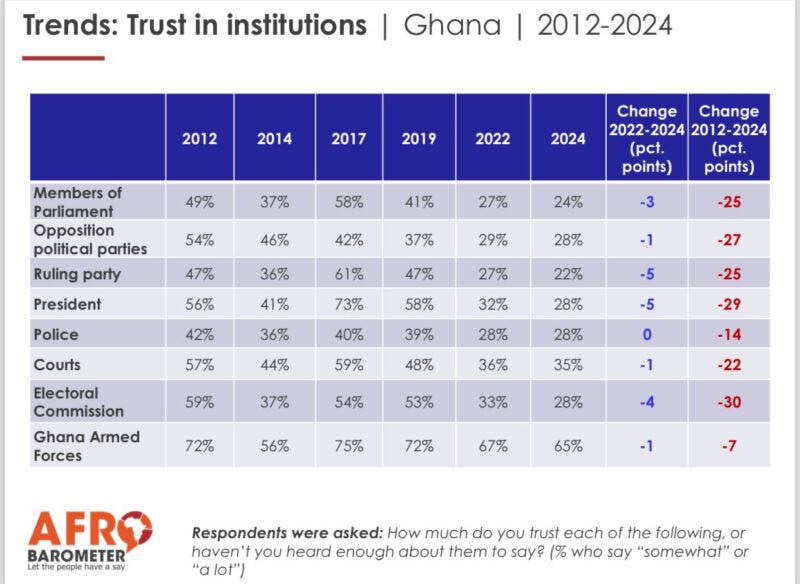
This debate occurs amid heightened scrutiny of Ghana’s judiciary. Leading up to the 2024 elections, under the current Chief Justice, the Supreme Court faced accusations of partisanship, labelled "Unanimous FC" for rulings favouring the then-incumbent government. The opposition National Democratic Congress (NDC), now in power after winning the 2024 elections, had repeatedly alleged the previous administration was “packing” the courts with loyalists. A Ghanaian law professor's study supported these claims, indicating judges often rule for the parties that appointed them. With nearly all current justices appointed by the former NPP President Akufo-Addo, concerns about judicial impartiality have intensified. Public confidence has plummeted. A 2024 Afrobarometer survey revealed 65% of Ghanaians have little or no trust in the courts, more than double the 30% in 2005/2006. Alarmingly, 97% believe judges and magistrates are corrupt. This distrust largely stems from the courts’ handling of politically sensitive cases, widely perceived as biased towards the executive. Inconsistent rulings, especially from the Supreme Court, have deepened mistrust, fueling the perception of executive influence.
There's a growing fear that if the current Mahama administration succeeds in removing the Chief Justice—through lawful or questionable means—it could establish a dangerous precedent. Such actions risk initiating a cycle where each new government targets and removes justices deemed unaligned with their interests, thereby severely weakening the judiciary and endangering Ghana's democratic balance of power. While some argue that a complete overhaul of the judicial system is necessary, including removing the current CJ, due to perceived alignment with the past administration, the long-term consequences of setting such a precedent must be carefully considered. Ultimately, this case transcends a personal or partisan dispute. It's a constitutional stress test for Ghana’s democracy, closely watched by legal scholars, civil society, and the international community.