
Tenterhooks
The Central Bank of Nigeria (CBN) has said the old ₦200, ₦500, and ₦1,000 banknotes remain legal tender till 31 December 2023, according to…

The Central Bank of Nigeria (CBN) has said the old ₦200, ₦500, and ₦1,000 banknotes remain legal tender till 31 December 2023, according to the acting CBN spokesman, Isa Abdulmumin On 9 March, Ondo Governor Oluwarotimi Akeredolu said that the continued rejection of old naira notes by traders was flagrant disobedience to the law which “stifle(s) local trade and business transactions, weaken the economy and cause us great harm and avoidable troubles.” Lagos Governor Babajide Sanwo-Olu struck a similar tone in a 13 March statement to business owners and government agencies in the state.
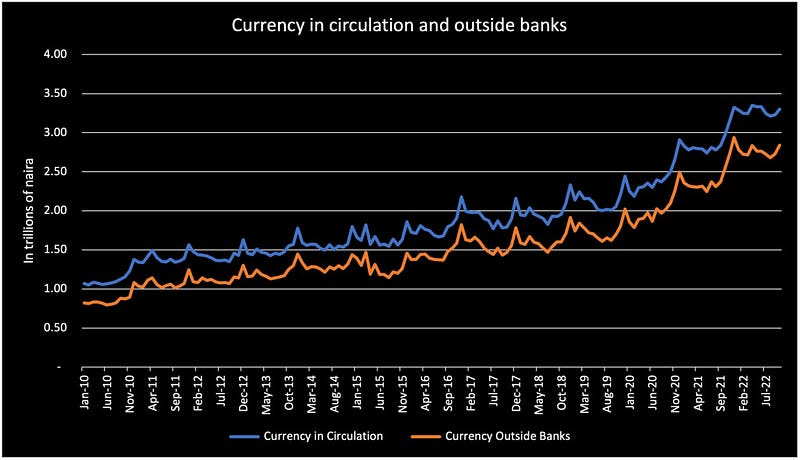
By itself, the Naira swap policy is a good thing. According to the bank, of the ₦3.23 trillion in circulation as of October 2020, only ₦500 billion was within the banking industry, a reality that had hampered the CBN’s ability to manage inflation using its monetary tools. However, rather than swap Naira notes, the CBN withdrew old notes and failed to introduce many new ones, essentially trying to implement its decades-old cashless policy within three months. This caused a shock to the informal sector, home to the large unbanked population (comprising a majority of Nigerians), and the heightened demand for online transfers and e-payments from banked Nigerians strained the banking infrastructure. To buttress the point, recent Nigeria Inter-Bank Settlement System (NIBSS) data — the custodian of much of the banking industry’s interoperability function — shows that across the country, cashless transactions dipped to ₦37.67 trillion in February 2023 as Nigerians continue to grapple with failed and delayed cash transfers. This is despite a 41.29 percent increase in e-payment gateway usage (from 638 million in January to 901.46 million in February). This dip in overall trade volumes is attributable to delayed or failed cash transfers and deferred purchases. In a country where only 37.3% have mobile internet access, and 55.4% have electricity access, an attempt to force the population to prioritise electronic financial methods was always going to be tough for the 100 million people for whom cash is their main and, in many cases, only play. Compounding the situation, the cash scarcity forced people to buy cash (no, that was not a typo) at rates approaching 20% in certain parts of the country, further impoverishing people at a time when their livelihoods were already taking a hit. There are a few key points to add to the postscript of this policy. The first is that it took pressure for the CBN to comply with a court order. The bank’s directive only occurred when it was clear from a presidential announcement that compliance was also Aso Rock’s position. Under Governor Godwin Emefiele, the CBN has mortgaged the institutional independence enshrined in law. This policy is the final nail in the coffin of the regulator’s facade of policy independence. The second learning is that the general public refused to accept the old notes as legal tender after the Supreme Court pronouncement but rather waited until the President and the CBN concurred, which speaks to the general disregard for the judiciary. That is partly the fault of the third arm of government — considering its inability to operate by the tenets of efficiency and reasonability — and partly the fault of those in authority who have consistently disregarded the court. Why do it on the streets if someone like the Attorney-General of the Federation, Abubakar Malami, sees court judgements as suggestions? The most important lesson from this debacle is the destruction of faith in the financial system. The multi-decade effort to drive financial inclusion in one of the world’s largest blocs of unbanked and underbanked people has been undone in three months, and restoring that confidence will take toil, sweat and years.